Page 1 of 1

Engine Position When Trailering; Alternative Transom Savers

Posted: Mon Apr 11, 2022 10:04 am
by f1loco
I recently bought a new trailer resulting in my classic 13-footer riding higher above the pavement, so high, that even with the outboard engine tilted down, the skeg now clears the pavement by 12-inches.

Q1: Is towing with the engine trimmed down better [than with in the engine in some other trim position]?

The boat transom is not flat but angle down to the front, so there is still stress on the transom

Q2: because the engine can be trimmed all the way down on the trailer, and other than an "debatable" transom saver, are there any devices that would help take off load on the angle transom?

BACK STORY: I am getting ready for a Florida Keys trip which will be a six hour tow. I have a c.1968 13-footer with a Yamaha 25T FS outboard, mounted with through transom bolts. I had to do some sanding and glass work on the boat; the wooden section of the transom were cracking through the existing laminate. I am pondering about the six-hour highway speed tow.
Re: Engine Position When Trailering; Alternative Transom Savers

Posted: Mon Apr 11, 2022 11:58 am
by jimh
f1loco wrote:Q1: Is towing with the engine trimmed down better [than with the engine in some other trim…]?
I think so.

The stress on the transom in terms of weight compression is the same as any other case. The moment arm of any bending forces acting to deflect the transom are minimized in the full-down trim.

I don't see the small transom angle offset from perfectly vertical as a concern. Just trim the the engine to vertical when towing if worried.

Re: Engine Position When Trailering; Alternative Transom Savers

Posted: Mon Apr 11, 2022 6:17 pm
by Phil T
It acceptable for the engine to be in the vertical position.

Re: Engine Position When Trailering; Alternative Transom Savers

Posted: Tue Apr 12, 2022 9:57 am
by Jefecinco
Twelve inches of clearance may not be enough when launching or retrieving your boat on a steep ramp incline or when entering or leaving a roadway with at a steep angle. I trim our outboard when using a launch ramp to the point that the lowest part of the engine is approximately level with the keel.

Re: Engine Position When Trailering; Alternative Transom Savers

Posted: Tue Apr 12, 2022 10:07 pm
by dtmackey
Jefecinco wrote:Twelve inches of clearance may not be enough when launching or retrieving your boat on a steep ramp incline or when entering or leaving a roadway with at a steep angle. I trim our outboard when using a launch ramp to the point that the lowest part of the engine is approximately level with the keel.


Good point, but the thread was about transom savers and I highly doubt one would need a transom saver to back down the ramp after tilting the motor up. Personally I think transom savers are like snake oil and a waste of money.

What I find even a bigger waste of money is the advertised trim savers that are nothing more than a tube that goes over the trim rams to "prevent" undue stress on the trim unit while trailering. Anyone that knows how hydraulics work would laugh at this as the trim unit takes a far bigger force and pounding using the boat in any type of sea since the engine vectoral forces under way only add to the pounding of any wave action that far exceeds any trailing forces.

My son is a junior in college in mechanical engineering and I asked him if this would be a good senior project and he laughed at me. His response was it is a no brainer that transom savers are a marketing money maker. He's onto bigger and better things and headed to Taiwan for an intern with Apple this summer.

Transom savers are the perfect example of marketing, until it meets engineering to debunk it.

D-

Re: Engine Position When Trailering; Alternative Transom Savers

Posted: Wed Apr 13, 2022 8:57 am
by jimh
The market for most of the "transom savers" seem directed to Mercury engines. For decades OMC engines have included a mechanical support bracket built-in to the engine mount that relieved pressure on the hydraulic trim actuator.

Re: Engine Position When Trailering; Alternative Transom Savers

Posted: Wed Apr 13, 2022 11:23 am
by Phil T
Yamaha offers tilt trailer supports.

E.G.https://www.simyamaha.com/engine-tilt-trailering-support-mar-mtspt-ym-10/

yamahasupports.jpg
Fig. 1. Yamaha engine with "transom saver."
yamahasupports.jpg (77.29 KiB) Viewed 3994 times

Re: Engine Position When Trailering; Alternative Transom Savers

Posted: Wed Apr 13, 2022 1:36 pm
by jimh
Many trim-tilt mechanism are made by one manufacturer and sold to several engine manufacturers. Nearly identical devices can be found on several brands. A big supplier is the SHOWA CORPORATION. More at

https://en.wikipedia.org/wiki/Showa_Corporation

and see mention of outboard engine tilt products in the corporation's annual report:

    Outboard Marine Engine Components
    Power trim and tilt units change the angle of outboard engines
    and provide the following three functions. The trim function
    provides good screw efficiency and steady cruising by adjusting
    the angle of the outboard engine while running. The tilt function
    enables owners to prevent outboard engine damage from
    clinging shellfish by raising the engine above the water’s surface
    when moored. When driftwood or other objects strike the
    outboard engine while under way, shocks are absorbed, helping
    to prevent damage to the outboard engine and boat

Source: https://www.hitachiastemo.com/en/corpor ... AR2018.pdf

In the way-back of outboard engine manufacturing, most of the trim-tilt units were made by Presto-Lite, at one time a FORD subsidiary, but gradually the SHOWA devices took over. Practically all the trim units on modern outboard engines are made by SHOWA.

The trim-tilt devices that are most prone to be used with a "transom saver" are the single-ram actuator devices, as those devices are the ones most likely to fail, based on a recent conversation with outboard engine trim-tilt expert rebuilder TRIMANDTILT.COM, who are the premier source of rebuilding and repair of these units.

https://www.trimandtilt.com/

Re: Engine Position When Trailering; Alternative Transom Savers

Posted: Wed Apr 13, 2022 1:52 pm
by jimh
Regarding an engine position appropriate when the boat is loaded on a trailer and will be towed on the highway, Figure 2 below shows how I positioned the twin Yamaha 70-HP engines on my boat during about 20,000-miles of highway towing. No "transom savers" were ever used, nor were they ever considered to be needed. The engines were position so they were restrained in downward movement at the top of the dual actuator rams of the slow-speed trim actuators, and restrained in upward movement by gravity and the single high-speed ram actuator.

engineTraileringPosition.jpg
Fig. 2. c.1987 Yamaha 70-HP engines shown in position for highway trailering.
engineTraileringPosition.jpg (46.47 KiB) Viewed 3979 times


Evinrude E-TEC engines have a built-in trailer support bracket. I always use that bracket when towing my boat with E-TEC 225-HP engine.

ETEC_EngineSupportBracket.jpg
Fig. 3. 2010 E-TEC 225-HP engine with built-in support bracket for trailer towing.
ETEC_EngineSupportBracket.jpg (60 KiB) Viewed 3976 times


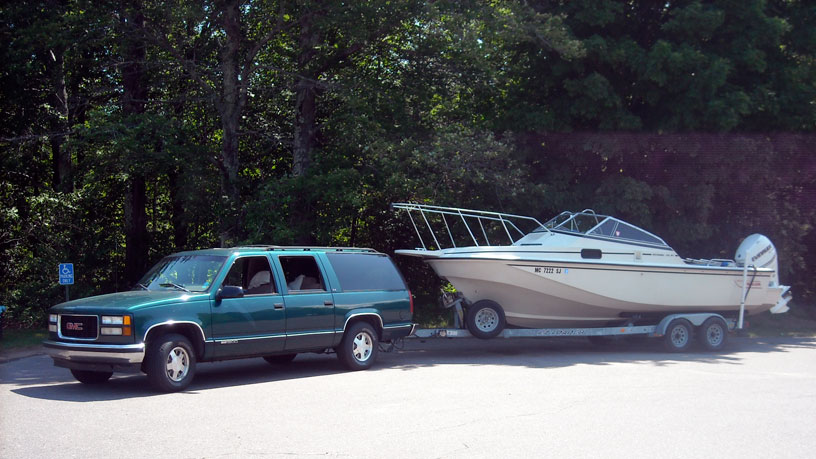
We have towed the E-TEC in the position provided by the built-in trailer support for probably more than 20,000-miles and hundreds of hours. For example, we towed to Wisconsin and the Apostle Islands in 2012, which meant four days on the road.

Image
Fig. 4. Ready to depart Little Sand Bay on Lake Superior for a very long drive home.

These three illustrations should give a clear picture of how an outboard engine can be positioned when on a trailer for highway long-distance towing. By the way, or longest towing was about 4,800-miles, about eight days on the road, from Michigan to northwest Washington State and return.