Page 1 of 1

Repair of Unibond Hulls

Posted: Wed Jun 17, 2026 5:11 pm
by LeftyCK
[Moderator's Note: separated from another thread on a diferent topic.]

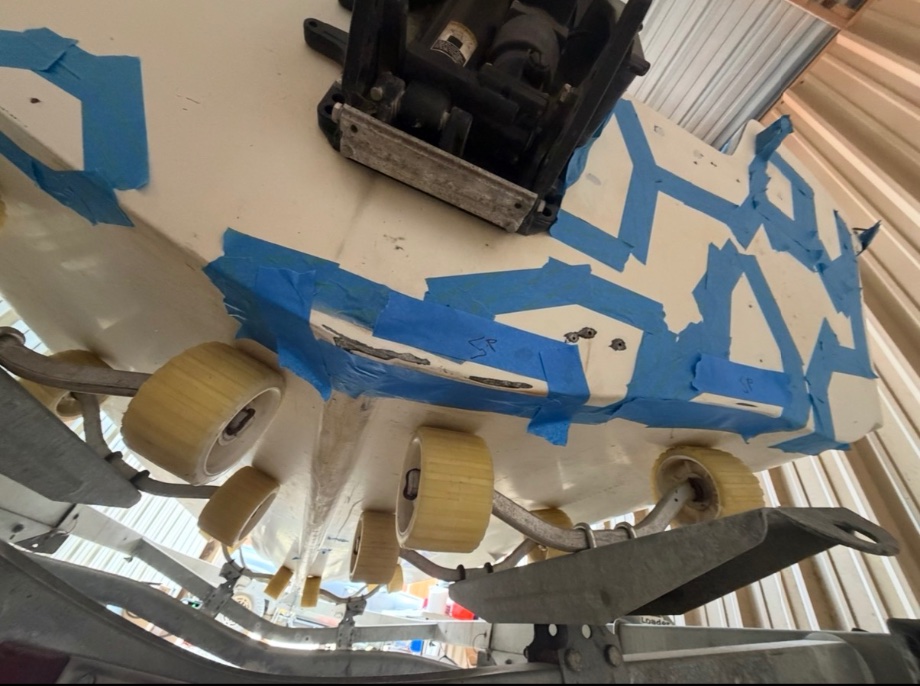
Regarding the hull condition that is seen in Figure 1, I am in the process of filling some damaged areas with 1/4-inch fiber-reinforced gel coat putty.

Image
Fig. 1. A hull with some Frankenstein damage that will be repaired.

Re: Repair of Unibond Hulls

Posted: Wed Jun 17, 2026 5:14 pm
by jimh
On the proposed repair technique: you do not want thick areas of gel coat resin. Gel coat resin should be only the top layer that covers properly made structural repairs. See this article for advice:

INSTRUCTIONS -- HULL PATCH KITS
https://continuouswave.com/whaler/refer ... tions.html

The Epoxy Cure
https://continuouswave.com/whaler/refer ... epair.html

Re: Repair of Unibond Hulls

Posted: Wed Jun 17, 2026 5:15 pm
by LeftyCK
To your point about the reinforced gel coat putty: I am only using this material in very thin applications to fill small scrapes and chips that reach the top bit of structural fiberglass. Afterwards I will coat regular gel coat in two or three more applications.

My hope is that this will blend somewhat into the hull aside from the obvious color difference. Refinishing the entire hull with the correct Spectrum Color gel coat to match how it came from the factory is a future endeavor.

For the two locations that I have what would be considered more severe structure damage to repair, I am planning to fiberglass with a vinyl ester resin as I have seen on the YouTube channel ‘Fish Bump TV’, and coat with four to five coats of gel coat resin.

My only concern is the compatibility of the vinyl ester resin with the Whaler closed cell foam. Being that these two locations are through the fiberglass, the resin will make contact with the foam so I do not want the resin to eat the foam.

Q1: is there any concern with vinyl ester resin eating the Whaler closed cell foam?

Re: Repair of Unibond Hulls

Posted: Wed Jun 17, 2026 5:16 pm
by jimh
I don’t have any experience using polyester laminating resins to make repairs. I use epoxy resin from WEST System.

leftyCK wrote:Q1: is there any concern with vinyl-ester resin eating the Whaler closed cell foam?
I don't know if vinyl-ester resin will eat foam. I do know that epoxy will bond very well to foam.

The element in most polyester resins that causes harm to foam is the styrene components. Epoxy does not produce styrenes.

Epoxy is a better adhesive for bonding to other cured materials than the polyester laminating resins used in molding fiberglass boats. In fiberglass boat building the polyester resins are all laid-up in at one time, and they cure together forming strong primary bonds. When you use polyester resins to make a repair on top of totally cured polyester resin laminates, you get a weaker secondary bond.

Epoxy will provide a stronger bond. Epoxy is easier to mix in small batches. Epoxy cures to a hard surface when exposed to air. Polyester resins will not cure to a hard surface if exposed to air, unless you use wax additives or over spray with poly-vinyl alcohol. Epoxy will not dissolve cured foam in the hull.

The best way to produce future stress cracks in gel coat resin is to build up the thickness to more than appropriate, which would usually one coat of about 20-mills thick.

Listen to my interview with Jim Watson from WEST System in the WHALER RADIO section:

https://continuouswave.com/whaler/radio ... tPart1.mp3

https://continuouswave.com/whaler/radio ... tPart2.mp3

As explained by Jim Watson, gel coat resin will form a proper (secondary) bond to fully cured epoxy resin that has been properly prepared by removal of any amine blush layer.

A recent youTube presentation from WEST System demonstrates the extremely strong bond that occurs with applying polyester gel coat resin on top of fully cured and properly prepared epoxy resin. See

Can You GELCOAT OVER EPOXY? | We Tested It!
https://www.youtube.com/watch?v=UUxzWEAZ8Vs
Re: Repair of Unibond Hulls

Posted: Wed Jun 17, 2026 5:38 pm
by jimh
Jeff Rohlfing demonstrates using polyester gel coat resin mixed with a thickening paste as a method of filling empty screw fastener holes and small gouges and scratches in a Unibond hull on his youTube channel, See

Boston Whaler Gel Coat Repairs
https://www.youtube.com/watch?v=q8Zuv_sEI00

There is probably an enormous amount of youTube advice about gel coat repairs, but Jeff's presentation provides a very good demonstration with a Boston Whaler hull.