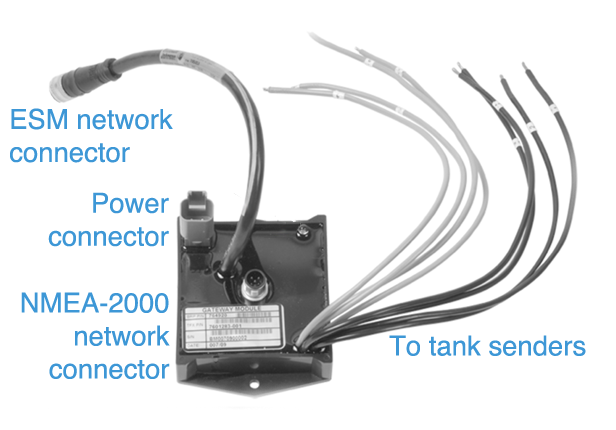
With the Evinrude E-TEC G2 engines, there is no network device called a GATEWAY module. None of the wiring you describe for that device will be used.
The rigging wiring for networks will be very straightforward. There are two networks:
--a standard NMEA-2000 network that is used for instrumentation devices; and,
--a dedicated REMOTE CONTROL network used as the primary engine electronic shift and throttle control network
The dedicated Remote Control network is wired using proprietary connectors and cables, using a proprietary six-pole connector. The connector is quite distinct from the normal NMEA-2000 connector. It uses a push-on snap-in-place retainer collar instead of a threaded collar, and there are six poles in the connector contacts. The Remote control network has only two categories of device attached: an E-TEC G2 engine or an ICON II electronic shift and throttle (EST) control. This network is used as the primary network for controlling the engine remotely.
There are no network T-connectors or terminators in this network in single-engine single-control installations, as there are just two devices, the controls and the engine, connected with a special male-to-male gender cable marked with distinctive yellow identification marks. For situations of multiple controls or multiple engines, the network wiring uses two proprietary six-port hub components to accomplish the wiring of multiple devices to the Remote Control network. These hubs have five connectors for attachment of engine or control devices, and one port (of opposite gender) for connection to the other hub. The two hubs are connected by the special male-to-male gender yellow-marked cable.
The standard NMEA-2000 network is used in the normal manner. Many devices can be attached to the network using the conventional network wiring arrangement of network T-connectors for each device , two terminators, and a power nodes. The E-TEC G2 engine has a standard NMEA-2000 port with its own cable, and that cable is extended by a standard NMEA-2000 extension cable and connected to the NMEA-2000 network backbone via a T-connector. The ICON II EST controls also have a NMEA-2000 port and integral cable, and that cable is also connected to the NMEA-2000 network backbone in the conventional manner, using an extension cable if necessary and a T-connector.
The two networks work side-by-side. If there were a failure in the dedicated Remote Control network, the NMEA-2000 will be used for engine control until the dedicated Remote Control network is restored.
The wiring at the engine is shown in an illustration in an article I wrote in June 2014.
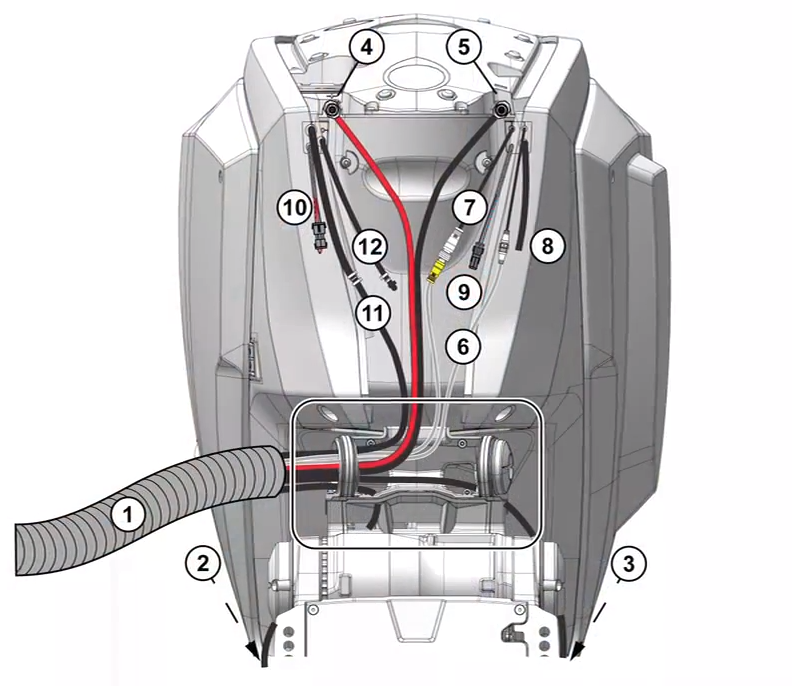
As shown in the diagram:
1 - Rigging hose
2 - Starboard steering hose
3 - Port steering hose
4 - Positive battery cable
5 - Negative battery cable
6 - NMEA-2000 network connection
7 - ICON II control network connection
8 - REmote flush hose
9 - Remote oil tank sensor
10 - Auxiliary Battery Charging connection
11 - Fuel hose
12 - Oil hose (remote tank)
For more details see:
E-TEC GEN 2 Rigging Center, ICON II Remote Controlshttp://continuouswave.com/ubb/Forum1/HTML/022677.htmlIn the ICON II remote controls there are two tiers:
--ICON II PREMIUM EST controls, and
--ICON II EST controls
Initially there were only ICON II EST controls, but the name of those controls was changed to the ICON II PREMIUM EST controls and a less expensive option was introduced and took over the name ICON II EST controls. The controls available are thus:
FOR E-TEC G2 ENGINES:
--ICON II PREMIUM (was ICON II) top-mount single-lever single-engine
--ICON II PREMIUM (was ICON II) concealed-side-mount single-lever single-engine
--ICON II PREMIUM (was ICON II) top-mount dual-lever multiple-engine
--ICON II (should be called BASIC) top-mount single-lever single-engine
--ICON II (should be called BASIC) concealed-side-mount single-lever single-engine
Between the ICON II PREMIUM EST and the ICON II EST there are differences in features and capabilities. I try to summarize them as follows:
ICON II PREMIUM
--chrome trim and gray body
--RPM TUNE switch
--LED F-N-R indicator lamps
--conventional friction on handle movement
--fuel level sensor inputs
ICON II
--all black-gray body
--no RPM TUNE switch
--no LED indicator lamps
--progressive friction on handle movement
--no fuel level sensor inputs
It is possible to integrate some foot-pedal throttle control devices with ICON II PREMIUM controls, but I omit the details here.
To be complete, I also mention the ICON controls for legacy E-TEC engines. These are entirely different controls and cannot be used with E-TEC G2 engines:
FOR LEGACY E-TEC ENGINES:
--ICON EST top-mount single-lever single-engine
--ICON EST concealed-side-mount single-lever single-engine
--ICON EST top-mount dual-lever multiple-engine
Finally, to gain a better understand the wiring, I recommend watching the following presentation on the topic of the Evinrude E-TEC ICON II Remote Control Installation:
https://vimeo.com/93110277