I have thought about the circuitry I would use for an arrangement of:
--two engine cranking batteries
--one deep cycle battery for house loads
--one engine charging source without an auxiliary charging output
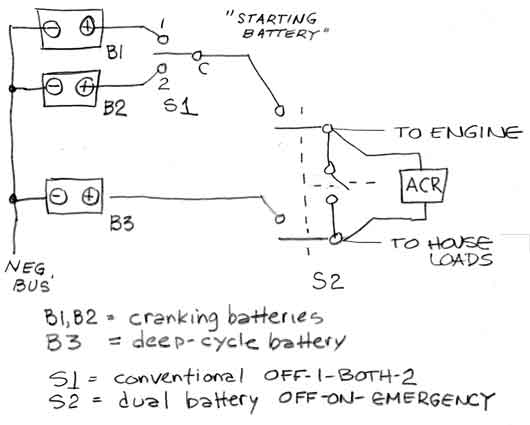
My first concept is shown in this sketch, an electrical schematic diagram:
- threeBatteryOneEngine.jpg (15.79 KiB) Viewed 10058 times
NOTES ON THREE-BATTERY ONE-ENGINE CIRCUIT
I show only the positive circuit for clarity. The negative circuit is in common for all batteries, all loads, and all charging current sources.
Batteries B1 and B2 are of similar type and are engine cranking batteries.
Switch S1 is a conventional marine battery switch with OFF-1-BOTH-2 positions and three terminals. Either battery B1 or B2 can be selected to start the engine and receive charging current from the engine, or the two batteries can be combined in parallel (BOTH position) to allow starting when one battery alone would be insufficient.
Switch S2 is a newer style of marine battery switch with OFF-ON-EMERGENCY positions and four terminals. It has two independent circuits, one for engine starting and one for house. They remain isolated unless the switch is moved to EMERGENCY, which combines the two circuits.
Battery B3 is a deep-cycle battery and feeds certain isolated loads on the boat so their power is not affected by engine cranking and the accompanying battery voltage sag.
The ACR device permits Battery B3 to be charged from the engine at any time that the other battery--which is either B1, B2, or the combination in parallel of both B1 and B2--has reached sufficient voltage to be considered re-charged.
In normal operation S1 would not be in the BOTH position. This avoids any problems with having three batteries connected in parallel to the charging current source. The charging of B1 or B2 would be affected by the position of S1. As a standard practice, the operator would switch between B1 and B2 using S1 in order to maintain them both in a charged state. For example, if the boat is used daily, alternate B1 and B2 every other day. Or, use B1 for the voyage out on a particular day, and B2 for the voyage back.
If desired, a second ACR could be added between only B1 and B2 so that the battery not in use was also automatically charged. However, that could result in the automated action of all three batteries being in parallel on the single charging current source, which I do not think is a good plan.