http://www.ieeeoes.org/pubs/newsletters/oes/html/spring11/UnderwaterVehicle.pdf
and provides fascinating details of the great attention to efficiency that was necessary to achieve the performance goals for this AUV. Since it runs on battery power, every effort was made to make the propulsion system as efficient as possible.
A general and less-technical description of the vehicle is given at
http://www.mbari.org/at-sea/vehicles/autonomous-underwater-vehicles/long-range-auv-tethys/
The orange nosecone of the AUV holds the instrumentation payload. The center yellow section has the battery and system electroncis. The aft orange section has the propulsion motor. The small mast at the stern holds antennas for Iridium satellite, GPS receiver, and local radio communication. Photo credit: MBARI.ORG
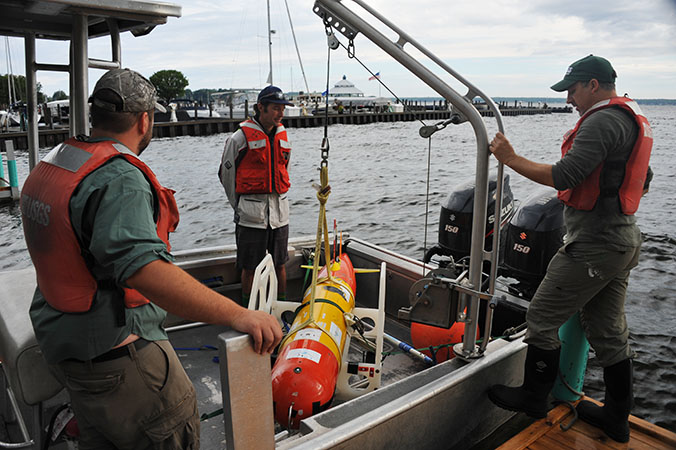
The TETHYS came to Lake Michigan on loan from MBARI, travelling 2,500-miles by road in a partially disassembled state. After arriving in Michigan it was reassembled, then checked out and water tested. Due to the lower buoyancy in freshwater, some adjustments were necessary. Eventually TETHYS was launched on several survey missions exploring Lake Michigan. The purpose of the survey was to collect information about zooplankton in the water.
TETHYS was deployed from Muskegon, Michigan to begin the survey on the southern part of Lake Michigan, travelling from Muskegon to Chicago and thence to Milwaukee. TETHYS was then recovered and transported by vehicle farther north, to begin a second trip surveying the northern portion of Lake Michigan.
The data gathered by TETHYS will be given to scientists to analyze and map the distribution of zooplankton. Previously estimates of algae and zooplankton have been difficult to accomplish at a whole-lake scale using conventional technologies. The autonomous underwater vehicle provided unique coverage of all parts of the lake over a short time.
Since TETHYS was operating under water while underway on its mission, it was most likely unobserved by recreational boaters.