Typically you will need to allow for added weight over the boat's estimated hull weight of 2,800-lbs, which according to the specifications found in the 2005 Boston Whaler printed catalogue that weight is WITHOUT an engine, so planning for a 4,000-lbs trailer capacity will perhaps a bit close to the margin if you are to account for the engine, the fuel, and added gear on the boat. A boat's weight with engine, rigging, gear, canvas, fuel, and miscellaneous stuff aboard tends to approach almost double the bare hull weight (or 5,600-lbs in this case), so going to a 4,700-lbs rated trailer capacity might be more prudent.
Generally a trailer rated for 4,000-lbs (or 4,700-lbs) will be a tandem-axle model.
These days most manufacturers make bunk trailers and do not offer keel rollers. You can get a trailer without keel rollers, and then you can fit your own keel rollers to it. Some manufacturers do offer an option for a keel roller.
E-Z-LOADER makes a suitable trailer at 4,000-lbs rated capacity in their model TEZ102 17-20/22 trailer with 13-inch wheels and tires. The distance between the wheel fenders is approximately 86-inches. (The width depends on the wheel and tire selection, so be sure to check carefully before ordering.
The next larger trailer is the TEZ 19-22, which has 4,700-lbs capacity.
Cf.:
https://www.ezloader.com/images/pdf/adj-trailer-specifications.pdfThe trailer would be similar to the one shown below:
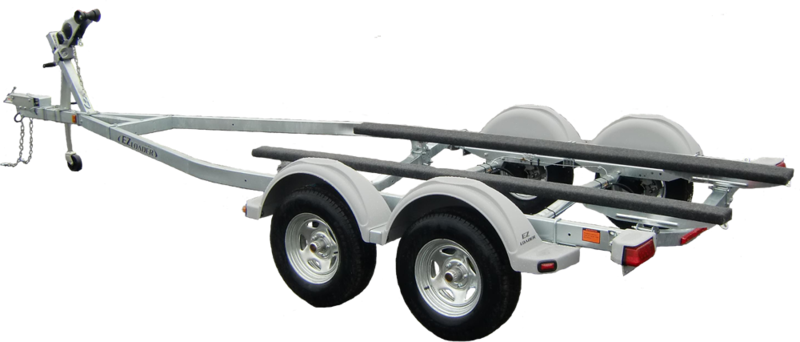 Fig. 1: E-Z-LOADER adjustable tandem-axle trailer.
Be sure to check the ratings of the hitch coupler on the trailer. You want plenty of margin there. On my boat, overall 24-feet long, the hitch coupler is rated for 7,500-lbs towed load, 600-lbs tongue load, and the ball is 2-5/16-inch. I am towing 5,600-lbs of trailer and boat with a 2015 truck rated for 6,800-lbs. I would not want ANY lower tow rating. I used to tow with a longer wheelbase 1995 truck rated at 7,000-lbs, and that rig was more stable than my newer truck. Both trucks have 5.7-liter V8 engines. I still have that older truck, and I use it for short distance towing, but tend to favor the newer (and hopefully more reliable) truck for longer hauls. My trailer is rated for a capacity of 5,200-lbs. The boat typically will weigh 4,350-lbs. i never drive above 62-MPH.
The best approach to buying a new trailer is to find a local dealer that handles new trailers. See what brands that dealer has. See what type of delivery can be had, as finding the perfect trailer in stock without a boat already on it will be hard.
What I have seen is dealers will order multiple trailers from a manufacturer to save on shipping costs. Typically a manufacturer will send a big semi-truck trailer loaded with five or six trailers to a particular area, with trailers intended for more than one dealer. When the truck is loaded, the trailers are stacked up to best fit them on the available space on the flat bed, sometimes removing the wheels and tires to save space and carrying them elsewhere on the load. The truck is routed to the several dealers so at the first stop the top trailer or trailers are unloaded, next stop the next tier, and so on.
If you live in a boating area where there are some local trailer builders, you may be able to get a trailer made locally on relatively short delay. Typically locally made trailers are found in areas with a lot of trailer-boating activity.
The nice aspect of getting a trailer from a national brand manufacturer that has wide USA distribution is those brands tend to have been in business for a long time, and are likely to remain in business for many more years. If you need an OEM replacement part, you can usually get one from a national dealer. If you get a trailer make by Billy-Bob's local trailer shop, they might be gone when you need help. Also the national brands tend to have a lot of experience in what it takes to make a good boat trailer, so those trailers tend to be rather durable.
I have no idea what towing rating there is for your "Tacoma". You will be probably towing close to or perhaps just over 5,000-lbs. You will NEED good trailer brakes. You may need a weight-equalizing hitch if the Tacoma is not up to the expected tongue weight.
Tongue weight for a boat trailer needs to be about 5-percent of towed weight, so in this case about 500-lbs at worst case. Be sure your truck’s hitch receiver, drawbar, and hitch ball are rated for that kind of weight and have a bit of margin.
Also be sure to check the Maximum Rear Axle Weight on your Tacoma. When you drop the trailer hitch on the truck, the load on the rear axle is going to be much higher than normal.
For a detailed analysis of weights involved in towing, see my article at
Boat Weight from Certified Scalehttps://continuouswave.com/ubb/Forum1/HTML/016667.html