Page 1 of 1
Cleaning barnacle rings from hull
Posted: Fri May 05, 2017 11:28 am
by gringotim5
The previous owner must of let the boat sit in the water for a while. It looks like it had some barnacles on it that have been scrapped off. The hull looks to be okay, with no penetrating marks from the barnacles. The scraped-off barnacles left little rings on the hull. There are also some water marks.
What do I need to do to clean the barnacle rings from the hull?
To make the hull smooth and white again?
Can a marine detailing person [accomplish the work to achieve the goal]?
Thanks
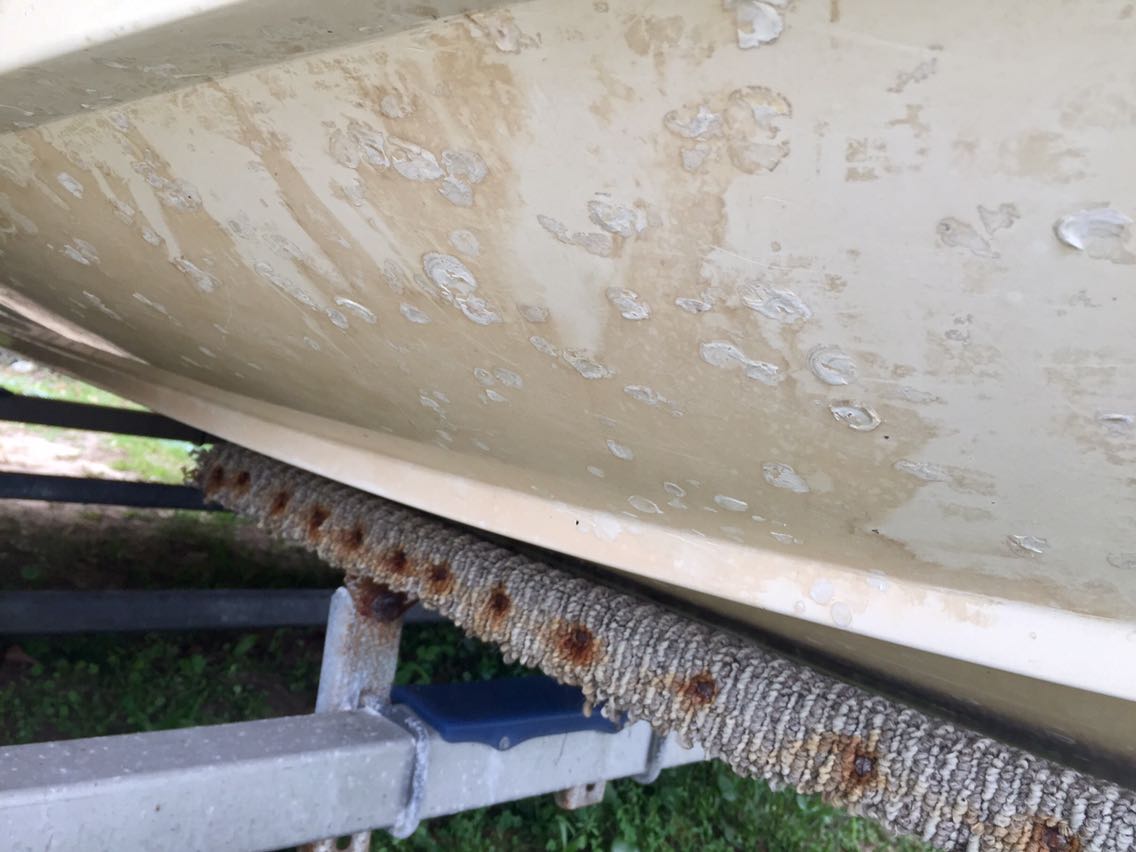
- RenderedContent-A10F0C52-D48D-4B65-8FB7-9A8381CBAAB3.JPG (99.04 KiB) Viewed 9390 times
Re: Cleaning barnacle rings from hull
Posted: Fri May 05, 2017 1:03 pm
by quickenberger
A light buffing compound and a buffing pad attached to a variable speed buffer should do the trick. It'll also remove gel coat oxidation. For the one off job or weekend warrior Harbor Freight tools will do fine.
https://www.harborfreight.com/power-too ... shers.htmlAll sorts of options out there.
Re: Cleaning barnacle rings from hull
Posted: Fri May 05, 2017 1:03 pm
by jimh
Are you asking about a Boston Whaler boat?
Re: Cleaning barnacle rings from hull
Posted: Fri May 05, 2017 3:35 pm
by gringotim5
Yes a Boston Whaler Dauntless 180
Re: Cleaning barnacle rings from hull
Posted: Fri May 05, 2017 4:55 pm
by Jefecinco
Muratic acid (swimming pool cleaner) is effective for removing barnacle traces. It's strong stuff so outdoor use is recommended. Wear glasses, rubber gloves and a long sleeved sacrificial shirt. A spray bottle is a good applicator for testing on a small area. Have a hose on hand to rinse the trailer as you go. It is hard on aluminum and galvanized steel. Try a small area. Leave on for a few seconds and scrub with a nylon pot scrubber. Rinse well. Experiment to find out how much time is required.
Re: Cleaning barnacle rings from hull
Posted: Fri May 05, 2017 6:39 pm
by jimh
With a Boston Whaler boat, the thickness of the hull laminate is probably less than in a typical fiberglass hull. If you attack the hull with abrasives, you have to be careful about how much of the surface you abrade away.
The gel coat layer is likely about the same thickness on a Boston Whaler as on most boats: it is not very thick, probably about 0.020-inch. Once you abrade away the gel coat, you will be down to the laminate layers. These will show up right away as a separate color.
When you begin to abrade the surface, be aware it can be removed very fast. Don't concentrate on one area too long.
If I were attempting to remove these remnants of barnacles, I would start in a very inconspicuous area. If things do not go well, the mistake won't be in prime view.
Re: Cleaning barnacle rings from hull
Posted: Fri May 05, 2017 6:43 pm
by jimh
Jefecinco wrote:Muratic acid (swimming pool cleaner) is effective for removing barnacle traces.
This is probably a better approach: use some chemistry instead of just pure abrasion.
Re: Cleaning barnacle rings from hull
Posted: Fri May 05, 2017 8:30 pm
by gringotim5
Thank you for all the suggestions. I want to be as less intrusive as possible [because] I wouldn't want damage the hull gel coat.
Re: Cleaning barnacle rings from hull
Posted: Mon May 08, 2017 2:05 pm
by jimh
From the image posted above of the hull, it looks like there was no anti-fouling paint. There probably wasn't any bottom paint or barrier coat of any kind. Hulls that sit in the water for extended periods of time will pick up some water into the gel coat and laminate. Let the hull thoroughly dry out. The splotched color of the gel coat may be due to retained water in some areas.
My c.1990 Boston Whaler boat hull has no barrier coat or anti-fouling paint. I generally do not keep the boat in the water for more than one week at a time, and most of that is in rather cold freshwater with little aquatic plant growth. Most of its life the huil is sitting on a trailer. I think the longest period of immersion of the hull has been about 12-days. In warm saltwater in the Gulf of Mexico, I saw marine growth beginning to attach to the hull after just five days in the water.
A boat that is kept in the water for extended periods should probably have a barrier coat to seal up the hull. The paint color can be matched to the hull color to make the presence of the paint less obvious. Then an anti-fouling coat to retard marine growth.
Read the factory advice on bottom paint at
http://continuouswave.com/whaler/refere ... tml#bottom