I used monofilament line instead of 1/8-inch braided nylon because mono slides easier in tight areas. Because of the way the T-Tops are welded, it is very difficult to pull braid past the rough edges. For those that don't know. When T-tops are built, and especially in areas where wire chase have to be, the builder will drill a hole the size of the outside diameter (OD) of the cross pipe. The cross pipe is then inserted in the drilled hole and welded. This is a stronger connection then just butt welding the pipes. Where that cross piece enters the pipe is where it can get difficult pulling wires and such. The inserted pipe is not always flush with the inside of the main pipe.
I used 3/8" Neodymium Rare-Earth Magnets and 1/2" Neodymium Rare-Earth Magnet discs
I used three of the smaller 3/8" washer style magnets with the 130 pound test mono. They are loosely attached so that they can roll, slide whatever. I used six of the solid disc magnets. The outer magnets could pull the inner magnets and mono through the pipe even being separated about an inch. This really worked well and allowed me to do in 10 minutes what I had been trying for hours. In this picture the magnets are separated the minimum distance to keep them, well, separated.

I also use a tool I made like this. I used Stainless TIG welding wire. This is convenient for pushing and pulling a wire past a bundle. For example, in the T-Top down leg where the bundle turns and goes into a console, midway down the leg.
- wire_tool_zpscgqodnbu.jpg (1.09 KiB) Viewed 7089 times
I've had boats since 1990, and worked on them before that. It wasn't until I bought my 17 Outrage last year and tried running the transducer cable that I finally broke down and bought a Klein Tools fish fiberglass rod. In the past I have used an automobile speedometer cable replacement or repair part with much success. I also have Klein steel and fiberglass fish tapes. None of these worked.
Klein makes a 6-foot-long, 1/4-inch fiberglass glow-in-the-dark "fish" rod. Not cheap, but the quality is there, and when the tool works...Of course I needed about 8-9 feet, so I have two of these.
To connect the rods I also bought from Home Depot an aluminum spacer. These are in the chart-style drawer cabinets in the hardware isle, right by the magnets. Two 1/8-inch-holes drilled and two pieces of a nail allow me to join the rods together. I just use blue masking tape to hold the pins in. These rods are rigid enough to push through, yet flexible enough to be able to bend a bit. And being in sections allows assembly as needed in tight quarters.


To connect the cables to the fish I use Klein wire grabber, similar in function to Chinese finger cuffs [also called a Kellems Grip]
[interesting story behind the inventors Kallems]
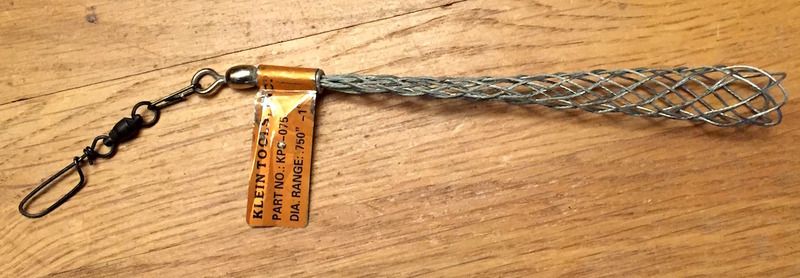
This is the 3/4" - 1" -inch version. It will work with a Lowrance transducer cable end, not easily, but you can do it.
To connect the grabber to the fish I used a Sampo 300 pound test ball bearing swivel. The snap end attaches to the rod.
- Sampo_swivel_zpsd2s17b7g.jpg (1.81 KiB) Viewed 7092 times
The loop end is attached to the grabber with a quick clip. To attach it I tried several methods until found these quick clip fishing tackle connectors. The one below the black line. The top styles bent or popped open when trying.
- Quick_snap_zpsqg7m8ow8.jpg (6.23 KiB) Viewed 7090 times
I would have used pictures of my actual grabber, but it is blowing 30-50 here and is only 35 degrees with a wind chill of 25 - and earlier in the week I was in a tee shirt working on the boat.