 ContinuousWave
 Whaler
 Moderated Discussion Areas
ContinuousWave: The Whaler GAM or General Area
New Coast Guard Small Boat
Moderated Discussion Areas
ContinuousWave: The Whaler GAM or General Area
New Coast Guard Small Boat


search | FAQ |
profile | register | author help
|
|
ContinuousWave Whaler Moderated Discussion Areas
ContinuousWave: The Whaler GAM or General Area
New Coast Guard Small Boat
|
| Author | Topic: New Coast Guard Small Boat |
| jimh |
 posted 12-28-2012 12:11 AM ET (US)
posted 12-28-2012 12:11 AM ET (US)  
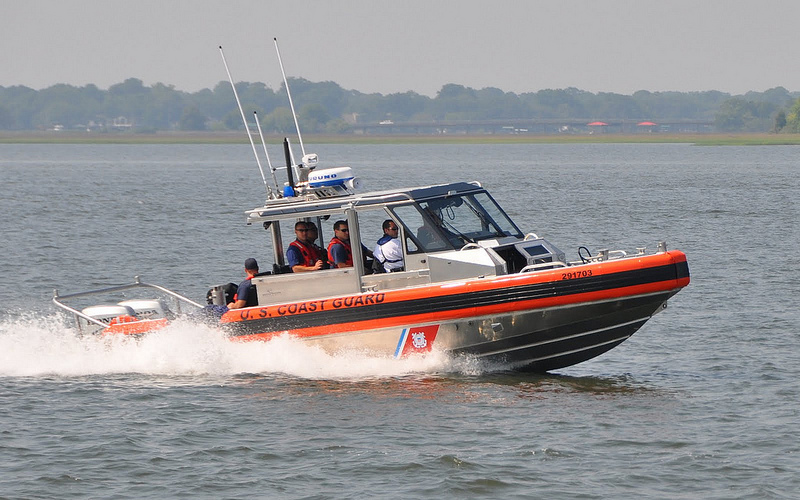
Metal Shark Boats of Jeanerette, Louisiana, have been awarded a $13-million contract to supply the United States Coast Guard with 38 boats of the new RESPONSE BOAT, SMALL-II class after a competitive bidding process.
The new RB-S II boats will have dimensions of Length = 28-foot 6-inch The boats are powered by twin HONDA four-cycle outboard engines, and are reported to have a top speed of 45-nautical miles per hour. The initial contract award works out to a price per boat of about $342,000. As of October 2012, 22 boats have been delivered. The new RB-S II class of boat could grow to perhaps a total of 500 boats, as this new boat replaces the present Defender-Class RESPONSE BOAT, SMALL, as those older boats reach end of life and are retired. Metal Shark Boats refers to this model as the DEFIANT 28. They presently have their demonstrator boat available for sale, if anyone is interested. The use of the Honda four-cycle outboard engine is quite interesting. This engine was also used on the present RB-S Defender Class boats, and apparently has earned its place on the new acquisitions. Reports of incredible reliability and longevity of the Honda outboard engines are frequently heard in dock talk about these USCG boats. The previous RB-S class boats were made by S.A.F.E. Boats. http://www.uscg.mil/acquisition/rbs/pdf/rb-s.pdf |
| jimh |
posted 12-28-2012 12:30 AM ET (US)
The cabin of the new RB-S II is constructed with windows which can drop down in place to create a more open cabin. I am not sure if the power is the 225-HP Honda or the new Honda BF-250. The hull is rated for 600-HP. To reach the 45-knot speed, a pair of 250-HP engines sounds more likely. More pictures at |
| David Pendleton |
posted 12-28-2012 02:17 AM ET (US)
This picture must be of the "demonstrator" model, as I'm sure the standard deployed model will be bristling with M-249's. Vessel safety check, anyone? |
| Jefecinco |
posted 12-28-2012 10:08 AM ET (US)
Any idea if the foam collar makes the boat "unsinkable"? |
| boatdryver |
posted 12-28-2012 10:54 AM ET (US)
The foam flotation collar on the old Safeboat Defender boats was a lot bigger in volume than the foam collar on these Defiants. The collar on these have more the look of a huge rub rail. Good looking boat, though. Is anyone else surprised these tough aluminum hulls have such a short service life? JimL |
| wezie |
posted 12-28-2012 10:56 AM ET (US)
As far as this batch of wasted money, I really do ot care if they float or sink. If the gubermunt, with all of our money builds these things that do not have positive floatation, would you be surprised? So much for the gubermunt even pretending to support US businesses. |
| BQUICK |
posted 12-28-2012 11:05 AM ET (US)
Pretty sad that the US Coast Guard couldn't use US made outboards. GSA in DC just bought a bunch of Hyundais for gov't use. |
| Mr T |
posted 12-28-2012 11:37 AM ET (US)
wow- $342K for a 28 footer. I'm assuming it is a given that this rig will have all the latest and greatest technology, but... that much? I need a government contract to build something- anything.
|
| jimh |
posted 12-28-2012 11:47 AM ET (US)
Re the Honda outboards, I suspect that Honda employs more people in the USA than Mercury and Evinrude combined. The Honda outboard engine must have established a good track record in prior use. And if the USCG is already set up to maintain and repair them, it would be reasonable to continue to use them. Re the floatation--I have not seen any mention of it, but I assume these boats are built with aluminum chambers which provide reserve buoyancy. Re the lifespan of the existing Defender class RB-S class: yes, it seems strange that some of the 500 or so boats built for that class are already coming up for replacement. Perhaps those nice S.A.F.E. boats will start showing up in surplus property disposal auctions. Or, perhaps they will be given to other government agencies. I have to say that as I travel around the water these days it seems like every government agency in the USA has recently acquired a very nice boat. I see U.S. Park Service boats, I see U.S. Coast Guard boats, I see Border Patrol boats, I see Homeland Security boats--and they are all very new, very fancy, and--no doubt--very expensive. So I can hardly imagine there is any government agency that would take a hand-me-down Defender class 25-foot Response Boat after the Coast Guard beat it up for ten years and be satisfied. Heck, even obscure agencies like Fisheries and Wildlife Management get new $500,000 boats. These days if I go to a municipal marina on the Great Lakes it is typical to see at least one--and sometimes two or more--very new and very fancy small boats belonging to some government agency sitting in a permanent slip awaiting some particular special use. Being a builder of extremely high-quality customized 25-foot to 30-foot welded aluminum boats must be one of the best opportunities in the boat building business these days. |
| jimh |
posted 12-28-2012 12:11 PM ET (US)
After considerable searching, I have found the initial request for proposal for these boats. It makes for some interesting reading: https://www.fbo.gov/utils/view?id=ccd08d149989cbb68b0299dc3ddcf7a2 You can find more documents for the acquisition process at |
| Binkster |
posted 12-28-2012 01:18 PM ET (US)
Things have changed. When I was in the Coast Guard in the early-mid sixties, the boats and most of the Coast Guard ships were hand me downs from the US Navy, and worn out when the CG Got them. The exception might be their Buoy Tenders, but they were all from the early 1900's and coal fired. The CG 83' Patrol Boats were ex WWII Navy minesweepers and made of wood lapstrake construction. Around 1965 the GC finally got their own 82' Patrol Boat, built of steel with twin GMC diesel engines. They are still in use today, although many were sent to Vietnam in '66, along with 13' Whalers that the CG had to purchase from private Whaler dealers, and then paint them grey themselves. I was stationed on a 311' CG cutter for 3 months, which was originally a US Navy Sea Plane tender in WWII. The hull was the same as a Navy Destroyer Escort, but all the voids in the ship were fuel tanks. The CG obtained that ship in the late '40's, and used it for ice burg patrol in the North Atlantic for years. rich |
| jimh |
posted 12-28-2012 02:04 PM ET (US)
The present RB-S Defender class 25-foot boat was initially designed and acquired in c.2002 in a bit of a rush. The boat was planned to have a 10-year life span. There are more details in http://www.uscg.mil/acquisition/newsroom/pdf/CG9newsletterSep10.pdf |
| jimh |
posted 12-28-2012 02:15 PM ET (US)
Here are the RFP specifications for the outboard engines re service life:
quote: |
| jimh |
posted 12-28-2012 02:19 PM ET (US)
Per the above, the winning contractor has to provide engines that have an average of 4,000-hours of MTBF or be considered out of compliance. I guess the choice of engines is at the discretion of the contractor. |
| phatwhaler |
posted 12-28-2012 06:39 PM ET (US)
Many of the 25ft Safe boats have been cleaned up and given to the US Border Patrol for their riverine program. They are sporting Verdos by the way. I highly doubt a operationally ready 29 RBS is going to hit 45 knots with twin 225 Hondas. The drop down windows are a direct result of the San Diego accident. |
| Tom Hemphill |
posted 12-28-2012 08:16 PM ET (US)
In some of the manufacturer's photos linked to, I see what looks like an inboard powered model. It's the one in icy water, with a full width swim (brrr!) platform. I wonder if any of those were part of the contract award? |
| jimh |
posted 12-28-2012 10:37 PM ET (US)
Phat' says: "The drop down windows are a direct result of the San Diego accident." That is quite a comment. Could you check over the RFP and see if there is anything in the RFP that specified the configuration of the windows? Also, the boat involved in the collision in San Diego Bay was a 33-foot Special Law Enforcement boat, not a 25-foot Defender class [Response] Boat, Small. |
| phatwhaler |
posted 12-28-2012 11:09 PM ET (US)
My opinion is that due to poor visibility from within the 33 SAFE boat due to the various blind spots and reflections off the glass the new boat was designed to minimize these issues. I believe the visibility issues were discussed in the NTSB report of the San Diego accident. |
| jimh |
posted 12-29-2012 09:10 AM ET (US)
The NTSB report on the collision in San Diego Bay is available on-line. Perhaps you could cite the section about the windows. It would be interesting to see of one could connect the dots between any recommendation in the NTSB report about the design of the 33-foot Special Law Enforcement boat and the United States Coast Guard Request for Proposal for their new 28-foot Response Boat. If there is such a link, as Phat' has suggested, one ought to be able to find it in the report and in the proposal. |
| BQUICK |
posted 12-29-2012 11:35 AM ET (US)
"Re the Honda outboards, I suspect that Honda employs more people in the USA than Mercury and Evinrude combined." That's pure conjecture. This is the UNITED STATES Coast Guard, defending the USA. I suppose the US Army is now using Toyotas then, too. I'm sure they could keep a Merc running with all the money they dump. |
| Tom W Clark |
posted 12-29-2012 11:55 AM ET (US)
quote: It seems the USCG's principal requirement is reliability and durability rather than top speed, "hole shot", quietness or low emissions. Given that Toyota does not manufacture outboard motors, this might explain why so many Hondas are used. |
| Tom W Clark |
posted 12-29-2012 12:00 PM ET (US)
Honda employs over 27,000 people in the United States http://corporate.honda.com/images/banners/america/ honda-contribution-2009.pdf Yes, they employ more people in the USA than Mercury and Evinrude combined, many times over. |
| jimh |
posted 12-29-2012 12:00 PM ET (US)
If you look at the contract specification carefully you will probably find that they already include provisions for special set-asides, for contractors that are owned by minorities, women, small businesses, and so on. Do we need a special category for Mercury to receive special consideration, too? Are you proposing that there should be a special set-aside for Mercury? I don't understand the basis for that sort of notion. Why would Mercury qualify for a special set-aside in the contract award? And if Mercury, then why not Evinrude? As for the number of employees of Honda in the USA., they operate many large assembly plants here for automotive production. It would not take too much investigation to come up with some numbers. But I don't feel compelled to research it. Just on a rough estimate it looks like Honda wins to me. Each plant employees many thousands of workers on two or three shifts. Also, the government is buying plenty of Brunswick products for its use. The Brunswick VERADO engine is used on many small boats the government is buying. I believe in some of those categories they must have a much lower allowance for MTBF, based on the recitation to me by a Homeland Security officer that they get new VERADO engines every year on their boat. |
| prj |
posted 12-29-2012 05:09 PM ET (US)
A Homeland Security guy told me during our dock talk that they replaced the Verados every year because they had so much damned money in the budget they needed to spend it to justify next year's budgetary increases. And that the Verados were the prettiest and best performing engines they had ever seen. Thats what he told me. I imagine BQUICK's remark, a snide crack at Mercury if you read it completely, is expressing his desire that the US Government support US owned and headquartered companies. I feel as he does, generally. Supporting products made as locally as possible is a good idea, quality presumed equal. That latter part is the kicker, I suppose. WalMart employs more people than Filson, but that certainly doesn't make WalMart a better company, producer or corporate citizen than Filson. |
| jimh |
posted 12-29-2012 05:31 PM ET (US)
If there is a set aside for Brunswick, what about for Evinrude and BRP? |
| prj |
posted 12-29-2012 06:08 PM ET (US)
Evinrude E-TECs are produced right here in Sturtevant, WI. But ownership is Canadian, is that correct? Where are Honda outboard motors produced? I'm not certain how the RFP is written or how the specifications describe the "propulsion", other than Jim's excerpt included. It certainly would be easy enough to include performance specifications with production/ownership or other qualitative goals that could be met or ignored, at the bidder's discretion. Back to the Metalshark boat replacing the venerable SAFE boat version of the USCG's fleet, it is not nearly as aesthetically pleasing a vessel as the original. The forefoot looks remarkable flat and shallow, more like a flats boat/bass boat than a wave piercing proud bow. The new version also lacks the distinctive and rather salty reverse cant on the pilot house windscreen, replaced by a non-descript moderately clunky cabin and parallelagram sidelights. When these heavily militarized, 1/3 million dollar crafts with 4-5 armed and armored soldiers inevitably pull over my family and I on our modest pleasure craft in inland waters while fishing quietly or cruising along, I look forward to getting a better close up glimpse of their latest and greatest technology used for providing "safety checks" to our citizenry. Heaven forbid they perform such demanding duty on a decade old vessel. |
| jimh |
posted 12-29-2012 07:47 PM ET (US)
We're evolving into a society where the government picks the winners. May the outboard with the best lobbyists win. |
| AZdave |
posted 12-29-2012 08:11 PM ET (US)
Does any entity in the US buy more outboards and major components from the far east than the Mercury Marine division of Brunswick? |
| BQUICK |
posted 12-29-2012 08:54 PM ET (US)
I guess as long as the CG boat flies an American flag everything is fine....like I see vets who drive Hyundais do. Maybe Mercury or Evinrude WOULD employ more workers if US agencies bought more motors from them.... Seems like being patriotic is not considered a virtue these days....pretty sad. |
| phatwhaler |
posted 12-29-2012 09:12 PM ET (US)
I'm not sure where the RFP is located, however I wouldn't be surprised to see some requirement to meet the ABYC forward visibility standards. These were mentioned in the NTSB report. |
| jimh |
posted 12-30-2012 08:00 AM ET (US)
I found the RFP and gave a hyperlink to it earlier in the discussion. It's a lengthy document. I have not read all of it. |
| Tom W Clark |
posted 12-30-2012 12:01 PM ET (US)
Visibility requirements are discussed in section 070-3.4.10: Visibility (Lines of Sight): The crew space shall allow for maximum lines of sight for the crew in both seated and standing positions, including lines of sight when coming alongside larger vessels and structures, as well as lines of sight when in turns. All around visibility outside the boat from the conning station with not greater dead visibility sector of two (2) degrees in any one direction and not more than fifteen (15) degrees total loss of visibility in 360 degrees. The crew space shall not be subject to glare from external light sources up to fifteen (15) degrees above the horizontal plane. Other reasons for the drop down windows may include: - Ventilation, section 070-3.4.9: Ventilation: Life-cycle cost considerations preclude the RB-S from having installed air conditioning. With this in mind, the crew space and installed ventilation system (see Section 512) shall maximize ventilation and natural cooling for the crew. - Emergency Egress, section 070-3.4.12: Emergency Egress: During the life of RB-S fleet, there is a high likelihood that one or more boats will capsize due to unexpected environmental conditions, interaction with other vessels, hostile intent of others, or human error. The RB-S shall have egress means for all crew in the crew space to quickly and safely exit the crew space. In addition, air pockets that are available in the inverted position are highly desired to allow the crew extra time in performing egress. - Weapons Operation, section 070-3.4.13: Weapons Operations: During law enforcement missions, the RB-S may be required to fire upon other vessels from inside the crew space using small arms. Typically this is done from the seated position, and the small arms are fired at vessels that are directly abeam of the RB-S or slightly forward. The crew space shall provide openings that can be used for this purpose. |
| jimh |
posted 12-31-2012 12:59 AM ET (US)
Re the questions raised by prj and his objections to the hull configuration and general aesthetics of the new design: the best answer for the hull design as it relates to ride and handling characteristics, as well as other general questions about the utility of the new boat design, will come from the Coast Guard personnel that operate the new boats who also have operated the old boats. If they begin to complain about the ride of the new boat or complain about the accommodations, placement of windows, and other matters of general utility, then we will have a reasonable basis to draw a comparison. I have not spent 1-minute underway in the existing 25-foot Defender class boat, so I cannot offer any prediction on how its ride will compare to the new boat. One would need to have a lot of experience in both boats and in many sea conditions in order to be able to offer a reasonable assessment of the comparative ride characteristics. As for the aesthetics, they are trumped by concern for utility. It is nice to be able to have both a useful design and a pleasant looking design, but for boats like these the consideration of utility will certainly be more important. If aesthetics were more important, we could get varnished teak gunwales for the new boat. |
| jimh |
posted 12-31-2012 01:01 AM ET (US)
Tom--Thanks for the nice collection of excerpts regarding the fenestration. |
| fno |
posted 12-31-2012 08:58 AM ET (US)
Read the specification this morning. Can't say that it justifies the 342K price tag, but I can understand now why the cost is so high. Considering there are two trailers, one extra motor, covers, additional spare parts for continuous operation from day one. That does not include the odd navigational items on the spec for a navigational parallel, hand held compass, and a penlight. Nor the 5-12" x 20" fenders with 10' of 14" double braid. One thing I did notice is the amount of documentation. Everything from technical manuals, to BOM's on down to Autocad drawings and updates for the life of the contract(8 yrs) That kind of documentation is very expensive and must be created up front while the cost is ammortized over 8 years.... |
| Dave Sutton |
posted 12-31-2012 08:21 PM ET (US)
The cost on these is unreal. What a floating obscenity to rub in the faces of the taxpayers. |
| AZdave |
posted 01-01-2013 12:51 AM ET (US)
Things with short serial numbers are expensive. What would an iphone cost if the projected production run was five hundred? |
| Russ 13 |
posted 01-01-2013 12:52 AM ET (US)
$342,000 for a 28-foot boat--any idea why our government debt is OUT OF CONTROL? Thats over $122,000-per foot. UNREAL. |
| jimh |
posted 01-01-2013 08:19 AM ET (US)
I don't think the cost is terrible. Price a 28-foot Boston Whaler from the commercial division, and ask them to include all the material required in the contract: --two trailers What is amazing to me is the size of the order--it could expand to 500 boats. Compare with Binkster's recollection of the dilapidated boats in the Coast Guard of his era. This is first-class hardware. As a nation we are spending a lot of money on things like this. |
| RevengeFamily |
posted 01-01-2013 08:23 AM ET (US)
Russ--$342,000 for a 28 foot boat works out to $12,214-per-foot. I think you slid the decimal point the wrong way. However $12,214.00 is still what I would consider "stupid money"... If you don't mind I will join you at being ill. And I would also like to be excused from giving the politicians money to [throw] away at an alarming rate.--Norm |
| Dave Sutton |
posted 01-01-2013 09:21 AM ET (US)
"As a nation we are spending a lot of money on things like this."--I would say "squandering" would be a far more descriptive term. |
| george nagy |
posted 01-01-2013 09:48 AM ET (US)
Given that the pricing seems to be in line with that of other customized craft in the marine industry, I am not too sticker shocked by the price for each boat, however I am very taken aback with the concept that we as a nation would spend that kind of money for a small craft like this, particularly at this time of recession. Boo hoo! |
| jimh |
posted 01-01-2013 11:14 AM ET (US)
ASIDE--Before anyone gets too upset with the cost of these 28-foot boats, you might want to give some attention to the price of the Coast Guard's new National Security Cutters. These 418-foot vessels cost about $640-million apiece. Eight are to be built, giving a minimum acquisition cost of over $5-billion. Their expected lifespan is only 20-years. The operational costs of a fleet of eight ships like this must also be in the hundreds of million-dollars each year. They operate with a crew of 113. It is just part of the cost of the "War on Drugs." But these are cheap by Navy standards. Even a small Navy ship costs $1-billion these days. Another price for the "War on Terror." |
| elaelap |
posted 01-01-2013 02:50 PM ET (US)
Hey, these Response Boats cost us taxpayers chump change. How about the absolutely-necessary-for-our-survival F-35 fighters. These jets would cost taxpayers $396 billion, including research and development, if the Pentagon sticks to its plan to build 2,443; that's about $140 million a piece. Just gotta have 'em -- all 2,443 -- to save western democracy from them, uh, uh, bad guys... Tony |
| jimh |
posted 01-01-2013 05:01 PM ET (US)
More images of the new boat here: http://www.flickr.com/photos/bonefishcommunications/sets/ 72157627966865965/ |
| David Pendleton |
posted 01-01-2013 07:25 PM ET (US)
Interesting crew layout pictures. I'll bet it's the FNG who ends up standing in the back every time. |
| george nagy |
posted 01-01-2013 07:29 PM ET (US)
It is hard to believe we could have gone this far without boats like these protecting us against ? Ourselves? What are the life safety implementations of these craft? They look to be more tactical "security" type craft than search and rescue. It would seem that unlike the threads regarding evinrude or mercury this thread mainly contains posts similar in tone and opinion that these crafts and the overall purchasing of this type of equipment by the government is somewhat unacceptable by the majority of the posters, this is encouraging in a way and maybe there isn't as much distance between us when it comes to major expenditure of OUR money. |
| Dave Sutton |
posted 01-01-2013 09:40 PM ET (US)
"They look to be more tactical "security" type craft than search and rescue"
Their value as police is enhanced by their unique legal standing to conduct warrantless searches that would be illegal if done by any other law enforcement group in the USA as a violation of the Fourth Amendment, but which are done under the guise of "vessel safety checks". I'm waiting expectantly for someone to bring this to court as a violation of our constitutional rights. These guys are not around to help you, unless it's to help you into the pair of the handcuffs that they all carry (along with a pistol, baton, and pepper spray). Dave
|
| Binkster |
posted 01-02-2013 09:50 AM ET (US)
Dave is right on. When I was in the Coast Guard (Reserves) in the 60's, we were a friendly bunch, SAR was our primary duty, but we always were there to help hapless boaters. On one of my 2 week active duty stations at Shinacock Inlet Lifeboat station, we got a call from a commercial dragger, who said he ran out of fuel with his nets down, and couldn't retrieve them. So out we went in one of the stations 26' Patrol boat(ex Navy of course). We ran about an hour or so till we located this hapless commercial fishing boat, no GPS in those days. We gave the grateful crew 4 Jerry cans full of diesel, and went on our way. That evening the caption of the fishing boat stopped by our station and gave the chief a basket of fish to show his gratitude. We ate fresh fish for dinner for a while. On another 2 week duty, I was stationed on a lighthouse in the middle of Long Island Sound. Very boring duty, nothing to do but stand radio watch, 4 hours on 4 hours off 24/7. We were grateful when local boaters came by and let us water ski off their boat. That was the way it was in those days. Boaters and commercial fishermen appreciated the CG. It all changed in '65, when the Coast Guard went to Vietnam.(see below YouTube video). After the war there was this drug problem. During the '70s and beyond, drug ships were coming from Columbia and S.America, and using small boats smuggled pot into the USA. The Coast Guard, still under the Department os Transportation, became the only defence agains the drug smugglers. They became a militarized police force. Even their uniforms changed. Gone were the Navy blues and the old traditions. They were now Water Cops. Glad I was in at a better time. Its not in my nature to hassle innocent boaters, but I guess thats the way it has become. After all they just can't shoot up suspected boats and ask questions later like they did in Vietnam. (check out the 13 foot Whalers in the video) http://www.youtube.com/watch?v=J3UcBuFC8Z4 rich |
| jimh |
posted 01-02-2013 10:17 AM ET (US)
When you have a boat and it touches the water, your legal standing changes quite a bit, it seems. I recall many years ago launching my 15-foot Boston Whaler boat at a ramp in the lower Detroit River (Elizabeth Park). As soon as the hull of the boat hit the water, officers of a local law enforcement agency--I think it was the Sheriff--who had been standing nearby and watching me, came over and initiated a vessel safety inspection. I believe that when my boat was on its trailer and I was on the highway, I could not be arbitrarily stopped and inspected by a police agency, but once the boat was in the water, I was fair game. I don't know how the Coast Guard works today, but I suspect that if you are an entry level officer or bosun mate and given an assignment to go on patrol in one of these new 28-foot boats, when you return to the base after four hours (or more) underway, you better have some paperwork filled out that shows you stopped some boaters and made some inspections. I also suspect that at the end of year there is a tally made of all these thousands and thousands of safety stops. In the next Congressional budget hearing, an Admiral points to a chart and shows that the Coast Guard conducted x-number of routine safety inspections, and that's one of very important reasons why they need 500 new boats at a cost of $342,000-each. |
| Binkster |
posted 01-02-2013 12:44 PM ET (US)
Below is an excerpt from Wikipedia about the drug history of a little town of about 600 permanent residents down in the Everglades south of Naples off highway 41. It was the main focus of the Coast Guard in Florida during that time period. It was a great place to boat and fish, but most of us stayed away. You didn't know whether you would be hassled by the CG or the smugglers. Both were everywhere. In the end most of the commercial fishermen which was the main industry of the village,(it seems that commercial fishermen love to make extra money) and even the mayor went to prison. It was the work of the CG that put an end to the smuggling of "square grouper"(floating bales of marijuana). A lot of people, however made a lot of money, and hid this money in their homes. The Coast Guard has the power to search your home without a search warrant, believe it or not. They went into these suspect homes sometimes years later even with new residents, tore Sheetrock from walls and tore up wood floors, and found alot of stashed cash. I didn't really believe this, however I bought an outboard (on E-Bay) from an old resident of Everglades City about 4 years ago, and he confirmed it. He said the CG tore folks home up. Its changed now, not the sleepy little village it was, but a very expensive place to live with expensive homes and big boats, much like Naples. Wikipedia excerpt. |
| jimh |
posted 01-02-2013 01:05 PM ET (US)
To get back to the new United States Coast Guard [RESPONSE] BOAT, SMALL II design, the requirements of the boat call for a lot of "ballistic protection" or armor plating of the boat cabin to protect the occupants. Apparently the United States Coast Guard anticipates that these boats are going to "exchange small arms fire" (another euphemism from the days of Vietnam military briefings) with other boats. In that regard, I wonder what are the statistics of United States Coast Guard personnel casualties from small arms fire while underway on a mission in a [RESPONSE] BOAT, SMALL category boat. I wonder if the crew members on these boats are routinely exposed to gunfire from other boats. How many are wounded each year? How many killed each year? Are other boaters really shooting at the Coast Guard? If you read the design specifications you will also find that there are requirements for the crew to be able to have a specified range or arc of fire for their weapons from the boat outward. Maybe we need to change the name of this class of boat from [RESPONSE] BOAT, SMALL to GUNBOAT, RIVERINE or LITTORAL. I suppose it is easier to get funding for the boats if you describe them as ["response"] boats instead of "gun boats." But if these boats really have a dual mission, why not include that in their category description? |
| elaelap |
posted 01-02-2013 01:09 PM ET (US)
To those, like Dave Sutton, who totally disrespect the USCG, here's my letter and the editor's response about an incident that happened to me a couple of years ago. (This from the November, 2009 edition of Latitude 38, a northern California sailing monthly magazine.) -- _________________________________ "HATS OFF TO THE COASTIES I run a 21-ft Boston Whaler out of Bodega Bay, and I have Commercial Assistance Towing as well as Auxiliary Sail Vessel endorsements on my USCG/Merchant Marine Master’s ticket. Over the past couple of decades, I’ve towed at least six or seven disabled boats back to the harbor up there, and stood by to assist several others. (We don't have a SeaTow equivalent running out of our little harbor 60 miles north of San Francisco, so we help each other the best we can.) I’d never been on the other end of a tow line until November 14. In almost dead calm conditions that morning, I was motorsailing my newly-acquired Niagara 31 sloop against a strong ebb halfway between Alcatraz and the Golden Gate Bridge. Suddenly my boat's 13-hp Volvo diesel blew a head gasket, so there went our power. We were right in the center of the ship channel at the time, and I could see a container vessel approaching the Gate. I won’t share the language I used before I calmed down somewhat and realized that, for the first time in my life on the water, I needed help. The Coasties instantly responded to my call on 16, switched me to 22A, and told me that help was on the way. Within about five nervous minutes, one of their 45-footers was on the scene. Her three-person crew competently walked me and my three-person crew through proper procedures to receive their tow. We swiftly lowered sails, and I managed not to miss the rescue boat’s accurately-thrown heaving line. It was not difficult to make their tow line fast to my boat's bow cleats, although I'm embarrassed to admit that I had to be reminded by the Coastie skipper not to make both ends of their tow bridle fast to the same starboard cleat. I moved aft after being politely admonished by the Coast Guard skipper to clear my boat’s foredeck while under tow. Our run at hull speed out of the main shipping channel and back up to Gas House Cove was uneventful. But I was relieved to see the large container vessel that had come in the Gate pass a couple of hundred yards off our port beam. In my excitement, I failed to get the names of the Coasties who helped us out. I wish I could thank them personally and by name for their skill, seamanship, and especially for their courtesy and understanding. I’d take my hat off to all of them, but the sun’s reflection off my aging, balding dome would necessitate their swiftly grabbing for sunglasses, and they’ve already done enough on our behalf, that's for sure. Tony Wilde Tony — Yours isn't the first boat/sailboard/dinghy/kitesailor to have been dead in the water in the shipping channel, so you can be sure that the pilots and crew on ships keep a sharp eye out for situations such as that. Nonetheless, there have been accidents. More than 30 years ago, our friend Lou Albano and a crewmember on his 30-ft Hurricane were run down and killed by an outbound ship after the engine on their boat failed and there was no wind for them to sail out of the way." The Coasties are okay with me!! Tony |
| andrey320 |
posted 01-02-2013 01:36 PM ET (US)
My thinking was in line with most fellow members here until a few weeks ago when a local small USCG boat was rammed by a panga which resulted one USCG fatality.... I guess they do run into situations requiring firepower, unfortunately, they were not ready to fully utilize it this time.... http:/ / losangeles. cbslocal. com/ 2012/ 12/ 02/ us-coast-guard-killed- during-law-enforcement-operations-near-santa-cruz-island/ I read in a local boating paper that the panga was chased for hours until it's engine died just outside of Mexico waters. |
| Binkster |
posted 01-02-2013 01:53 PM ET (US)
The Coasties will be on the scene if you and your boat is 1. sinking 2. on fire 3. threat of loss of life. In Tony's case it was threat of loss of life. He was unable to maneuver his boat away from the container ship. I would also guess they would come out to your boat if they suspected you of terrorism. BTW, Tow companies started up when someone found a loophole in federal law that stated that the Federal Government is not allowed to interfere with private business. So someone started a tow company, and then the GC couldn't tow vessels unless they were in the dangers listed above. They deserve all the best equipment they can get. They deserve it, becuase they spent so many years as the ragtag branch of the service, now under Homeland Security the funding seems to be unlimited. rich |
| lizard |
posted 01-02-2013 02:08 PM ET (US)
I think it is pretty bad karma to slam the Coast Guard. Some day, they just might save your life (and your sorry attitude). In southern CA, there has been a marked increase in attempted human smuggling, via the Pacific Ocean. Law enforcement are now posted up on the hills overlooking La Jolla, Scripps, Oceanside, etc. complete with night vision and something that I think is called Heat Seeking Thermal imaging. Many of these pangas are outfitted with power and speed in mind and it is safe to assume heavy fire power is aboard. With all of the ridiculous ways the government spends money, this seems an odd item to focus on. It costs over $800K annually, to keep a soldier on the ground in Afghanistan, times the 68K troops still there. Can you imagine the annual cost to run JPL? |
| jimh |
posted 01-02-2013 02:42 PM ET (US)
[The designation of the RB-S II is actually RESPONSE BOAT, SMALL, which was not always properly used in the above. I fixed those instances where RB-S was not properly used--jimh] |
| jimh |
posted 01-02-2013 02:56 PM ET (US)
Thanks for the citation of a USCG crew being killed in a Law Enforcement action--an extremely unfortunate incident and a tragedy. The boat that USCG crew was on was launched from a USCG Cutter HALIBUT. The HALIBUT is a 87-foot Marine Protector Class coastal patrol boat. See http://en.wikipedia.org/wiki/Marine_Protector_class_coastal_patrol_boat A boat like the HALIBUT carries a rigid-hull inflatable boat (RIB). The RIB is an open cockpit boat and does not appear to have a cabin with ballistic protection. One is pictured here: In a high speed pursuit in open water, it could be very risky to come into a high speed collision with another boat. I don't know what the operational orders or normal procedures and methods of the United States Coast Guard say about launching an RIB from a Marine Protector class coastal patrol boat to pursue another vessel in the open ocean. It does look risky to me. My inquiry about Coast Guard casualties was in regard to those occurring during missions of a boat like the one we are discussing, the RESPONSE BOAT, SMALL II, during its routine patrols. I don't think we get much small arms fire between boats on the Great Lakes. Maybe it is more common in southern Florida. |
| David Pendleton |
posted 01-02-2013 04:27 PM ET (US)
As Jim points out, we don't have the same problems as the Southeast and West Coasts. What may be a completely appropriate response in the Florida Keys is completely inappropriate on much if not all of the Great Lakes. |
| Binkster |
posted 01-02-2013 05:04 PM ET (US)
David, I don't understand your point. Drugs don't come through Florida anymore. rich |
| Dave Sutton |
posted 01-03-2013 02:01 PM ET (US)
"I don't think we get much small arms fire between boats on the Great Lakes"
One day one of these buffoons will step off the dock with all that crap on (in addition to the laced up high boots that cannot be kicked off in the water) and will drown in 6 feet of water, since they do not wear PFD's while walking on the dock. Now, to frame this: I literally grew up in the USCG. Great Great Grandfather was on the Methodist Lifeboat "New Jersey" saving sailors off the coast before there was a federal life saving service. Great Grandfather lost his life in a breeches buoy rescue on the NJ coast in 1906 as a member of a surfboat crew. Grand-Dad was a Coast Guardsman between WW-I and thru the end of WW-II. Dad was a 39 year veteran USCG Mustang officer, E-1 to O-6, serving in the Pacific in WW-II, Korea, and Viet Nam.
In MICHIGAN.
. |
| Tom W Clark |
posted 01-03-2013 03:46 PM ET (US)
Referring to members of the United States Coast Guard as "buffoons" strikes me as being in pretty poor taste and stupendously ignorant. The active duty and retired members of the USCG I know personally (including a few Whaler owners who participate here on ContinuousWave) are universally knowledgeable, capable and courteous folk. Perhaps members of the USCG are now like cops and lawyers: everybody likes to bitch about them...until they need their help. |
| Dave Sutton |
posted 01-03-2013 07:54 PM ET (US)
"Referring to members of the United States Coast Guard as "buffoons" strikes me as being in pretty poor taste and stupendously ignorant" USCG pilots (who I work with professionally) are people I respect. They are the best in the business. In fact the entire USCG aviation world is pretty hard core, and I respect them sincerely. USCG rescue swimmers are the best in the business. And I mean that they are the BEST. This observation is partly from personal experience, having had one jump into the water next to a boat I was crewing on, where we had a diver under CPR who needed a basket lift. Don't think I live in a cave. USCG Cuttermen who go thru the surfboat school in Astoria are the best. They know their business and do it well. But: USCG cop wanna-bees, patrolling the harbors of Michigan with so much police crap on that they would drown if they fell off of the dock are buffoons. Or more properly their leadership is a bunch of buffoons who are sending kids out dressed like clowns and not sailors. Their leaders have caused them to act in a way that is confrontational, and which has caused many like me to no longer say "welcome aboard". I simply do not welcome boot-wearing, gun-toting, "I need to run your drivers license for possible warrants" cops aboard my boat with a smile. And certainly do not think they need nearly $400K assault boats to do this from.
Dave . |
| andrey320 |
posted 02-10-2013 12:11 PM ET (US)
Saw the boat at Channel Islands harbor yesterday while stand-up paddle boarding (the weather was not great for boating or SUP-ing in open water...). Unfortunately, I did not have a camera with me. It was parked near the old boat, so it would be nice to show. Very nice looking boat! Kind of looks smaller than the old one but with a larger cabin. The front of the hull kind of looked like a Whaler. The cabin/windows design definitely looks like it provides more visibility. |
| |
Powered by: Ultimate Bulletin Board, Freeware Version 2000
Purchase our Licensed Version- which adds many more features!
© Infopop Corporation (formerly Madrona Park, Inc.), 1998 - 2000.