 ContinuousWave
 Whaler
 Moderated Discussion Areas
ContinuousWave: The Whaler GAM or General Area
22' Outrage Whaler Drive and Trailer


search | FAQ |
profile | register | author help
|
|
ContinuousWave Whaler Moderated Discussion Areas
ContinuousWave: The Whaler GAM or General Area
22' Outrage Whaler Drive and Trailer
|
| Author | Topic: 22' Outrage Whaler Drive and Trailer |
| menahaunt11 |
 posted 12-13-2013 02:53 PM ET (US)  
Looking at buying a used trailer for my 1991 22' Outrage Whaler Drive. I found a used double axle bunk trailer that held a 22-foot boat prior and has weight capacity of [5,000-lbs]. I know it is not the ideal scenario, as I should be looking at a trailer that is sized for a 24-foot boat, but the price is right. I can move the winch forward a foot to make for a better fit, but I'm slightly concerned about 1-foot to 1.5-foot of Whaler Drive that will hang unsupported off the back. The trailer will be used for storage 95-percent of the time and will not see much, if any, time on the road. Will an extended period of the 1-foot to 1.5-foot of non-support on the Whaler Drive compromise the bracket's structural integrity? And just to note, I sold my E-TEC 250-HP so the bracket will not be supporting an outboard for the next few years. But I have to take into consideration that when I do re-power, there will be that added unsupported weight. Any thoughts or insight would be appreciated. I'm relatively new to boat trailers in general. Thanks |
| bwguardian |
posted 12-13-2013 04:55 PM ET (US)
I don't see any [concerns] given there will be no engine on it. That being said in addition to this condition for a couple of years, why not put the trailer under it and stay on the look for something more capable of supporting the additional engine weight and road worthy? |
| jimh |
posted 12-13-2013 06:48 PM ET (US)
My 22-foot classic hull with Whaler Drive has been sitting on a trailer most of its life. There is no support for the Whaler Drive when the boat is on the trailer; the Whaler Drive hangs from the transom. I cannot imagine how you could provide support for the Whaler Drive and still be able to launch the boat from the trailer. |
| bwguardian |
posted 12-13-2013 07:48 PM ET (US)
Jim, a good friend of mine has a 1991 22' Outrage with the Whaler drive option. They had a local trailer manufacter build a trailer for their hull that has an added support for the Whaler drive. There have been no [concerns] at all relative to launching or retreiving the hull. |
| jimh |
posted 12-14-2013 01:19 AM ET (US)
I cannot picture any method of support for the Whaler Drive on a trailer that would not hinder the launching. If you have some details of how this is accomplished I would be very interested to see them. If you cannot host the images, email them to me. |
| cc378 |
posted 12-14-2013 10:21 AM ET (US)
I have a 1988 OUTRAGE 20 with Whaler Drive and Honda 200. As Jim described, my Whaler Drive hangs off the end of the trailer and is not supported. It has been this way since 1988. I too do not see how one could make trailer that supports the WhalerDrive and still works at a ramp. I am in the market for a new trailer and would love to see if there is such a trailer. |
| Buckda |
posted 12-14-2013 11:53 AM ET (US)
Do an Internet image search for how to set up a trailer for stepped hulls. You could have a custom trailer built or adapt a trailer for a 25-27' hull to have bunks set up to support the WhalerDrive if you wanted to. The question becomes: is it really necessary? |
| Russ 13 |
posted 12-14-2013 12:19 PM ET (US)
The added support for the Whaler Drive is a raised portion at the end of each main bunk. This raised area supports the Whaler Drive when on the trailer, and is underwater and not touching the hull when launching or retrieving the boat: Genius! |
| cc378 |
posted 12-14-2013 09:58 PM ET (US)
While it may be possible, is it necessary? My Outrage is on the original loadrite trailer and does not support the Whaler Drive. |
| macfam |
posted 12-15-2013 08:43 AM ET (US)
With the number of Whaler Drive boats that have been built, and considering that all of them have been out there for years, this is unlikely to be a problem. If there were undo stress on the hull and transom, we would have heard reports by now. Curious--you sold your E-TEC; what are you planning as a replacement? |
| jimh |
posted 12-16-2013 11:34 AM ET (US)
I did not find anything of particular brilliance by following the recommendation of BUCKDA to conduct an internet search on certain key words, and it might be best if Dave just pointed to the resources with URL's that he thinks are illustrative. But Dave's mention of stepped hulls and trailers got me thinking, and I believe that the general approach for any sort of trailer that would be able to provide support for a Boston Whaler boat with Whaler Drive while it was on the trailer would therefore have to be a float-on trailer. The trailer would have to be deeply immersed so the hull floated completely clear of the support for the Whaler Drive. The Whaler Drive support would be, from the necessity of the design of the Whaler Drive, an appendage at the rear of the trailer that was several inches higher than the main part of the hull. To allow the hull to pass over this obstacle would require the hull to float free of the trailer by a distance equal to the height of the Whaler Drive above the rest of the hull bottom. On my 22-foot boat that vertical offset is about 2.25-inches. (See a diagram with dimension in my article at http://continuouswave.com/whaler/reference/propellerWDSingle.html that shows the vertical relationship.) On loading, the reverse method would have to be used. The trailer would be deeply immersed, the hull floated over it, the hull retained in position by the bow eye, and then the trailer pulled forward so the hull would lower itself onto the trailer bunks and Whaler Drive support. As a general method of loading a boat onto a trailer, I find that approach to be a problem. The boat tends to drop onto the trailer with a list or off center. You'd probably have to re-immerse the trailer after the initial loading to let the boat slide back and come to rest against the rear raised bunks supporting the Whaler Drive. I think it would be a nuisance. In my situation the Whaler Drive is only supporting a single engine, the engine is not particularly heavy, and I don't think it is a problem for the Whaler Drive to be hanging out. Any loading technique where the boat changes its angle relative to the trailer bunks as you pull the trailer out of the water will create very high stress on the bow eye and winch strap. If the stern of the boat has to rotate down to meet the trailer bunks as you pull the trailer out of the water--and this is how it would have to work with a trailer designed to support the Whaler Drive--the bow eye is going to have a very high load put on it. |
| menahaunt11 |
posted 12-16-2013 12:42 PM ET (US)
Thanks to everyone for their insight. A friend, and fellow member here, and I were discussing the trailer in question for my Outrage22 WD and we both wondered if the Whaler Drive bracket hanging unsupported off of the back (long term) would pose any structural risks to the transom area and/or bracket itself. We figured it'd be best to throw it up on here for discussion to reach a more supported conclusion. My reasoning for bringing up the subject was to determine whether the bunk trailer fit for a 22' boat would suffice, or a custom trailer, designed to support of the Whaler Drive, would be in fact necessary and or recommended for trailering purposes. But it appears as though it is not the case and as suggested by macfam, if Whaler Drive structural failures have in fact occurred, it would certainly have been documented here or found elsewhere. I sold the E-TEC to capitalize on its current value and put the cash towards a recent purchase of a used Edgewater 318cc. However I couldn't let go of the whaler hull. I hope to re-power in a few years, most likely with an ETEC again. I had a great 4 seasons with the engine, with just under 700 hours. It had one hiccup in season 3, but all parts were covered under warranty and was out of the water for less than a week. I'm also open to a Honda or Yamaha repower down the road, but alot can change in the outboard market in a handful of years so we'll see. Thanks again for everyone's input
|
| macfam |
posted 12-16-2013 10:23 PM ET (US)
John--Is that nice Edgewater going to be docked where the Outrage was, next to my 13' Super Sport? |
| Russ 13 |
posted 12-17-2013 08:18 AM ET (US)
To address the bow eye stress: yes, everyone that uses a float-on type trailer pulls on the bow eye, that is what it is for. Hundreds of pulls, zero problems. The added height of the Whaler Drive support is out of the way when the trailer is submerged. Problem solved. |
| jimh |
posted 12-17-2013 11:27 AM ET (US)
There isn't any stress on the bow eye when launching because the winch strap is not connected. The stress occurs when loading. The boat is held in position by the winch strap connected to the bow eye. If the boat is floating so that it is not resting on the trailer bunks at the stern, which must be the case in loading when there is a support at the stern for the Whaler Drive, then there must be some instance, when the water level is reduced--this happens by pulling the trailer up the ramp--when the stern of the boat settles down onto the trailer supports. This means the boat must pivot downward at the stern while still being held in place at the bow by the winch strap attached to the bow eye. This causes an increase in tension of the winch strap. The boat rocks downward. I suppose you could keep the winch strap looser so that as the bow eye pulls back there is not so much tension. A picture showing a trailer that has been set up to provide support for a Whaler Drive would be of interest. If anyone has such a picture, please post it. If you can't find a way to post it, email the image to me and I will include it. |
| Spitti |
posted 12-17-2013 08:24 PM ET (US)
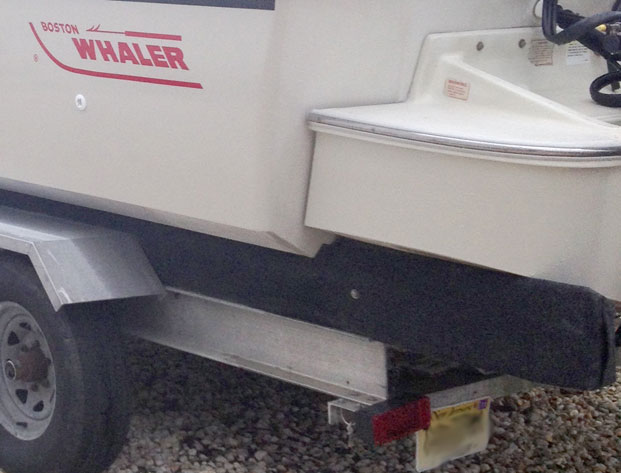
My 25 Outrage Whaler Drive on trailer. Whaler Drive sits on bunks.
|
| Russ 13 |
posted 12-18-2013 08:01 AM ET (US)
Nice photo. |
| jimh |
posted 12-18-2013 10:09 AM ET (US)
I'd like to see the trailer shown in a view from the side and low. |
| jimh |
posted 12-20-2013 09:27 AM ET (US)
To Russ 13--You are welcome to post to this thread with comments about the Whaler Drive. If you want to discuss your use of punctuation, contact me via email. |
| jimh |
posted 12-20-2013 09:46 AM ET (US)
Spitti--Thanks for sending the images of the boat on the trailer. If you have a chance, it would be nice to see a view of the bunks shown from the side and at a level of about the waterline of the boat. This would better show how the bunk height increases at the aft end of the trailer to support the Whaler Drive. How were the bunks fabricated? Did you modify a standard trailer? |
| Spitti |
posted 12-21-2013 04:45 PM ET (US)
I cannot get the shot (Jim would like to see) right now because the boat is covered for winter. The trailer is a BOATMASTER and same vintage as the boat. I am sure it is the original trailer, but can't confirm . As for the bunks, they run from under the hull right to the Whaler Drive, and they are not stepped. I belive its is the location and angle of the bunks that allow them to catch the hull and the Whaler Drive on the same plain . Hope this helps. I will send you photos soon--in Spring time. Thanks--Sal P |
| jimh |
posted 01-17-2014 11:06 AM ET (US)
I am looking forward to seeing more details of the trailer bunks. The idea that they are not stepped and still manage to support the Whaler Drive is intriguing. |
| kwik_wurk |
posted 01-17-2014 06:32 PM ET (US)
If the bunks are square, yet catch the Whaler Drive, that means they are tilted bow down, or flare out at the stern. |
| jimh |
posted 01-18-2014 09:28 AM ET (US)
A view of the trailer and the bunks when the boat is not loaded will probably best show the features. |
| Russ 13 |
posted 01-20-2014 12:20 AM ET (US)
I enjoy posting to this sight, not so much enjoyment being edit-ed. Back to the topic. For a float-on type trailer, the stepping up of the rear bunk area to hold the Whaler drive, is not a problem. (Most trailers used in FL are of this type) The bow eye & winch roller keep the boat from moving aft. And the side guide on poles, keep it centered as the trailer is brought up under the boat when retrieved. |
| |
Powered by: Ultimate Bulletin Board, Freeware Version 2000
Purchase our Licensed Version- which adds many more features!
© Infopop Corporation (formerly Madrona Park, Inc.), 1998 - 2000.