 ContinuousWave
 Whaler
 Moderated Discussion Areas
ContinuousWave: Whaler Repairs/Mods
The 2001 Space Odyssey Dilemma
Moderated Discussion Areas
ContinuousWave: Whaler Repairs/Mods
The 2001 Space Odyssey Dilemma


search | FAQ |
profile | register | author help
|
|
ContinuousWave Whaler Moderated Discussion Areas
ContinuousWave: Whaler Repairs/Mods
The 2001 Space Odyssey Dilemma
|
| Author | Topic: The 2001 Space Odyssey Dilemma |
| jimh |
 posted 08-09-2006 12:42 AM ET (US)
posted 08-09-2006 12:42 AM ET (US)  
With my 1992 Evinrude 225-HP outboard motor, I am in the same sort of a dilemma as the crew of the spaceship were in the classic science-fiction cinema 2001 A SPACE ODYSSEY. Let me explain: If you'll recall in the movie, the crew of the spaceship S. S. DISCOVERY, Dave Bowman and Frank Poole, are cruising along toward Saturn when the computer controller, HAL, interrupts:
The crew goes EVA and removes the AE-35 unit, bringing it aboard to examine it, but they cannot find anything wrong.
(In the movie, they put the original AE-35 unit back in place, and things go downhill after that, but not because the AE-35 failed...) I've been trying to track down an intermittent problem with my engine's ignition controller, the Power Pack. It has been cutting out on the #5 cylinder. Twice in the last month I have worked on this, each time thinking I found the problem. On the first pass, I thought it was a bad ground connection on the spark coil for #5. After I cleaned and re-worked the connection, and installed a new coil, too, the engine ran well for many hours of use. But eventually, the problem came back. This time I was able to cure it, again. I found what seemed like a loose low-voltage or primary coil push-on connector. I increased the tension in the connector so that it snapped into place more firmly. And once again, the engine ran well for several days. But, have I cured the problem? I have already purchased a replacement Power Pack, and I could install it without a great deal of fuss. The dilemma is along the same lines as the crew of the S.S. DISCOVERY. Should I put in the new Power Pack, or should I keep the old one in place and wait for it to fail? In favor of putting in the new one is the notion that the timing of the failure, if it comes, might be inopportune. Since I have already bought a replacement, why not install it and be done with it. In favor of sticking with the old Power Pack is the notion that I still have not really determined for certain the exact cause of the problem. While the remedies I applied seemed to cure the situation each time, it could have been just coincidental. The real cause might be the Power Pack itself, and to find out if that is true, I need to leave it in place until it fails. I would be interesting in hearing opinions on which way to proceed. This weekend we don't have any plans for boating, and I could swap out the Power Pack in an hour or so. |
| Bulldog |
posted 08-09-2006 01:18 AM ET (US)
Swap it out, you bought it already, keep the old one as a spare. You might have fixed the problem but that nagging feeling will always be there.................Jack |
| andygere |
posted 08-09-2006 01:59 AM ET (US)
Put the powerpack in and you will have eliminated one more potential source of the problem. If it occurs again, you will now know that it's not the powerpack or the coil.
JIMH: I think this motor will now be reliable until some other part fails. HAL: That's true, and it will remain in operation until the next part fails. But you know that's not what we really want, don't you Jim? JIMH: Hal, what are you trying to say? HAL: http://www.moviesounds.com/2001/alright.mp3
|
| erik selis |
posted 08-09-2006 06:44 AM ET (US)
Hehehe, good one Andy. I would replace the powerpack asap. Why wait until it occurs at an inconvenient time. Erik |
| pglein |
posted 08-09-2006 05:14 PM ET (US)
Intermittent problems are the worst, and usually most expensive to repair. First it's hard to isolate the problem. You can rarely truly isolate it with enough certainty. You're often left making the decision to replace an entire unit when it may be only one part within the unit that is bad. And it may very well turn out that it was not that unit, but rather that the intermittent problem has simply temporarily gone away. Further, they usually require extensive testing and sometimes unecessary parts are replaced before the source is truly isolated. Lastly, the fact that the problem is not constant may sometimes lull you into confidence in machine is actually not reliable, possibly leaving you stranded when it fails unexpectedly. Sorry I can't help. I've got my own intermittent problem to track down and fix right now. |
| Buckda |
posted 08-09-2006 05:25 PM ET (US)
Jim - I doubt that they (BRP) will take back an electrical component once you've opened the packaging. Mercury does not. Still, I'd replace the powerpack right now, since you have a gut feeling that is the problem - and you already have the part. As others said, you can save the original in the case that it was NOT the source of the problem, and reinstall it in an emergency if the NEW one fails. Good luck. What did Dave Zammit say?...(other than "Hey, I can give you a good deal on twin 150 E-TECs!") :) Dave |
| kingfish |
posted 08-09-2006 06:40 PM ET (US)
Jim- I had an intermittent problem with my motor (your motor's "twin") late last summer, and it just plain sounded funny to me, although it didn't sound any funnier than normal to anyone else...I finally took it in for a link & sync and the marina said everytime they got ready to run the adjustment, a *different* cylinder dropped out. Someone there had seen this before and suggested a new power pack; they changed it out and the old girl has been running just fine ever since. I vote to go ahead and change yours out too. John |
| jimh |
posted 08-09-2006 10:20 PM ET (US)
I am starting to lean in the direction of changing out the Power Pack before it fails. My assessment is along this line of thinking: Either: Assume the Power Pack was good and was not the problem to begin with: --the bad grounds were causing the problem, and then later the bad low voltage primary connection was causing the problem in #5 cylinder. In either case, the poor Pack Pack circuitry for that cylinder was operating into a sometimes-open circuit. This may have damaged or weakened the Power Pack. Also, I have been told that what typically happens in these situations is that one bad cylinder can affect the firing of others, so more cylinder's circuitry could have been affected. Therefore it is reasonable to replace it with a new one now that the bad grounds have been fixed. --or-- Assume the Power Pack was bad from the start and was causing all the problems. My remedies were just coincident with the Power Pack starting to work again: --the Power Pack was and is bad, so, naturally, it needs to be replaced. I guess in either situation a new Power Pack makes sense. I'll put the new one in as soon as I have the chance. |
| jimh |
posted 08-30-2006 10:49 PM ET (US)
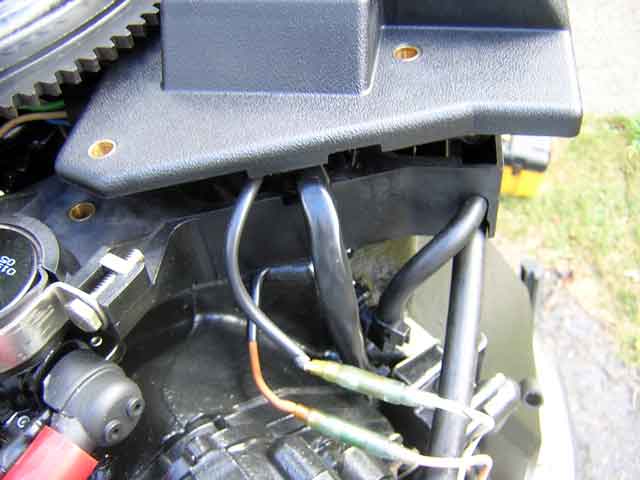
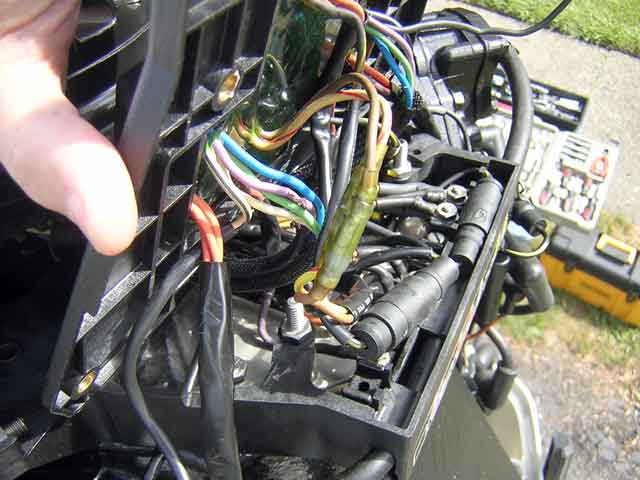
Follow-up: I finally got a chance to install the new Power Pack. You can get the old one out and slide the new one in place without having to remove the flywheel, although it takes some care to accomplish this. If the flywheel were not in position, installation would be easier. There are a lot of wires and connections involved with the Power Pack. I took some pictures and made some sketches to be sure I could get everything back together. The position and lead dress is very important. Space is tight, and everything has to fit just so or there will not be enough room. (I'll add some pictures later to show this more clearly.) After the installation, I started the engine up on a hose and muffs. Immediately I could tell there was a change. The engine seemed to run faster at idle and have a different sound. Next step was to haul the boat over to Orchard Lake--a nearby inland lake which I often use for testing--and run the the motor at full throttle speeds. There was a noticeable change there, too. The motor seemed to have more power, and it easily spun the propeller up to maximum red-line speed, 6,000-RPM. The engine was definitely running better. The final test was a long five-day weekend on the water. The engine ran beautifully and seemed stronger than ever. The new Power Pack had not only cured the intermittent spark on cylinder #5, it seemed to have given the whole engine a boost. Perhaps there were more misfires than I had noticed in the past. It seemed clear that the old Power Pack was not performing as well as this new one. |
| jimh |
posted 08-30-2006 11:07 PM ET (US)
The Power Pack is located under the flywheel at the top of the block. What appears to be the cover is actually the electronics assembly.
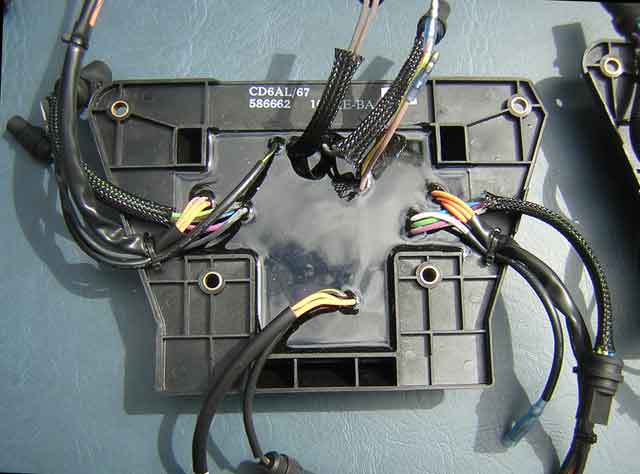
The new Power Pack has some of the leads routed properly already. A Ty-Wrap cable clamp holds them in place. The electronics are potted into a cavity in the plastic molding.
|
| PeteB88 |
posted 08-31-2006 04:23 AM ET (US)
What's the price of that power pack? |
| jimh |
posted 08-31-2006 08:20 AM ET (US)
This OEM part is about $300. |
| jimh |
posted 08-31-2006 08:32 AM ET (US)
You can look up the part number of the appropriate power pack using the Evinrude website at |
| jimh |
posted 10-15-2006 10:59 AM ET (US)
More follow-up on the power pack replacement: Since replacing the power pack, the motor has been running flawlessly. We spent another week in September on the water at Watts Bar Lake in Tennessee, and we ran the motor several hours each day. There was no sign of any ignition problem. I did notice one minor problem. When I pulled the cowling to check on the spark plugs, I happened to notice that the brown wire from the temperature sensor on the #2 cylinder had become disconnected from the brown wire on the power back. (There is a push-on connector that joins them.) I am certain that this was connected following my replacement of the power pack. However, I did change the routing of this lead slightly. Originally the brown lead from the power pack was held in place by being routed under the edge of the plastic mounting plate. I did not like that arrangement, as it looked to me like the insulated wire was being pinched against the engine block. When I installed the new power pack, I moved the brown lead so that it came freely out from under the mounting plate. Upon removing the cowling and finding the push-on connection between the brown leads had come apart, I suspected that it had loosened due to vibration. I then suspected that perhaps the original routing of the lead (pinched under the plastic mounting plate) was intentional, and this secured the wire somewhat so that it would not vibrate loose. I added a Ty-wrap to bind the brown lead into a bundle with the other leads coming from the power back on that side. This should suppress any tendency to vibrate. Also, I made sure I had very firmly joined the two leads at the push-on connector; that might have been the original problem that caused them to become disconnected. This experience does remind me that whenever you perform work on a device like an engine where there is the potential for vibration, it is a very good idea to check on the condition of your installation after a few hours of use. In this case, the open connection was not affecting normal engine operation. It is an over-temperature alarm indicator. Thus I did not notice any problem due to this failure. However, I would not have been notified of an over-temperature condition on that cylinder bank, and that could have lead to an expensive problem. If you install anything on a motor, check it after several hours of operation to be sure it is still properly fastened and all connections are tight. |
| jimh |
posted 10-15-2006 11:06 AM ET (US)
By the way, as best as I can recollect, the original power pack never did exhibit any further failure after I finally corrected the problem with the low-voltage connector at cylinder #5, so I cannot say conclusively that there was a problem in that power pack. However, I did not run the motor for any great amount of time, just a few days, so its performance was not established as rock-solid. I did describe all of my experience and repairs to a very knowledgeable OMC Master Mechanic (Ben at Lockeman's Boat and Hardware in Detroit) who has worked on these motors for decades. His conclusion was that the previous restoration of the spark to cylinder #5 was more or less coincidental with all of the repairs I made, and based on his experience, he felt the power pack was probably intermittent. He had seen such intermittent problem before with these units. In any case, the investment was modest (about $300) and the problem is gone. And as an additional benefit, the motor seems to be running better. See: Reading Spark Plug Color |
| andygere |
posted 10-15-2006 01:47 PM ET (US)
jimh, Great info on sourcing and solving the problem. Intermittent problems with outboard motor electronics can be difficult and frustrating to troubleshoot. I lived (and sometimes rowed) with a similar problem for a full summer with the Mercury 40 on my old Sport 13 until a very good mechanic finally resolved it. Unfortunately for you, this means you may wind up waiting another season or two before hanging a new E-TEC or E-TECs on that nice Revenge of yours. |
| |
Powered by: Ultimate Bulletin Board, Freeware Version 2000
Purchase our Licensed Version- which adds many more features!
© Infopop Corporation (formerly Madrona Park, Inc.), 1998 - 2000.