 ContinuousWave
 Whaler
 Moderated Discussion Areas
ContinuousWave: Whaler Repairs/Mods
Effect of Ethanol on Aluminum Fuel Tank
Moderated Discussion Areas
ContinuousWave: Whaler Repairs/Mods
Effect of Ethanol on Aluminum Fuel Tank


search | FAQ |
profile | register | author help
|
|
ContinuousWave Whaler Moderated Discussion Areas
ContinuousWave: Whaler Repairs/Mods
Effect of Ethanol on Aluminum Fuel Tank
|
| Author | Topic: Effect of Ethanol on Aluminum Fuel Tank |
| Jeff |
 posted 12-16-2009 10:59 PM ET (US)
posted 12-16-2009 10:59 PM ET (US)  
[Originally from a different discussion on a different topic--jimh] How can ethanol affect an aluminum fuel tank to the point of needing to be replaced? |
| jimh |
posted 12-17-2009 06:59 AM ET (US)
I do not believe that gasoline blends containing ethanol directly affect aluminum fuel tanks. If they did, there would be a substantial crisis in boating. I believe there is a very high population of boats with aluminum fuel tanks which contain ethanol-blended gasoline. |
| Russ57 |
posted 12-17-2009 01:29 PM ET (US)
As long as [unclear] is no more than 10% you are fine. [Changed TOPIC to fiberglass tanks. Please start a new discussion to include the effect of ethanol fuels on fiberglass fuel tanks. Thank you.--jimh] |
| Blackduck |
posted 12-17-2009 02:20 PM ET (US)
It is not the ethanol itself that is the problem, it is the substance that is created when water and old ethanol mix. This stuff is very corrosive, and will eat thru aluminum. So, if there is no water in your tank, no problem. If you have some water, and the fuel is fresh, no more of a problem than regular gas with a little water, but get old, breaking down E-10 and you have problems. That is why treating stored fuel is more important than ever. |
| Jeff |
posted 12-17-2009 07:54 PM ET (US)
[Complained that his comments originated in another discussion and have been separated from that discussion. Moderator's note: The effect of ethanol on aluminum fuel tanks cannot possibly be limited to only one model of Boston Whaler boat, to one owner, and to one instance of tank replacement. If there is to be discussion of this topic, it seems completely reasonable to me that it be discussed separately from a topic which seeks information about the model number of a particular manufactured product which will fit into the fuel tank cavity of a particular model of Boston Whaler boat. I don't find it reasonable to simultaneously discuss chemistry and catalogue numbers.] |
| jimh |
posted 12-18-2009 03:45 AM ET (US)
quote: What substance is created when water and old ethanol mix? |
| knothead |
posted 12-18-2009 08:46 AM ET (US)
[Gave a long and interesting narrative on sailing in large boats where stainless steel fasteners experienced failure. I believe this reply was intended for another discussion--jimh] |
| Blackduck |
posted 12-18-2009 09:39 AM ET (US)
I don't know the substance, or its formula. I guess it could be discovered by doing some research on the subject. I have read enough on the subject to be convinced that this is fact, and not speculation. |
| jimh |
posted 12-18-2009 10:06 AM ET (US)
I have also read in many places that the "stuff" is very corrosive. At the same time, I have read that the "stuff" is a mixture of alcohol and water. A mixture of alcohol and water is often used on human skin, and you can buy bottles of it at most any pharmacy as a non-prescription solution labeled "Rubbing Alcohol." How can a solution which is safe enough to be used on human skin be "highly corrosive" to the point of eating through aluminum, often aluminum plate that is otherwise quite durable and resistant to corrosion? |
| Buckda |
posted 12-18-2009 10:48 AM ET (US)
quote: Source: State of Texas (State Energy Conservation Office) cf: http://www.seco.cpa.state.tx.us/re_ethanol.htm Also from this source: quote: For those that don't trust Texas or the possible influence that the oil interests may have had on that State's Energy Conservation Office, here it is from a much more biased (pro-ethanol) source:
quote: and
quote: cf: http://www.biofuelshub.com/features/18-special/1074-is-e10-corrosive To the point made in the above article, ethanol in itself is not particularly corrosive, or rather, it is not MORE corrosive than gasoline. It is the presence of water, which IS corrosive (and Jimh, you drink that every day), and is also a pretty powerful oxidizer. Remember grade school? What is the most powerful force on the planet? Water. Unstoppable, given time. |
| Blackduck |
posted 12-18-2009 11:00 AM ET (US)
I could be wrong, I am a lot, but it is my understanding that the substance, "stuff", also called a "goo" by one expert, is a totally new, and different substance. It is also my understanding that the E-10 must undergo some sort of change to cause the separation, before it can combine with water, to form the new "goo". I don't bother with a lot of details in my way of doing things. I am a "doer". I just thought I could help with the aluminum tank question. May I also take the time to wish you a very merry Christmas and thank you for another year of access to your great site. Walter |
| Buckda |
posted 12-18-2009 12:42 PM ET (US)
Walter - What you may be referring to is a byproduct of the solvent properties of ethanol-enhanced fuel. It is more likely than regular gasoline to "scrub" impurities from your tank. So existing tanks that may have built up sediment or impurities on the sides of the tank may now have those sediments (perhaps liquefied) contained IN THE FUEL, which is delivered to the engine, causing problems. Ethanol-laden fuels have also been blamed for damaging older non-alcohol resistant fuel lines and fuel-system components (fuel pump diaphrams, rubber and plastic components, etc). All of these contribute to the general header of ethanol fuel-related problems. To the point that the state of Texas made above regarding pipeline corrosion - I think you do see that impurities that are available in the surrounding environment - be they WATER, RUST, SLUDGE (built up over years), SEDIMENT, DISSOLVED RESINS, whatever - it seems that fuels with a high ethanol content more readily absorb these impurities into the fuel solution, and deliver them, sometimes catastrophically, to the engine. Because SO MUCH collateral damage is being done to boats by this fuel, there may be certain things that are blamed on Ethanol that really aren't true ethanol-related problems. I think Ethanol SPEEDS the demise/corrosion of hardware/fuel system components, but most of the aluminum tanks that have "ethanol" corrosion problems probably already had corrosion problems in the first place exposing weaknesses for the more aggressive solvents in the ethanol to work on. Further, I think it bears consideration to evaluate the benefits of stainless as a possible material for replacement under-deck tanks. |
| jimh |
posted 12-18-2009 05:21 PM ET (US)
When I read those comments about ethanol being corrosive, I interpret them to mean 100-percent ethanol. In gasoline blends used for marine applications, ethanol is typically less than ten percent of the fuel blend.
If we throw in 2-gallons of water, we will saturate the blended fuel, and we should have something like 1.5-gallons of water that cannot go into solution. It is at this point where the chemistry becomes unclear for me. What happens to the 1.5-gallons of water not in solution? The common wisdom says that some ethanol leaves the gasoline and joins the water. When ethanol leaves the gasoline solution and goes into solution with water, what is the ratio of water to gasoline? What would be the concentration of ethanol in the water in our example above? In rubbing alcohol we often see solutions where the mixture is 30:70 water-alcohol. This is still a safe solution to use on human skin. I realize that in rubbing alcohol the alcohol is isopropyl alcohol, not ethanol. Perhaps this is a crucial difference. In ethanol testers, the usual technique is to mix the blended fuel with water so that water is about 10-percent. This seems to force all the ethanol out of the gasoline. The basis of the tester is that all the ethanol comes out, and that is how it measures the ethanol. In cases where there is just a small amount of water over the saturation limit, how much ethanol comes out of the gasoline? I cannot imagine that a 0.75-percent volume of water could draw 10-percent of the total fuel volume (the ethanol) out of solution. An additional point that is frequently cited is the presence of ethanol in the water makes the water more corrosive than it otherwise would be. Is there any way to quantify this with some description other than "more corrosive"? |
| Peter |
posted 12-18-2009 05:57 PM ET (US)
Perhaps someone should pull $28 out of their wallet, get a copy of this paper www.scientific.net/MSF.546-549.1093/preview and provide a report. |
| L H G |
posted 12-18-2009 06:37 PM ET (US)
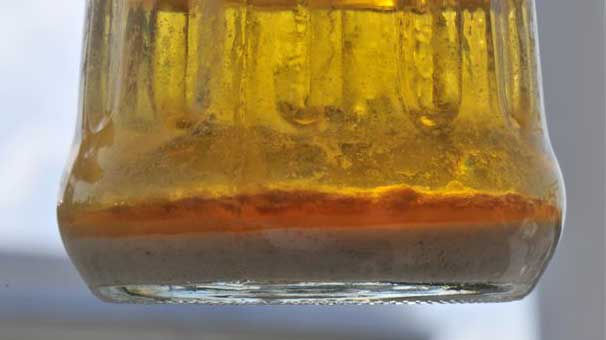
I interpret JimH's remarks to mean that E-15 won't be a problem for aluminum fuel tanks either. Incidentally, does this dark stuff at the bottom of the bottle really look like "rubbing alcohol"? http://www.mercurymarine.com/serviceandwarranty/outboardfaqs/ethanol. php#15 The whole article by Mercury is pretty good. |
| Peter |
posted 12-18-2009 06:49 PM ET (US)
No, the dark stuff at the bottom of the jar looks like Mercury touch up paint. Is that how they get Mercury touch up paint? |
| L H G |
posted 12-18-2009 08:10 PM ET (US)
Actually, Peter, it looks more like the unburned fuel and gunk that spews out of the prop exhaust of an E-tec. |
| jimh |
posted 12-19-2009 09:29 AM ET (US)
I am not clear where Larry found a mention of ethanol-gasoline blends of 15:85 in my comments. I did not intend to imply that and am at a loss to explains Larry's inference. My observation about the corrosive nature of ethanol-gasoline blends at 1:9 is based on the experience of midwestern boaters who have been using that fuel for a decade or more. Were it deadly to aluminum tanks its effect would have become apparent by now. |
| jimh |
posted 12-19-2009 09:59 AM ET (US)
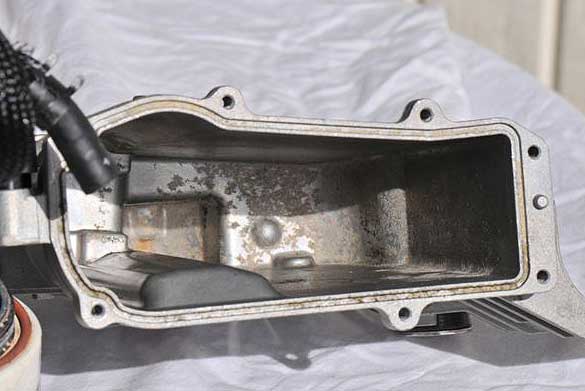
The effect of ethanol gasoline blends on aluminum fuel tanks is being seen by marine service technicians in the field. It appears that corrosion of aluminum fuel tanks is occurring and the aluminum of the tank is being carried away in the fuel, where it manifests as seen in two images below.
It is believed that these effects were caused by ethanol-gasoline fuel in which a phase separation had occurred. The E10 fuel itself is not believed to be harmful, but if phase separation occurs, a more concentrated solution of ethanol and water lies on the bottom of the tank, where it can strip the protective oxide layer off the aluminum and cause pitting and corrosion. Further, it is believed in saltwater area the concentrated ethanol can combine with chlorides to make an even more aggressive mixture. The influence of saltwater is an interesting consideration. Boaters in the midwest have been using ethanol fuels for a decade or more, and in general have found problems with aluminum fuel tanks to be minimal. The recent spread of ethanol blended fuels to saltwater boating areas, however, has produced more problems. The effect of saltwater on the ethanol may explain why coastal boaters are having more problems than inland freshwater boaters. |
| |
Powered by: Ultimate Bulletin Board, Freeware Version 2000
Purchase our Licensed Version- which adds many more features!
© Infopop Corporation (formerly Madrona Park, Inc.), 1998 - 2000.