 ContinuousWave
 Whaler
 Moderated Discussion Areas
ContinuousWave: Whaler Performance
2002 DAUNTLESS 180 Performance Data and Engine Height and Propeller Inquiry
Moderated Discussion Areas
ContinuousWave: Whaler Performance
2002 DAUNTLESS 180 Performance Data and Engine Height and Propeller Inquiry


search | FAQ |
profile | register | author help
|
|
ContinuousWave Whaler Moderated Discussion Areas
ContinuousWave: Whaler Performance
2002 DAUNTLESS 180 Performance Data and Engine Height and Propeller Inquiry
|
| Author | Topic: 2002 DAUNTLESS 180 Performance Data and Engine Height and Propeller Inquiry |
| K Albus |
 posted 09-29-2008 10:06 PM ET (US)
posted 09-29-2008 10:06 PM ET (US)  
I did a few speed trials the other day with my 2002 Dauntless 180. I have a 2002 Mercury Optimax 135, with a Mirage Plus 17p propeller. According to my owner's manual, the recommended "Full Throttle RPM Speed" is 5000-5500 rpm. During the trials the air temperature was approximately 71 degrees, and the water temperature was approximately 65 degrees. The trials were run in fresh water. Winds were light, and there was minimal current. There were, however, occasional wakes from other small boats. Load included about 20 gallons of gasoline, and equipment and passengers weighing approximately 600 lbs. I normally carry about the same amount of equipment and passengers, but usually carry about twice as much gasoline. I did several runs in opposite directions. The following are my averages, with the exception of the last two lines, which were my top speed in each direction. 2000 rpm 7.5 mph All speeds are speed-over-ground, measured by GPS. My results are slightly lower than the performance numbers published by Boston Whaler for my boat and engine combination. Boston Whaler reports 43.6 mph at 5500 rpm with same boat, motor, and propeller. At 4500 rpm, Boston Whaler reports a speed of 36.0 mph, and at 3500 rpm a speed of 27.8 mph. In the past, in calmer wind and water conditions, I have reached approximately 5,400 rpm and 41 mph. That was with about 250 lbs. less passenger weight, but more gasoline weight. I also believe the air temperature was quite a bit lower. And it took quite a while to get to those numbers. I believe the difference between my numbers and Boston Whaler's numbers is in large part attributable to the Stingray hydrofoil I have attached to my motor, together with the height at which my motor is currently mounted. When my boat is on plane and properly trimmed, the hydrofoil (and the anti-ventilation plate) are clearly underwater. See: When viewed out of the water, the anti-ventilation plate is approximately 1/2 inch lower than the keel of the boat. In the following picture I have clamped a dowel rod to the bottom of the anti-ventilation plate to demonstrate the position of the anti-ventilation plate relative to the keel. I am currently considering raising my motor, and purchasing a four-bladed, stainless steel propeller. I am primarily interested in getting on plane quicker and in the "extra bite" reportedly provided by a four-bladed propeller. Although top speed is not among my primary concerns, I am hoping that by raising the motor and switching to a four-bladed propeller, I can at least maintain my current top speed, albeit at higher full throttle rpm. Please provide relevant advice and suggestions. Also, who wants to come to my house and show me how to raise the motor? ;) |
| jimh |
posted 09-29-2008 11:54 PM ET (US)
I agree with your assessment that the current engine mounting height is on the low side, and I suspect that you would benefit from raising the engine, at least one-hole if not two-holes. This will reduce the drag, which will add speed. Also the propeller will run in less water, and this may allow the engine to turn it to a higher speed. If you have the boat on a trailer, and if you have a stout tree limb, and if you have some nylon web strap, you ought to be able to raise the engine yourself or with only one assistant. The technique: --Position the engine under the tree limb with the boat on trailer; --adjust trailer tongue lift so tongue is very low, thus engine is high; --fashion a harness around the engine and secure it to the tree limb; --loosen engine bolts and let engine weight be taken on straps; --remove bolts --raise trailer tongue with jack, thus lowering the transom; --re-install bolts in appropriate holes and tighten. |
| jimh |
posted 09-30-2008 12:06 AM ET (US)
I ran your numbers on my PROPELLER CALCULATOR http://continuouswave.com/cgi-bin/propcalc.pl in order to deduce the SLIP: RPM=5200 That value of SLIP is quite low for a single-engine installation, and I believe it represents the under-stated PITCH of the MIRAGEplus propeller. When the MIRAGEplus propeller is run fully submerged its pitch tends to act like a larger pitch than the rated pitch. If you raise the propeller so it runs closer to the surface, it will lose some of its pitch effectively. This will bring up the engine speed. |
| Tom W Clark |
posted 09-30-2008 12:23 PM ET (US)
The motor is too low. The factory mounting height recommendation is one hole up (two holes up if hydraulic steering is used) and with the MIRAGEplus propeller you could easily move it two holes up. This will improve all aspects of the boat's performance by reducing drag which will in turn improve fuel economy, acceleration and top speed. The steering effort will be reduced and the bow rise during acceleration will be lessened. Any tendency towards porpoising will be reduced as well. 6.8 percent slip is perfectly typical of the MIRAGEplus. I would not experiment with any propeller changes until after you have corrected the motor mounting height. |
| K Albus |
posted 09-30-2008 12:34 PM ET (US)
Thanks for the feedback, guys. I will start by moving the motor up one hole. Does anybody know if the Optimax has a lifting eye, or I will need to buy one? Or will the skeg support the weight of the motor if the motor is laterally supported? |
| Tom W Clark |
posted 09-30-2008 12:41 PM ET (US)
You would need the Mercury accessory lifting eye that screws on to the flywheel. You could probably rig a system of straps to hold the motor upright as the last bolt are removed before lowering the transom. Be careful. |
| Casco Bay Outrage |
posted 09-30-2008 02:43 PM ET (US)
k - I raised my 402 lb motor using the trailer tongue jack technique. Just need a second person to keep the motor from moving. Not hard to do. |
| mikemdd |
posted 10-01-2008 02:07 PM ET (US)
Tom, Just wondering why the determination of engine height is different with hydraulic steering. Thanks |
| Tohsgib |
posted 10-01-2008 02:41 PM ET (US)
You do not need to remove the 2 lower bolts, just losen them I believe(not sure about Merc). lower tongue, place 2x4 under skeg, remove nuts on upper bolts, loosen lowers, have friend jack it up slowly until upper bolts are easily removed, keep raising 2 holes, install 1 upper bolt. Then silicone or 3m the other upper bolt and install it, then repeat for the other side. Tighten her down and let it rip. |
| Tom W Clark |
posted 10-01-2008 02:51 PM ET (US)
Mike -- I do not know for sure but I always assumed the one-hole-up recommendation for mechanical steering has to do with aligning the tilt tube to the access in the hull where the steering cable exits; if the motor is too high the cable has a hard time making it to the motor. With hydraulic steering, there is no such limitation and thus the motor can go up where it really ought to be.
|
| Tohsgib |
posted 10-01-2008 02:59 PM ET (US)
That was a dumb idea and hence why I said I was not sure. Every other engine I have owned had slots...not familiar with Mercury. Tie it to the lifting eyes then. |
| K Albus |
posted 10-01-2008 03:17 PM ET (US)
I have ordered a lifting ring, and plan to use two ratchet straps to different rafters in my garage to support the motor. (I don't have any big trees nearby that I can use.) When I remove and replace the bolts, should I use Loctite on the threads? Also, with regard to silicone in the bolt holes, will just a blob of 3M 4200 in each side of each hole be sufficient? Or should I be using some other type of silicone? |
| Tohsgib |
posted 10-01-2008 03:34 PM ET (US)
4200 is fine and just make ure it is blobed on each end so water stays out. No need for locktite. Nuts should hve nylon ends or lock washers if no nylon. I also prefer to have the nuts on the engine side, less chance of cutting your hand while cleaning out the bilge and looks nicer. |
| mikemdd |
posted 10-01-2008 10:23 PM ET (US)
Tom, That makes sense on the hydraulic vs. mechanical steering. This is something that is not discussed a whole lot, but actually can be a serious consideration in options. |
| Lars Simonsen |
posted 10-02-2008 08:34 PM ET (US)
I have a 1998 18' Dauntless with a 135 Optimax. I raised it to the middle hole, and I think I've got it about right. I have a 19" pitch Stilletto prop. It jumps up onto plane, and my top speed is higher than yours. At full throttle, fully trimmed out, with a "normal" load (two people and fishing equipment) I can get it to redline (5500 rpm). One thing I noticed when I raised the motor is that the stern seems to "sink" more when you're coming off plane. I've grown accustomed to trimming my motor down, and putting the trim taps down, as I come off plane. |
| Lars Simonsen |
posted 10-02-2008 08:37 PM ET (US)
I also used the trailer jack technique. I didn't have a second person to help me, so I did rig a "lift" from the ceiling of my garage (it's a two story garage so the ceiling is very sturdy) not to actually lift the motor, but to keep it upright while I removed the bolts and jacked up the front of the trailer. There's no need for the lifting ring. |
| K Albus |
posted 10-13-2008 06:05 PM ET (US)
I moved my motor up two holes, and did another series of test runs. Before starting, I added three gallons of gas to compensate for the gas burned in the previous testing. The air temperature on the second day of testing was 76 degrees. The water temperature was 59 degrees. The winds were light, and there was little or no current. My passenger and cargo weights were the same as in the earlier tests. Once again, I did several runs in opposite directions. The following are my averages, with the exception of the last two lines, which were my top speed in each direction. 3500 rpm 26.7 mph As you can see, I made some decent gains in "Full Throttle RPM Speed" and in Miles Per Hour. I forgot to check my fuel consumption rates during the second set of trials. Although I did not measure time to plane in either set of trials, the boat seemed to jump on plane noticeably quicker after the engine was raised. My brother, who was the passenger during both trials, commented on this during the very first run in the second set of trials. In addition to the speed trials, I did a number of sharp turns at various speeds, and I experienced no detectable ventilation or washing out of the propeller. I took some additional pictures of the motor while on plane during this second set of trials. The wake now looks much cleaner. This was something that my brother also noticed early on in the trials. Starboard: http://i512.photobucket.com/albums/t329/kalbus/ Motor%20Height%20and%20Prop%20Selection/UpTwoHolesStarboardSide.jpg Based on the pictures, it looks like I could probably move the motor up even further. However, I think I'll take my small victory for now, and enjoy my new found performance as it is for a couple of seasons. The performance is also improved enough that I am no longer considering a new propeller. |
| K Albus |
posted 10-13-2008 11:44 PM ET (US)
Upon closer inspection of the last two photographs, taken after raising the motor, I believe the Stingray hydrofoil can be made out in the spray just behind the leg of the motor. |
| cooper1958nc |
posted 10-14-2008 11:44 AM ET (US)
I must be missing something here. On the lower holes, the boat went "25.7" mph at 3500. Top speed was 39 on lower, 40.5, or maybe 40.0 on upper. Is this really a measurable difference? The author says he is so happy with the performance a propeller swap is not necessary. I agree with that, but I cannot understand the improvement. The acceleration might have been better, perhaps, although no figures are given. |
| cooper1958nc |
posted 10-14-2008 11:45 AM ET (US)
(correction) I see it's 26.7 at 3500 not 26.0 sorry. Still hard to measure. |
| K Albus |
posted 10-14-2008 12:56 PM ET (US)
Cooper, it really wasn't hard to measure at all. I used my GPS. As stated in the posts above, the reported numbers were averages based on several trials. Although I didn't measure time to plane before or after moving the motor up, I have been using the boat for seven years now. Based on my many hours of experience with this boat, the boat was noticeably quicker to plane than it was before moving the motor up. After moving the motor up, the boat feels like it is performing better. The numbers back up the "feeling". Why is this hard to understand? As an aside to Cooper - I experienced about a 5% increase in performance. Although you posited in a different thread that a 5% increase in performance was essentially meaningless, I wholeheartedly disagree. As stated above, I am very happy with the performance gain I achieved. The improvement was noticeable before any speed trials were conducted. My brother, who was on the boat for both sets of trials, also noticed the difference right away, without having seen any of the numbers. If I could get another 5% increase in performance by simply changing propellers, I would certainly consider it. |
| jimh |
posted 10-16-2008 09:13 AM ET (US)
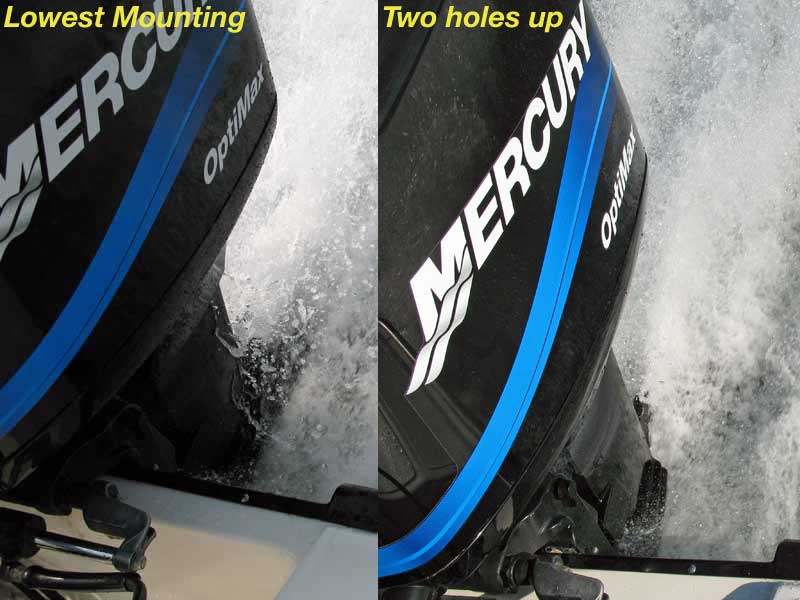
Here are the photographs of the engine gear case side-by-side:
It looks like the engine could come up another hole. |
| K Albus |
posted 10-16-2008 10:32 AM ET (US)
Actually, in the photos immediately above, in the photo on the left, the engine is mounted all the way down, and in the photo on the right, the engine is mounted two holes up. As I mentioned above, the Stingray hydrofoil can clearly be seen in the photo on the right. |
| Tom W Clark |
posted 10-17-2008 10:58 AM ET (US)
It is amazing what a simple adjustment of motor mounting height can do for a boat's performance. While the MIRAGEplus is a good propeller for that boat/motor combination, it may still be possible to see an improvement with another propeller. The only way to find out is to experiment. |
| jimh |
posted 10-19-2008 09:51 AM ET (US)
Let me suggest a technique for adjusting the engine trim that I recently discovered and tried myself: To experiment with engine trim, have someone else operate the boat from the helm station. Get the boat on plane and at the desired cruising speed. Go to the stern of the boat, and position yourself so you can observe the engine gear case and anti-ventilation plate. Using the engine trim switches on the engine cowling, trim the engine up or down while observing the gear case and anti-ventilation plate. When the engine trim has been adjusted to the desired setting, return to the helm and note the reading on the TRIM gauge. By using this procedure I found that I needed to trim out my motor further at my usual on-plane cruising speed if I wished to bring the anti-ventilation plate to align with the surface of the water. In any case, it was quite interesting to experiment with trim while being able to see the anti-ventilation plate's position. Of course, be certain to coordinate with the helmsman so there is no sudden change in speed which could throw you off the boat from your position at the stern. |
| K Albus |
posted 10-16-2011 06:45 PM ET (US)
Now for the final chapter on this project. In the spring of 2010 I raised my motor one more hole, for a total of three holes up. I didn't get a chance to take down detailed speed and fuel readings during 2010 or for most of 2011. I finally got out earlier today to get the latest set of readings. Here they are: 3500 rpm - - 26.8 mph - - 4.5 gph - - 5.95 mpg It took about everything she had to get to the new top speed, which is right at the rev limiter. With the motor set at three holes up, I get a little bit of prop ventilation when making tight turns with the engine trimmed out to a "normal" position. I also experienced some prop ventilation in 2-3 choppy Great Lakes seas on the 2010 Isle Royale trip if I had the engine trimmed anywhere but all the way in. Here's a picture of the wake with the motor mounted three holes up. http://i512.photobucket.com/albums/t329/kalbus/ Motor%20Height%20and%20Prop%20Selection/ThreeHolesUp.jpg . Although it doesn't show particularly well in the photo, the Stingray hydrofoil can now clearly be seen when the boat is running. I would not say, however, that the hydrofoil runs completely clear of the water. |
| K Albus |
posted 10-16-2011 06:48 PM ET (US)
I guess I shouldn't have said that the "rev limiter" kicks in at 5,600 rpm. I should have said that the over-rev alarm sounds at 5,600 rpm. |
| K Albus |
posted 10-16-2011 07:00 PM ET (US)
Here's another picture of the wake, which again doesn't really show very well just how visible the hydrofoil is: http://i512.photobucket.com/albums/t329/kalbus/ Motor%20Height%20and%20Prop%20Selection/ThreeHolesUp2.jpg |
| Peter |
posted 10-17-2011 07:24 AM ET (US)
I would take the hydrofoil off. There should be no need for it. |
| Nauti Tauk |
posted 10-17-2011 07:58 PM ET (US)
I agree....get rid of the silly foil. I've always thought of those gizmos (Jims word) as cheap substitutes for the real deal, trim tabs. With the engine up off the transom you have no need at all for that thing hanging on the engine. Actually it will reduce the drag a little bit further which is a good thing. (Marthas words) |
| Tom W Clark |
posted 10-18-2011 11:02 AM ET (US)
Wow, that is pretty amazing. Raising the motor one more bolt hole allowed your top sped to increase from 40.0 MPH to 42.3 MPH. I'd raise it that last bolt hole and see what happens. |
| K Albus |
posted 10-18-2011 11:59 AM ET (US)
I'm pretty much done with goofing around with the Dauntless. As I'm sure you know, I bought a Pursuit 235 Offshore. I will be selling the Dauntless in the spring, and it will be up to the new owner to make any changes. If I were to keep the Dauntless, I believe I would leave the hydrofoil on, and I would not raise the engine any further. Although its been a while, I seem to recall that installing the hydrofoil made a noticeable difference in the bowrise/time to plane. I also would not want to mess with filling the holes on the A/V plate after the hydrofoil was removed. With regard to raising the motor another hole, I would like to see the hydrofoil completely clear of the water. However, I would not want to see the ventilation issue get any worse. In a perfect world, with unlimited funds, I would probably remove the hydrofoil, raise the engine another hole, get a four-bladed prop, and add trim tabs. But it's not a perfect world, and that's not going to happen. |
| Tom W Clark |
posted 10-19-2011 10:30 AM ET (US)
I agree the MIRAGEplus will not like going up another hole; it does not tolerate surfacing conditions very well and even if it did, you are already exceeding the redline. I suggest you recommend to whoever buys this boat that the motor be raised that last bolt hole and a 14-1/2" x 19" Mercury Enertia be installed. The Enertia has less effective pitch but it grips extremely well so the 19" pitch may provide both more speed and bring the WOT engine speed back down to 5500 RPM. |
| K Albus |
posted 10-19-2011 10:32 AM ET (US)
Thanks for the feedback, Tom. I will point the new owner to this thread when the time comes. |
| Tom W Clark |
posted 10-21-2011 10:27 PM ET (US)
Let us know how your Pursuit does; I am sure I can find more speed and fuel mileage with a better propeller than it has now. |
| |
Powered by: Ultimate Bulletin Board, Freeware Version 2000
Purchase our Licensed Version- which adds many more features!
© Infopop Corporation (formerly Madrona Park, Inc.), 1998 - 2000.