 ContinuousWave
 Whaler
 Moderated Discussion Areas
ContinuousWave: Whaler Performance
OUTRAGE 22 Deadrise
Moderated Discussion Areas
ContinuousWave: Whaler Performance
OUTRAGE 22 Deadrise


search | FAQ |
profile | register | author help
|
|
ContinuousWave Whaler Moderated Discussion Areas
ContinuousWave: Whaler Performance
OUTRAGE 22 Deadrise
|
| Author | Topic: OUTRAGE 22 Deadrise |
| merensen |
 posted 01-08-2009 05:49 PM ET (US)
posted 01-08-2009 05:49 PM ET (US)  
[What is] for certain the deadrise on a 1979 Outrage 22? Thanks--Mike |
| Buckda |
posted 01-09-2009 02:07 PM ET (US)
I don't think you're going to get a "for certain" answer, but the real question is why do you need a "for certain" answer? Not knowing the deadrise on my Outrage 18 has never bothered me for a minute! I will say that the 22-foot hull is probably one of the best riding hulls that Whaler produced from the 70's-80's era. My father's 1985 Guardian 22 (Outrage) eats Lake Michigan chop for breakfast. Dave |
| jimh |
posted 01-10-2009 11:05 AM ET (US)
If you take a high-resolution digital image of the hull of your boat as seen from the dead astern and clearly showing the hull's v-angle, I will be glad to measure the deadrise angle using photogrammetric techniques. |
| Tom W Clark |
posted 01-10-2009 01:59 PM ET (US)
18 degrees. |
| bwguardian |
posted 01-10-2009 02:56 PM ET (US)
I second 18 degrees! |
| L H G |
posted 01-11-2009 03:43 AM ET (US)
I have always thought the 18 Outrage and the 22 Outrage were 16 degrees, since on both of these hlls BW specified that twin engine spacing was to be 29-3/4". That would indicate the same deadrise. I think the 25 and 27 hulls are 18 degrees, where I believe BW specified a 28" dual engine spacing, indicating a deeper Vee. Perhaps this photo can be used by Jim for his measurement. http://smg.photobucket.com/albums/v429/lgoltz/Outrage%2025/?action=view& current=DSCN1462.jpg . |
| jimh |
posted 01-11-2009 09:16 AM ET (US)
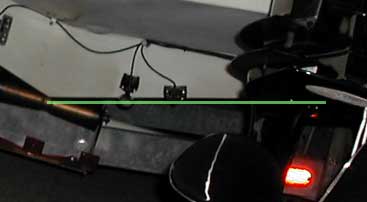
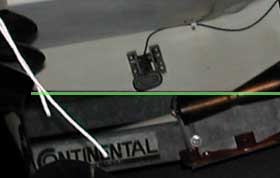
Larry--Your digital image of the transom of your Boston Whaler OUTRAGE 25 is perfect for photogrammetric analysis of its deadrise angle, and thanks for pointing to it in this discussion. Here are the results of my analysis, along with a description of the method: First, I rotate the image in PhotoShop until the hull is precisely horizontal. To determine the horizontal, I add a reference line. I then rotate the image to match to the reference line. I do this for each side of the hull, as the image may not be taken precisely on centerline and orthogonal to the hull. Here is the rotation in the clockwise direction:
Then I restore the image and rotate in the counterclockwise direction until it is again horizontal.
In this image the rotations were 15° clockwise and 18° counter clockwise. We total them and divide by two to get the average: 33/2 or 16.5° I'd say the deadrise of the hull shown in the image is 16.5-degrees. |
| jimh |
posted 01-11-2009 09:26 AM ET (US)
Previously I measured the deadrise of the OUTRAGE V-20 hull using this same technique and found its deadrise to be 10.5°. I also measured my REVENGE 20 hull using mechanical methods and found its deadrise to be 14°. This hull is the same as the OUTRAGE 22. Now we see the OUTRAGE 25 is 16.5°. These numbers seem consistent with the generally reported trend of increasing deadrise angle in the classic hulls. I summarize my findings: Older V-20 = 10.5° deadrise Cf.: |
| L H G |
posted 01-11-2009 01:17 PM ET (US)
That's very interesting work Jim, and it agrees with the dimensions I had thought were correct. Several years ago, I had the good fortune to meet Bob Dougherty personally, at the IMTEC Trade Show in Chicago, where he was marketing his then new "Marlin" (later "Edgewater") boats. I told him I owned two of his hulls, the 18 and the 25, and we talked at length about this Outrage generation. He told how the 1978 V-20 evolved, and I SPECIFICALLY REMEMBER that he said it had a 12 degree deadrise. They only went to 12 degrees because they were coming off the highly stable "banana" hulls and were trying to keep the famous lateral stability those boats offered in their first "V" model. Because of the unexpected harder ride, he told me the 1985 model year was changed to be a cut off version of the 22, with 16 degree deadrise. As an 18 owner, he told me the 18 was 16 degrees, and the 25 was 18 degrees. I can tell by looking at my two boats, that the 25 is definitely a deeper Vee. Your calculations seem to indicate all of this relative to each other, but somehow each are off by about 1.5 degrees. I can't explain that, but there may be some other factor hull designers use in determining these deadrise numbers. |
| Tom W Clark |
posted 01-11-2009 02:04 PM ET (US)
Jim has done a good job of estimating the hull angle at the transom using photography, but photography can very easily introduce distortions as it makes a two dimensional model of a three dimension reality. There is no substitute for a direct measurement. This is most easily accomplished with a simple bevel gauge. Curiosity has gotten the better of me and I just went out and measured my own Revenge 25. While this does not answer the question posed in this thread, I think it will be illuminating. I measured the angle of the hull at three spots along the keel, at the transom, amidships at a point about in line with the forward ends of he gunwales boards and further forward near the through hull drain form the sump in the cuddy. I had always assumed the classic Whaler had had a constant deadrise, that is, the angle of the hull does not change as you move along the keel within the area of the hull it rides on while on plane. This is a false assumption. I measured the angles with my bevel gauge, a basic tool in any shipwright's or carpenter's tool box for taking angles. I transfered the angle to a flat surface with a straight edge and carefully measured the angle with a protractor. This angle is then divided by two to reach what we commonly call "deadrise," though the historical definition is somewhat different. The results: At the transom -- 17.25 degrees Amidships -- 22 degrees Forward near the drain tube -- 26 degrees |
| jimh |
posted 01-11-2009 02:10 PM ET (US)
ASIDE--I am going to test my photogrammetric analysis technique by taking a digital image of a large drafting triangle--that is, if I can still find one hanging around at work. My old drafting table was moved out of the engineering department after I stopped using it about eight years ago. All the drawings are done on a CAD system now. I used to keep the drafting table tilted at an acute angle so people would not leave junk sitting on it. Finally the other guys wanted the space for some cabinets, and the table and VEMCO drafting machine went into the furnace closet. If my technique measures the angle on a 30-60-90 triangle accurately, then I will feel more comfortable about the measurements of boat hulls I have reported with it. |
| newt |
posted 01-12-2009 08:28 AM ET (US)
My former 1980 V20 hull had a deadrise of 11.5 degrees at the transom, based on actual measurements taken two feet either side of the keel. I agree that the photo measurements are a good approximation, but not exact. Even physical measurements can be misleading on any hull with a rounded bottom, since there is not a distinct point at the keel.
|
| newt |
posted 01-12-2009 08:56 AM ET (US)
Also, using Autocad to measure the angles on Larry's photo, I get the same 16.5 degree measurement that Jim obtained using PhotoShop. |
| jimh |
posted 01-12-2009 08:58 AM ET (US)
Tom--Thanks for those measurements, and that's very interesting to learn about the change in the deadrise along the keel. If you take a photograph which is precisely on the axis of the keel, I think it should show the deadrise accurately. I'll give that a try next time I have the opportunity and compare it with physical measurement of the angle. |
| Peter |
posted 01-12-2009 09:25 AM ET (US)
I have always wondered about the notion that the classic Whaler V hulls had a constant deadrise along the keel. When I look at the wetted surface of the hull of my 27 Whaler WD from the bow, the deadrise angle does not look constant. A changing deadrise angle from bow to stern seemed even more apparent with the 22 Revenge hull I previously had. Also, it seemed to me that the Revenge 22 has a much sharper bow entry angle than the 18 Outrage or 27 Whaler. |
| L H G |
posted 01-12-2009 11:47 AM ET (US)
As one who has spent way too much (obsessive) time lying on by back under the trailer, cleaning and buffing the bottom of my unpainted 18 and 25, I have known for years that the GenII Outrages had a variable deadrise. But when I said that, I got roundly chastized here for not knowing what I was talking about. So much so thatI was beginning to believe the un-informed, and that I mis-understood the concept of constant deadrise. Thanks for the detailed measurement information, Tom. |
| Tohsgib |
posted 01-12-2009 02:25 PM ET (US)
Most smaller hulls have variable deadrise. Look at the 15, 17, & 19/21 banana hulls for instance. Now many boats with a 24 degree transom are constant from bow to stern, my Baja being one. Problem with 24 degree V's are they can be quite "rolly" in the ocean at rest. |
| jimh |
posted 01-12-2009 08:33 PM ET (US)
Tom's measurements are interesting, and they show that the deadrise is not precisely constant in the hull. Now there is constant deadrise and then there is variable deadrise. When using the term "variable deadrise" I think of traditional offshore hulls which have a very sharp entry and then taper to an almost flat bottom at the stern. The C. Raymond Hunt firm has always said that their so-called constant-deadrise hulls were not constant deadrise, and that their hull deadrise changed slightly. It sounds like the classic Boston Whaler hull is in that same category. When you look at it by eye, the one or two degree variation in the hull deadrise is not readily seen. The notion of a constant deadrise does not mean there is never any change in the deadrise in the forward portion of the hull. It is almost universal that hulls have a finer entry forward than at the transom. What is significant is that the aft half of the hull (which is the portion that is in the water when you are on plane) has nearly a constant v-hull shape. You can quibble about a change of a degree or two and whether that nullifies the term constant. |
| TransAm |
posted 01-12-2009 10:19 PM ET (US)
The actual deadrise angle of my 25'Temptation (Outrage hull) is 16.5 degrees using my bevel gauge. I was not so inclined to crawl under for other measurements. |
| Tom W Clark |
posted 01-12-2009 10:28 PM ET (US)
TransAm, How did you measure the angle? You and I have exactly the same hull and I measured mine at 17.25 degrees at the transom, not 16.5 degrees. |
| TransAm |
posted 01-13-2009 07:46 AM ET (US)
The measurement indicated in my last post was done with a bevel gauge with only about a 6" extension late last night-perhaps some error involved without the benefit of proper light. I have re-measures this AM with a longer gauge to allow for a longer run (18" each way) up each side of the hull and some natural light. This angle as transferred to a large sheet of paper. The total angle was 145 degrees, subtracted from 180 leaves 35 degrees; divided by 2 and I come up with 17.5 degrees. The angles were measured with a 12" speed square. Using the same methodology, I measured the angle just forward of the front sump drain and recorded 25 degrees and again half way between the two (amidships) at 21 degrees. |
| TransAm |
posted 01-13-2009 07:54 AM ET (US)
P.S. I dug up an old protractor and verified measurements of my speed square; +/- .15 degrees, but I think that's splitting hairs. My hull is painted and that could probably cause a error that small. |
| jimh |
posted 01-18-2009 11:26 AM ET (US)
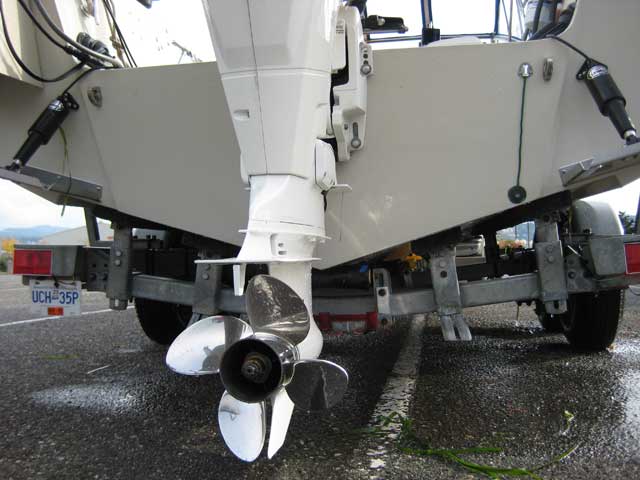
Tom Clark has taken an interesting picture of the stern of a REVENGE 25 sitting on the trailer which shows some details of the hull form. Here is the image (reduced size):
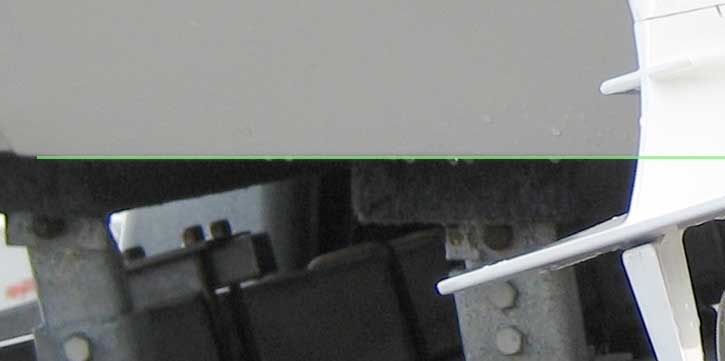
Here is a close up of the keel area. You may be able to see some change in the hull deadrise in this view: http://continuouswave.com/whaler/images/DEADRISE/ tomClarkRevenge25TransomCU.jpg I also measured the deadrise angle at the transom using my rotation technique. The results were 16° and 18°, for an average of 17° deadrise at the transom. This view is not orthogonal, so there may be a distortion.
|
| jimh |
posted 01-18-2009 11:39 AM ET (US)
The image Tom supplied was quite large so it was possible to get a very good measurement of the angle. The 25-foot hull now appears to have at least 17-degrees of deadrise at the transom. Perhaps someone with strong three-dimensional mathematics can assess how much error is introduced into the measurement by the plane of the image sensor not being orthogonal to the keel center line. That is beyond my current recollection of 3D geometry. Measurement of 17-degrees is in good agreement with anecdotal accounts of what the deadrise is supposed to be according to the designer. Also, since we now have a field measurement that shows there is a small variation in the deadrise as we progress toward the bow, the figure of "18-degrees" may be reflective of an average value rather than a precise measurement at the transom. |
| jimh |
posted 01-18-2009 11:43 AM ET (US)
It just occurred to me that although the image is not precisely dead-on to the keel centerline, it is looking fairly square to the starboard side of the transom. That is the side that measures 18°. Perhaps this is a more valid measurement than the 16° figure from the port side, where the camera is on a definite angled view to the transom. In that case, we get a precise measurement of 18° of deadrise. Hurrah! |
| Tom W Clark |
posted 01-19-2009 12:30 PM ET (US)
Jim, Again, I think your estimation of these angles is excellent. However, I do not see how it can be superior to directly gauging the hull and then measuring that angle. Both Joe and I have measured our identical hulls using the same method. At the transom I measured the deadrise at 17.25 degrees. Joe measured his at 17.5 degrees. Our measurements are within .25 degrees of one another. |
| jimh |
posted 01-19-2009 01:18 PM ET (US)
I am afraid I forgot the fundamental reason for making two measurements of the deadrise angle in an image, one in each direction and then averaging them: to correct for errors in the framing. Any single measurement would not be valid unless the image frame were precisely aligned to the boat hull lateral plane. This may explain the difference noted above between my 18-degree measurement and Tom's 17.25-degree measurement I see that my original photogrammetric measurement of 17-degrees is now in closer agreement with two actual measurements. 17.25 and 17.5. |
| SpongeBob |
posted 01-19-2009 09:36 PM ET (US)
Now for a practical application. At what angle do I cut the new 4"x12"x10' bunks for the trailer of our 22' Outrage? A. 17 deg., B. 17.25 deg., C. 17.5 deg., D. 18 deg.? Or is it that critical. I guess I could try and balance the boat on the table saw and set the blade that way but that seems like a lot of work. Seriously the current bunks are 90 deg. and I would like to get more of the bunks in contact with the hull. Jeff |
| SpongeBob |
posted 01-19-2009 09:42 PM ET (US)
Relevance - trailer "Performance" when loading and unloading. Jeff |
| TransAm |
posted 01-20-2009 09:09 AM ET (US)
E. It's just not that critical. Something close will do. Unless you load you boat exactly level with the trailer every time, you will never have an exact fit. If you are really anal, take the average of the 2 actual measurements, 17.375 and put your mind at rest. |
| TransAm |
posted 01-20-2009 09:18 AM ET (US)
Or if you are really, really anal, you could fashion adjustable bunk pads that swivel and come to rest precisely at the proper angles when loaded. |
| L H G |
posted 01-20-2009 05:27 PM ET (US)
Has the deadrise of a 22 been determined yet? |
| jimh |
posted 01-20-2009 06:21 PM ET (US)
Based on all the data presented in this discussion and in the prior discussions on this topic (to which hyperlinks are provided above), I'd say the deadrise at the transom of a classic Boston Whaler 22-foot hull is between 14 and 18 degrees. |
| Buckda |
posted 01-20-2009 06:42 PM ET (US)
Buckda posted 01-09-2009 02:07 PM ET (US) quote: ...but it sure has been fun trying to figure it out - 31 posts and 11 days later... |
| jimh |
posted 01-20-2009 07:17 PM ET (US)
And not a single reply from the originator of the discussion. |
| DeeVee |
posted 01-20-2009 10:39 PM ET (US)
When I replaced the 4x10 bunks on my aluminum trailer a couple of years ago, I measured a little less than 18 degrees. I ripped the bunks as close to that as I could with a 12" blade on a worm drive skilsaw. As it turned out,the bunks would fit better if they were closer to 17 degrees than 18 degrees. Bunks that are able to swivel to come to rest perfectly flat against the angled hull surface would be a better choice if possible, but my set up works OK the way it is. Doug Vazquez |
| |
Powered by: Ultimate Bulletin Board, Freeware Version 2000
Purchase our Licensed Version- which adds many more features!
© Infopop Corporation (formerly Madrona Park, Inc.), 1998 - 2000.