 ContinuousWave
 Whaler
 Moderated Discussion Areas
ContinuousWave: Whaler Performance
E-TEC Improves Fuel Economy 67-Percent
Moderated Discussion Areas
ContinuousWave: Whaler Performance
E-TEC Improves Fuel Economy 67-Percent


search | FAQ |
profile | register | author help
|
|
ContinuousWave Whaler Moderated Discussion Areas
ContinuousWave: Whaler Performance
E-TEC Improves Fuel Economy 67-Percent
|
| Author | Topic: E-TEC Improves Fuel Economy 67-Percent |
| jimh |
 posted 08-03-2009 09:25 PM ET (US)
posted 08-03-2009 09:25 PM ET (US)  
I just completed a 7-day cruise on my 1990 Boston Whaler REVENGE 22 Walk-Through Whaler Drive with a new engine, a 2010 Evinrude E-TEC 225-HP. The E-TEC replaced my 1992 Evinrude 225-HP carburetor motor. In early July we had cruised for 6-days with the carburetor motor. About the only thing that changed in the two cruises was the motor. We ran the same propeller on both motors. This was intentional so that a reasonably controlled comparison of the fuel economy could be made. We had approximately the same amount of gear aboard. If anything on the E-TEC cruise we carried more gear. On the E-TEC cruise we carried more fuel, as well, as we were in more remote areas with fewer opportunities to get fuel. We used the same fuel measurement instruments, the same GPS, the same tachometer, and so on. In the 6-day cruise with the carburetor motor we tried to run the boat at the point of optimum fuel economy on plane as much as possible. On the 7-day cruise with the E-TEC we ran the boat primarily at the speed that gave us the best ride in the sea conditions. We did not particularly try to run on plane only at the optimum fuel economy point. The overall fuel economy average with the carburetor motor was 1.85-MPG. With the E-TEC, the overall fuel economy average was 3.1-MPG. The improvement in fuel economy was 67-percent. It is important to note that my fuel flow gauge tends to overstate the fuel used, so the actual fuel economy for the trip was probably even better than 3.1-MPG. I will be installing some more accurate fuel flow instrumentation in the future. I hope to be able to give data with more absolute accuracy. However, this comparative data should be quite accurate. The price of gasoline in the area where we cruised was in the range of $3.65 to $4.75 per US gallon. We used about 120 gallons. If we had used the old motor, we would have needed about 80 gallons more. You can figure that we saved about $330 in fuel cost on this one trip alone. |
| home Aside |
posted 08-03-2009 11:00 PM ET (US)
Jimh, probably nice for shipboard conversations with the flytop, windshield, and side curtains up too Pat |
| Perry |
posted 08-03-2009 11:32 PM ET (US)
That is a nice improvement in fuel economy Jim. Why are you going to get a more accurate fuel flow instrumentation? Is there something wrong with your Navman 3100? |
| jimh |
posted 08-03-2009 11:47 PM ET (US)
The NAVMAN 3100 can't accurately measure the really low fuel flow rates. The future fuel flow data will probably have to come from the engine itself via NMEA-2000 instrumentation. Converting to digital gauges will be a Phase Two or Phase Three step in the transition. I do have a rather nice set of traditional analog gauges, so I am not in a panic to go all digital And, yes, we had the full canvas up all the time. The only exception was the very last day when we were down in SEVERN SOUND, more protected water. When the canvas is all down, the boat is faster and probably more fuel efficient. |
| jimh |
posted 08-03-2009 11:52 PM ET (US)
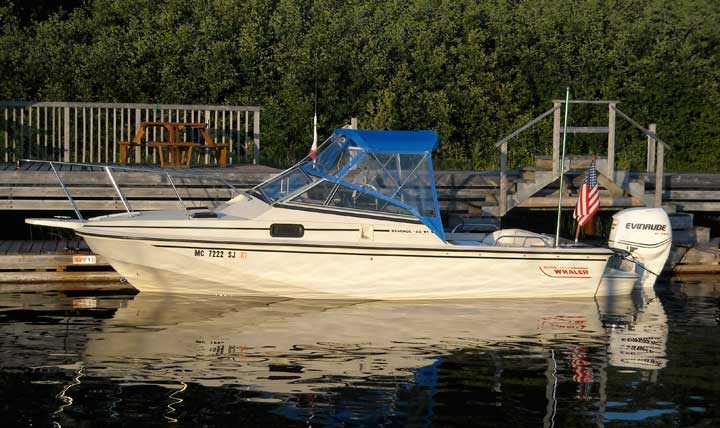
The new 2010 E-TEC looks nice on the boat, too:
|
| jimh |
posted 08-04-2009 12:16 AM ET (US)
We ordered the motor on Monday. It was shipped from Wisconsin on Tuesday. It arrived at Lockeman's on Wednesday about 1 p.m. By 5 p.m. Wednesday Douglas had it mounted and rigged. (I helped a little by having all the harnesses, cables, and hoses all pre-set and ready to connect to the motor.) By 6 p.m. Wednesday we were on the Detroit River taking a quick test drive. We ran the motor for about ten minutes, then hauled out. Thursday the boat was idle, but I was busy refitting all the gear I had removed to simplify the rigging process. I had removed all sorts of stuff so that the rigging could be accomplished very easily. I had to put the boat back together, which took all evening after work Friday we loaded all our cruising gear, which seemed like 500-lbs of stuff. Saturday we drove 320 miles to Georgian Bay, launched, and went cruising. It was really a rush to get all this done in time for vacation. I will have more time in the next few weeks to get speed and RPM data and work on the propeller selection. I expect that a 17-pitch REBEL or CYCLONE (four-blade) will be good starting points. About the color: I had always been in favor of a white motor, as the boat had a white Evinrude before, which I thought looked very nice. The blue H.O. motor at first was a shock to me, but eventually I became fond of the blue color scheme, too. In the end, I went with my initial preference and got the white motor. (Actually, for model year 2010 a 225-HP with 25-inch shaft is only available in white, so it wasn't much of choice.) The new E-TEC white is a bit more pure titanium white than the old 1992 motor, which I think was Ocean Pearl, a softer off-white. Also, the white motor seemed to look larger than the blue motor, at least initially. After a week, however, we were accustomed to the size of the motor and it stopped looking so big. The aft 6-inches of the cowling is really air space for a water trap and baffle in the air intake duct. The actual motor is not much larger than the old motor. |
| Tom W Clark |
posted 08-04-2009 12:22 AM ET (US)
Jim -- Did Chris allow to you to open it up at all and note the speed and RPM? |
| jimh |
posted 08-04-2009 12:34 AM ET (US)
Tom--Chris loves the new motor because it goes so slow--at idle. When you shift into gear the boat speed at dead slow is only 2.5-MPH. Around the dock this makes it easier to maneuver; no more controlled crashes at 5.5-MPH. We tried to baby the new motor and keep it off wide-open, but about the fifth day of the cruise--we had 25-hours on the motor by then--I did briefly push the throttle to the maximum. We hit 5,700-RPM and were still winding up when I pulled back to go around a hazard. The old 17-pitch propeller I was running (again, the same propeller to keep the comparison to the previous cruise as congruent as possible) is not the most efficient propeller for pushing the boat when heavily loaded. The SLIP was a rather lousy 18-PERCENT and the boat speed was around 40.5-MPH. |
| seahorse |
posted 08-04-2009 07:02 AM ET (US)
quote:
|
| Peter |
posted 08-04-2009 07:07 AM ET (US)
What is the mounting height for the E-TEC and is that the same as the old motor? |
| jimh |
posted 08-04-2009 07:50 AM ET (US)
The E-TEC is mounted one-hole up. The carburetor motor was mounted in the lowest position. I was not really in favor of mounting one-hole up for the new E-TEC, as my experience with the Whaler Drive seemed to indicate that the mounting height was already rather high with the engine mounted right on the transom. However, Douglas and Dave were very strongly recommending trying one-hole up. I acceded to their recommendation, and the engine went on the boat one-hole up from the lowest position. The propeller, an older SST 17, had been tested several times before. My comments about were: "This propeller showed a slight tendency toward ventilation....It could not be run with as much trim out as the baseline propeller." Cf.: http://continuouswave.com/ubb/Forum4/HTML/004799.html "The SST propeller did not have the holding power of [other propellers tested]. We had to run the engine at lower trim, particularly while getting up on plane, in order to prevent the propeller from loosing grip." Cf: http://continuouswave.com/whaler/reference/propellerWDSingle.html On the new E-TEC and even with mounting higher than before, the propeller seemed to hold better and had less ventilation. I was particularly pleased that it did not ventilate while we were slogging our way upwind in 6-foot confused seas during one ten mile offshore stretch where the Georgian Bay Small Craft Route has to leave the confines of the coastal barrier islands and ventures into open water. These were probably the largest and most confused seas we had ever been in with the boat, and there was no ventilation of the propeller. Of course, we had the engine trimmed way down. But the propeller never blew out. I think the new Magnum Straight Leading Edge (M2 SLE) gear case design may have helped prevent ventilation. The propeller seemed to have more grip than it did before. It appears that when on plane and in smooth water the anti-ventilation plate is still not running on top of the water, even at one-hole up mounting. I suspect that the new M2 SLE gear case on the E-TEC is slightly longer than the one on the old motor. |
| rtk |
posted 08-04-2009 07:58 AM ET (US)
Congrats on the new engine Jim. Looks great! Rich |
| Phil T |
posted 08-04-2009 08:27 AM ET (US)
Jim - Congratulations on the new motor. That is a fabulous photo. She sits very well and looks great. You must say who took the photo. You might want to submit it for Jeff's calendar. Phil |
| jimh |
posted 08-04-2009 08:32 AM ET (US)
For model year 2010 Bombardier has incorporated some changes in the E-TEC 3.3-liter V6 motors. All the 3.3-liter motors now include a KNOCK SENSOR. I believe that formerly the KNOCK SENSOR was only used on the 300-HP and 250 H.O. 3.4-liter motors. There are two KNOCK SENSORS, one for each cylinder bank. When knock, or pre-ignition in the combustion chamber is detected, the engine management module (EMM) responds with enrichment of the fuel mix and alteration of the ignition timing. I believe the knock sensor was added to help compensate for the wide variety of gasoline quality being used with the marine engines these days, and also to help handle high load situations where knock can occur due to operating conditions. The KNOCK SENSOR addition is typical of the continuing research, development, and refinement that Bombardier is providing in the E-TEC engine. The E-TEC is a truly modern engine, with an EMM with millions of transistors. It is a simple matter to take advantage of the power of those millions of transistors and add new features like this knock sensor. This is the true power of the modern engine with modern electronic computer controls. The engine can now adjust itself dynamically to changing situations of fuel and load demands. Data about the occurrence of knock is recorded in the EMM and is available in the ENGINE HISTORY REPORT. The report shows which cylinder had knock and for how many seconds. More amazing power of transistors. |
| jimh |
posted 08-04-2009 08:42 AM ET (US)
Phil--Thanks for the comments on the photograph. I have it with much higher resolution and better contrast. I hurriedly made that small JPEG for the web. I took the photograph. The setting is the W or "wall" dock at KILLBEAR MARINA in Pengally Bay, near Parry Sound. The sun was very low and gave great lighting. Behind the boat is a marshy area that has a large population of bullfrogs, mosquitoes, and at least one large black water snake, which we met when it was coiled up amid my black dock lines. We were relaxing on the dock after supper when I noticed the good lighting and got my camera out. In the time I walked around the marina to another dock to take the picture, a mother and two children came down the dock and sat at the picnic table to eat ice cream cones. I shot some images with them in the frame, but they were a distraction from the boat. I waited about five minutes for them to finish their ice cream, hoping that the sunlight would stay long enough. Just as the sun was about to drop behind the hill on the western side of the marina, the family got up and left the picnic table. I grabbed a few shots without them in the frame. Then the light was gone. |
| jimh |
posted 08-04-2009 08:47 AM ET (US)
In the picture, you can see the low sun angle in the shadow of the picnic table on the fence. The shadow is almost horizontal. The sun was only a degree or two above the horizon. |
| Peter |
posted 08-04-2009 09:45 AM ET (US)
I suspect that the knock sensor was added, at least in part, to comply with the 2010 EPA standards. The Magnum gearcase, regular and SLE, are larger in every dimension than the offshore (O-type) gearcase on your old motor. |
| RobertRibley |
posted 08-04-2009 12:11 PM ET (US)
Jimh That new Etec is purportioned beautifully on your 22wt. Looking forward to more perfomance reports and pictures. Wishing you many happy hours of boating. Robert |
| MarthaB |
posted 08-04-2009 12:28 PM ET (US)
Congrats on the new E-TEC. I bet you were happy that it worked out in time for the vacation. |
| Slippery Eel |
posted 08-04-2009 01:11 PM ET (US)
Jim, Congratulations on your new ETEC. It look great on your boat. Sort of like mine :) Hutch |
| jimh |
posted 08-04-2009 01:16 PM ET (US)
I think the E-TEC motor itself helps to avoid propeller blow-out, too. With a carburetor motor, if the propeller loses grip, the engine speed will rapidly climb. With the E-TEC, the engine speed tends to stay more constant with throttle setting. If the propeller slips a little, the engine speed might increase, but perhaps only 100-RPM. It does not race up several hundred RPM, spinning the propeller faster and losing more traction. |
| Buckda |
posted 08-04-2009 01:21 PM ET (US)
Jim - While that may be intuitively true and there may be a small effect as described, I can tell you from experience that at least on the 90 HP model, you can still lose traction and ventilate the propellers in challenging sea conditions. The benefit of two motors is that when one loses traction, the other one is still pushing away. Been there, done that on the trip to Georgian Bay... |
| jmorgan40 |
posted 08-04-2009 02:49 PM ET (US)
Jim, I believe the model you tested last year was a HO model. Did you go with the High Output model in white? By the way, she looks great. Joe |
| jimh |
posted 08-04-2009 06:06 PM ET (US)
The 225-HP E-TEC is not a High Output model. It is the standard 3.3-liter V6 model. |
| seahorse |
posted 08-04-2009 06:23 PM ET (US)
quote:
|
| Peter |
posted 08-04-2009 08:09 PM ET (US)
Is there any advantage to using fuel with an Octane rating greater than 87? |
| jimh |
posted 08-04-2009 08:36 PM ET (US)
Speaking of fuel and its octane rating, what we've been seeing at marina fuel docks (in Michigan) is a marine gasoline blend with 89 to 90 octane, and no dilution with alcohol or ethanol. While in Ontario, all the marina fuel docks told me that the gasoline I was buying (at rather expensive prices) was free from ethanol. The fuel used on both these cruises consisted of a mixture of highway gasoline, which I am reasonably certain was an E10 blended fuel, and marina gasoline, which again I am reasonably certain was pure gasoline with an octane rating of at least 89. |
| an86carrera |
posted 08-04-2009 09:05 PM ET (US)
Jim, The boat looks great with the E-TEC. I think the non-HO was the right choice for your boat. Good luck with it. Len |
| home Aside |
posted 08-04-2009 11:25 PM ET (US)
Jimh, LOOKING GOOD!!!! She's awesome Pat |
| jimh |
posted 08-05-2009 09:16 AM ET (US)
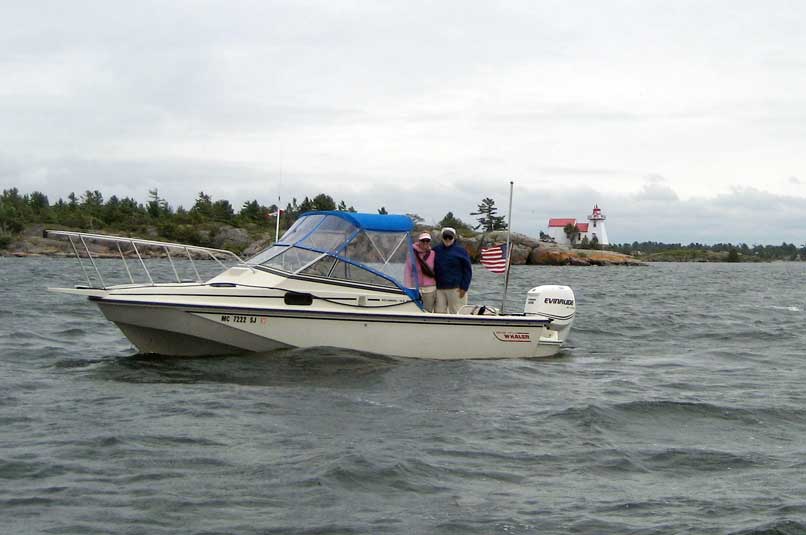
Here is another look at the boat and new motor, this time just off the inlet at Pointe Au Baril, Ontario, on Georgian Bay's eastern shore. One of nicer things about cruising with another boat is you can get a few pictures of your boat while at sea:
|
| jimh |
posted 08-05-2009 09:19 AM ET (US)
And, yes, this picture was taken in mid-afternoon in late July. And, yes, that is fleece and a wool scarf that Chris is wearing. The summer weather this year in northern Lake Huron has been a bit late in arriving. |
| jimh |
posted 08-05-2009 09:21 AM ET (US)
Oh, and yes, that flag on the stern staff is blown out straight and snapping, indicating winds of 25-knots or more. With a fetch of 100 miles across the "bay" the wave conditions offshore were building to impressive heights. |
| Buckda |
posted 08-05-2009 10:18 AM ET (US)
That photo illustrates the conditions rather well. If you look closely at the water - and remember, this is FRESH water, which resists foaming as compared to seawater - you can see the trails of foam that have drifted into this relatively protected bay from the open waters of Georgian Bay. The lake/bay was ripping that afternoon with seas in the 6-8 ft range of windblown, confused great lakes chop on top of only 15 ft of depth - making them steep and nasty. Canvas protection is not really an option on an open boat like a Whaler up there - it should be considered a virtual necessity. It is no wonder that pilothouse style boats are so popular in the area...early and late season must be brutal! |
| Liteamorn |
posted 08-05-2009 06:15 PM ET (US)
Your boat looks great Jim. Good luck with her! It seems like (at least in my Marina) that E-Tec has taken lead in repowering by a wide margin. I have noticed similar fuel savings with my Optimax. Those DFI engines really sip oil and gas. |
| Plotman |
posted 08-05-2009 10:40 PM ET (US)
Jim- That is a mighty impressive increase. Do you have a sense if the biggest savings was from time spent at idle, or when cruising. Put another way, what did your fuel flow meter show as your best MPG while on plane, and how does that compare to your old engine at a similar speed? I know the etecs are amazing at idle speeds compared to old two-strokes. David |
| jimh |
posted 08-05-2009 11:12 PM ET (US)
To understand how the overall average fuel economy is affected by the fuel consumption rate at various speeds, see my reference article at Average Fuel Mileage: Proper Weighting Factors The weighing of the overall average is in proportion to the amount of fuel burned at each rate. This mean, if carried to extreme, that an engine that burned no fuel at all at idle, would hardly have its total fuel economy affected by that fantastic fuel economy. It seems counter-intuitive, but the better the fuel economy at a particular engine speed becomes, the less it affects the average because less fuel is burned there. Most of the fuel we consumed was burned at cruising speeds. What I see with the E-TEC is a much broader range of boat speed and engine speed combinations that will produce excellent fuel economy. In contrast, the carburetor motor needed to run in a rather narrow speed range to get good fuel economy. The carburetor motor, under the loading we had in these cruises, would peak to about 2.0-MPG at optimum cruising speed. In contrast, the E-TEC would peak to about 2.7-MPG and generally be well above 2.4-MPG all the time. At idle speeds, the carburetor motor was miserable, and its fuel economy would be 1.5-MPG many times. On the other hand, the E-TEC would register as high as 40-MPG when coasting along at idle speeds. The 67-percent overall improvement really stunned me. I would have been glad to get a 30- to 40-percent overall average improvement, which would have been more in line with what Bombardier suggests. What we found with the carburetor motor and having a fuel flow meter that showed real-time fuel economy was we were constantly driven to run the boat at its optimum cruising speed in order to maximize fuel economy. While we happily did this to save money on fuel, it often made us run at a speed that we really did not want to run. With the E-TEC, we can go slow if we want and not waste fuel, and we can go fast if we want, and get better fuel economy there, too. |
| Peter |
posted 08-06-2009 08:58 AM ET (US)
"With the E-TEC, we can go slow if we want and not waste fuel, and we can go fast if we want, and get better fuel economy there, too." This is really true of all stratified charge DFI 2-strokes. They are more efficient at slow off-plane speeds than they are on-plane. In contrast, with carbureted 2-strokes, they are usually more efficient at moderate on-plane speeds than they are at any off-plane speeds. With the stratified charge DFI 2-strokes, the peak fuel economy is usually seen at in-gear idle speed. MPG generally goes down from there to a low at the on-plane transition and then up to an on-plane peak at moderate speeds. The on-plane peak MPG is substantially lower than the in-gear idle MPG, about 4 to 5 times lower based on my experience. |
| aja |
posted 08-06-2009 01:24 PM ET (US)
Jim: You may have mentioned this elsewhere, but what happened to finally convince you to upgrade from the older motor? It seems you have been contemplating this move for quite a while now with your fuel payback calculators etc, but assuming the old motor was sound it never seemed to pay off on it's own. As the owner of a '92 Johnson looper I am of course interested to hear what made the difference for you. Congratulations! |
| fourdfish |
posted 08-06-2009 04:55 PM ET (US)
As you know, I have a 2005 3.3L 200 E-TEC. I have never heard or experienced a KNOCK in the engine. I wonder what it sounds like? Jim-- The engine looks good and I hope you have many years of reliable experiences with it. BTW-- This is the coldest summer we have ever experienced 20years here in Door County. The lake water is cold and that has helped produce some really great salmon fishing this year. |
| crabby |
posted 08-06-2009 06:17 PM ET (US)
I'm surprised you dropped back to a 225hp from the 250HO; personally I am regretting going with a 250hp rather than the 250HO (since I could have had either motor for the same money and my 22 Outrage Cuddy just feels so much nicer once it hits 40mph). Prop: I still need to dial in my prop but now it is more motor height. I have the 17 inch Rebel and am seeing the best numbers compared to the other props I trialed (15 inch Rebel, 19 inch Viper, 17 inch Viper, 21 inch old SST). But my engine is mounted three holes up. Performance is good in smooth water but in a chop or seaway the prop loses it's grip and I want to drop the motor down to just a single hole up. Fuel economy: I have a single I-Command guage reading fuel flow from the engine. My numbers are no where near the numbers you reported with the 250HO at low speeds. You may find once you go for the I-Command setup that the numbers reported by your inline fuel flowmeters do not quite agree with the onboard sensors. Congratulations and best of luck! |
| jimh |
posted 08-06-2009 08:27 PM ET (US)
On what made me finally jump into a new engine: One influence in deciding to re-power with a new engine was the transition back to our old engine after having an E-TEC on the transom for a week or two. Last fall we had a chance to "test drive" an E-TEC. This spring we put our old motor back on the boat and spent 6-days underway with it. This turned out to be one of the best sales incentives for going back to the E-TEC. I really like my old motor. I had worked on it. I had made repairs to it. I had diagnosed problems with it and fixed those problems myself. I knew a lot about the motor, how it worked, and I was confident in it. I had perfected the motor. It ran about as well as a 1992 carburetor outboard V6 motor could run. There was a certain pleasure in seeing it operate so well, even though it was 17-years old. Like many here, I do take some pleasure in restoring and maintaining a classic product. My motor ran better than when I got it. I felt like it would run like that for years. There was nothing really wrong with it. However, the E-TEC motor is a better motor. It starts better. It idles better. It does not shake. It does not need to warm up. It gets much better fuel economy. It is quieter. The gear case is smoother--the shifts are fantastically smooth. The performance is the same--225-HP is 225-HP--although the E-TEC runs better over a wider range of engine speeds. Overall, the E-TEC is a better motor than my 1992 V6 carburetor motor. A crucial influence in the purchase decision was the appearance of a buyer for my old motor--a buyer with cash in hand and a reasonable offer. I could not see any way I could justify owning TWO 225-HP motors, so before I could buy an E-TEC, I had to sell my current motor. I also feel like at the present the price of gasoline is temporarily at a low. In 2008 we were paying $5.75/gallon for fuel on the water in our favorite cruising grounds. This taught me a lesson: gasoline is likely to become more expensive. Improving fuel economy is an important benefit that comes along with all the other benefits of the new motor. Also, I am 59-years-old. I don't expect that I will continue boating in the manner I am now forever. Sleeping in the cuddy of a 22-footer is not exactly the habit of too many 70-year-olds. I figured that I might as well treat myself to a new motor. I drive old clunker cars all year, so why not splurge on a new motor? The final influence was Lockeman's. They are great people to work with. I probably would never had purchased a new motor if were not for Lockeman's. They were instrumental in finding a buyer for my old motor, and absolutely superb to work with in getting the new motor. A tip of the hat to Dave, Dorothy, and Douglas. |
| Bert Zwueste |
posted 08-11-2009 08:43 PM ET (US)
Congratulations Jim. I estimated my reduction in fuel consumption to be more then 50%. Your figures confirm this. It still amazes me every time that I take the boat out. Your setup looks very nice. |
| martyn1075 |
posted 08-16-2009 01:53 PM ET (US)
It looks like that engine belongs on the classic Revenge hull. unlike many of the four-cycle motors. I love the idea of the four-cycle motor, but many factors already discussed on previous threads seem to be good advice that the E-TEC or other two-cycle technology still might be the best choice for this hull. I am currently looking at re-powering the same boat (but without the full transom), so your specs are helpful! Thanks |
| jimh |
posted 09-05-2009 08:36 AM ET (US)
I am back from another cruise with the new E-TEC engine, this time a six-day trip to Lake Ontario and the St. Lawrence River. As usual, I collected more fuel economy data. Before giving the data, however, I should mention there is a difference in the instrumentation method on this trip. For fuel consumption, I relied on the I-Command digital instrumentation connected to the E-TEC via a NMEA-2000 network. I believe this measurement of fuel flow is more accurate than the flow measured by my NAVMAN 3100 FUEL instrument. The NAVMAN 3100 FUEL instrument uses an turbine sensor in the actual fuel line to provide measurement of flow. The I-Command flow rate was set to use the data from the E-TEC engine's EMM. After a recent calibration of the NAVMAN flow rate (in which I used the I-Command as a standard of reference), the two instruments report similar fuel consumption rates when averaged over a long term and over various flow rates. The NAVMAN understates fuel flow at low flow rates, where it defaults to a reading of 0.1-Gallon/Hour, and it also overstates fuel flow at high flow rates, which is probably a function of the calibration setting used. In any case, on this trip the difference in fuel used as measured by the two instruments amounted to 1.2-gallons in 86.9 gallons used, a variance of only 1.5-percent. Another influence on the fuel economy was the presence of current and wind. As we were in a river for much of the time, boat speed was affected by current, which was typically at least 1.5-MPH and often higher. Wind and waves were also a factor. Because we made a 250-mile trip of out and back, the influence of the current, wind, and waves, should be somewhat neutral, although probably not precisely. The overall fuel data for the 250-mile trip was as follows: MILES = 249.5 Averages The average speed on this trip was quite high. It was influenced by a 100-mile run we made where we were on-plane all the way and running at speeds from 25 to 40-MPH, a fast trip back to our launching site to get home. During this segment we burned 37.6-gallons for 2.7-MPG, and we were running against the current and upwind the whole way. On this long, high-speed run we used 43-percent of the fuel for the whole trip, which reduced the overall average fuel economy somewhat compared to our last trip, where we idled along for many hours enjoying the scenery and getting fantastic fuel economy for more of the time. However, an overall fuel economy of 2.9 is still a very substantial improvement over the prior engine, which seldom could muster more than 1.8-MPG on a long term average under the best of conditions. The improvement is still 61-percent, an impressive figure. The cost of marine fuel for us was in the range of $1.20-CA/liter, which converts to $4.54-CA/gallon, and with currency conversion of roughly 7-percent yields $4.25-US/gallon. To assess the savings, we figure the old engine would have burned 250-miles x 1-gallon/1.8-miles = 139-gallons The new engine burned only 87 gallons, saving 52-gallons. At the cost of fuel in the region, this saved 52-gallons x $4.25/gallon = $221 So far the new E-TEC motor has saved me about $550 in fuel in just two trips. Of course, if you bought all your boat fuel at lower prices, for example if you only bought fuel on the highway and paid substantially less, the savings would not be as great. For our style of boating, however, we generally have to buy a majority of our fuel on the water, and often in Canada, and often in remote regions or in resort areas. This drives our fuel costs higher than someone who fuels in the U.S. at a highway gas station. |
| jimh |
posted 09-05-2009 11:52 AM ET (US)
Since the total trip was 250-miles and 87-gallons, if we subtract out the high-speed run figures of 37.5-gallons and 101-miles, we are left with 149-miles and 49.5 gallons. This implies that if not for the long high speed run, the fuel economy for the trip was averaging 3-MPG, which is just about what we achieved on the earlier trip. |
| high sierra |
posted 09-07-2009 01:00 AM ET (US)
Nice rig. |
| SC Joe |
posted 09-07-2009 01:11 PM ET (US)
Jimh--what is the dry hull weight (no engine)? |
| andygere |
posted 09-08-2009 11:30 AM ET (US)
Jim, Your results mirror my experiences when replacing a carburated V6 outboard with an E-TEC of approximately the same displacement, however your record keeping and analysis is a lot better than mine. I found that the I-Command fuel montior matches my Standard Horizon fuel flow meter pretty closely at planing speeds, howver the I-Command has better resolution and accuracy at no-wake speeds. Congratulations on the new engine, the notion of treating yourself to a new outboard is a good one. Life is too short to not do that sort of thing once in a while, and the payback in enjoyment is huge. The payback at the fuel dock is pretty substantial too, especially on the longer cruises that you are taking. Enjoy the new motor, it looks sharp on your Revenge. |
| jimh |
posted 09-08-2009 08:50 PM ET (US)
Joe--I have never measured the weight of my hull without engine. As far as I can tell, the weight of the hull has not changed during any of the periods for which I have presented data. |
| SC Joe |
posted 09-09-2009 09:17 AM ET (US)
I doubt it had, Jim. I wasn't doubting that. [Then changed topic to something entirely different. This has been removed from this discussion and a new thread created for the new topic. It is best not to change the topic of a discussion to something completely new. Just start a new thread--jimh.] |
| |
Powered by: Ultimate Bulletin Board, Freeware Version 2000
Purchase our Licensed Version- which adds many more features!
© Infopop Corporation (formerly Madrona Park, Inc.), 1998 - 2000.