 ContinuousWave
 Whaler
 Moderated Discussion Areas
ContinuousWave: Small Boat Electrical
Bombardier 2007 I-Command Gauges
Moderated Discussion Areas
ContinuousWave: Small Boat Electrical
Bombardier 2007 I-Command Gauges


search | FAQ |
profile | register | author help
|
|
ContinuousWave Whaler Moderated Discussion Areas
ContinuousWave: Small Boat Electrical
Bombardier 2007 I-Command Gauges
|
| Author | Topic: Bombardier 2007 I-Command Gauges |
| jimh |
 posted 06-21-2006 11:18 PM ET (US)
posted 06-21-2006 11:18 PM ET (US)  
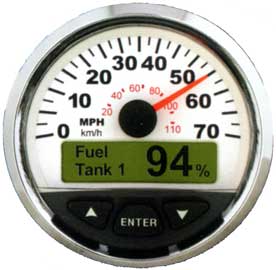
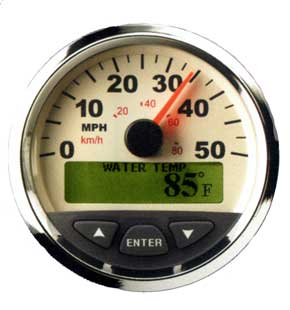
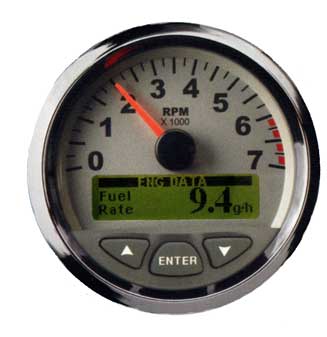
The 2007 Evinrude catalogue show five new styles of gauges available from Bombadier in their NMEA-2000 I-Command line. I-Command™ DIGITAL These gauges have an LCD-type display and are available in two versions:
--Digital Readout: the data is presented in a digital read out, for example, "Alt. Voltage 55.00." These gauges have a chrome trim ring.
--Analog Readout: the data is presented in an dial pointer type representation, for example, a pointer on a scale of 0 to 70 points at about 4/5-ths full scale, and a smaller digital display reads "55.0" on a gauge marked ALR:V. These gauges are black and do not have the chrome trim ring. Smaller individual display gauges are available either the chrome ring or black ring style. I-Command™ CLASSIC These gauges have a combination of a large meter and pointer scale dedicated to either RPM or MPH, and an LCD window which displays additional digital data, or smaller individual gauges that show one value wit a meter and pointer scale. These gauges are available in three styles:
--Chrome/White Face: a chrome trim ring surrounds a white gauge face with black markings.
--Chrome/Tan Face: a chrome trim ring surrounds a tan gauge face with black markings.
--Black Chrome/Silver Face: a dark chrome trim ring surrounds a gray or silver gauge face with black markings. These are very attractive gauges and would look great on any classic Boston Whaler boat. I have not seen them in person, but judging from the catalogue pictures, the Chrome/Tan Face would look terrific with the Desert Tan gelcoat of a classic Boston Whaler boat. |
| jimh |
posted 06-22-2006 11:15 PM ET (US)
[Added in-line images of gauges.] |
| andygere |
posted 06-23-2006 07:46 PM ET (US)
Jim is right, the tan faced classic I-Command gauges are indeed a very nice match with the desert tan console on my classic Whaler. The new all digital gauges look very much like the NMEA 2000 instruments produced by Lowrance. I wonder of Lowrance is the OEM for these new guages? |
| jimh |
posted 06-23-2006 08:32 PM ET (US)
There is a strong resemblance between the I-Command and the Lowrance-Net gauges. I do believe there is one important difference: only the I-Command gauges from Bombardier can read the data from an E-TEC engine. |
| JayR |
posted 06-24-2006 11:24 AM ET (US)
I just ordered the chrome/tan gauge from my dealer. Should be a nice match. My hull is a bit more white than the gauge but the white gauge would have been too white in my opinion.... I also added the water pressure and oil level sensor. I'm amazed at the amount of information this system will provide. |
| mfrymier |
posted 07-21-2006 05:22 PM ET (US)
Jim -- are there 2" versions of the digital I-Commands available as well? |
| mfrymier |
posted 07-21-2006 06:10 PM ET (US)
These new digital gauges, although maybe not "classic" in appearance, are REALLY flexible. For example, you could have two 3" displays and pretty much have that be the whole system display.... The only thing I need to figure out now is what to do with all the soon to be holes in my console! |
| seahorse |
posted 07-21-2006 10:33 PM ET (US)
mfrymier, 2" gauges that display the same as the 3" gauges are available and are pretty reasonable. |
| JayR |
posted 08-02-2006 11:34 AM ET (US)
Chrome / Tan turned out to be a real nice match with the interior gelcoat of my 1971 Outrage. I may opt for the speedometer gauge as well. Without it, I do not have access to fuel management functions. The tach will display GPH only. Here's a shot of the tach and oil level gauge http://img470.imageshack.us/img470/5710/08022006010sf5.jpg |
| jimh |
posted 10-20-2006 08:34 PM ET (US)
I have been reading some anecdotal reports of water intrusion into the I-Command gauges, as well as some comments that one version of them is being discontinued. Accurate information on this would be appreciated. Has Bombardier dropped one style of gauge? |
| seahorse |
posted 10-20-2006 08:49 PM ET (US)
I-Command Classic gauges with a date code of 089/06 and earlier may have water intrusion and fogging problems. BRP has sent a service bulletin to the dealers about this and how to exchange them, bulletin 2006-04 P. Instruments with a date code of 090/06 and later have improved sealing characteristics. |
| JayR |
posted 10-20-2006 08:55 PM ET (US)
Where would one find the date code? I do not see any water intrusion issues but ya never know. |
| kamie |
posted 10-21-2006 06:58 PM ET (US)
Anyone have the I-Command Digital gauges installed? Just wondering how they do out in the sunshine and how easy they are too see? I have the teleflex tan and gold gauges now and was going to replace them with the I-Command Classic Chrome/Tan ones. |
| mfrymier |
posted 10-23-2006 03:45 PM ET (US)
I have the iCommand Digital gauges installed. they are easy to see in the sunshine, and surprisingly easy to see even with my Polarized sunglasses on... They are also easier to install than the "classic" Icommand gauges. Be careful on the parts order. Email me directly if you need the installation manual which I weasled out of BRP dealer service. -M |
| ratherwhalering |
posted 10-23-2006 05:25 PM ET (US)
Matt's right. The classic I-command gauges require a consolidator hub. The EMM wiring harness, that connects to the consolidator hub, has a maximum length of 15 feet, 5 feet of which are needed inside the coweling, and an additional 3 feet are needed to reach the splashwell, leaving 7 feet. Therefore, the consolidator hub must be mounted somewhere in the stern, with an additional 15-20 foot data harness needed to reach the console. One can substitute a 8-inch terminator harness for the consolidation hub, and run it up the rigging tunnel, however the ground wire is not insulated, and will allow water to enter the deutsch connector. This also limits you to one network interface connection. With the iCommand Digital gauges, only an EMM harness and a 20 foot data harness are needed. with a 5-foot EMM harness, and a 20-foot data harness, the EMM/Data deutsch connector can be located in the engine coweling, leaving 20 feet of pure data harness for the rigging tunnel run to the console. Inside the console, T-connectors are daisy chained for each instrument and accessory, with a terminator at each end. |
| jimh |
posted 10-23-2006 09:10 PM ET (US)
I have quite a collection of information available here on I-Command gauges. See the index listing of publications available for download: I-Command Information Index |
| kamie |
posted 10-28-2006 07:57 PM ET (US)
Matt, Did you go with the digital or analog readout? Got any pictures of them installed? |
| Iam74Gibson |
posted 09-20-2007 10:51 AM ET (US)
I have installed these gauges in my new boat, and they are great! I just have one question/curiosity...the Alt Voltage reads 55.0 ... Just like in the picture in this post. I called BRP and they said this is correct. Shouldn't this read as AMPs ? If not, where does it get 55 volts? |
| jimh |
posted 09-20-2007 12:13 PM ET (US)
The correct unit of measurement of a voltage is in volts or in smaller or larger units of volts such a millivolts or kilovolts. Amperes are used to measure current flow. Your I-Command gauge marked as a voltmeter reads voltages in volts. As for why it is reading 55 volts and why this is normal, the alternator in an Evinrude E-TEC direct-injection two-stroke outboard motor generates 55 volts. Some devices in the motor operate on 55-volts directly. The 55-volt source is also converted by pulse-width modulation techniques to other voltages needed by other devices in the engine. The so-called "12-volt" system is derived from the 55-volt supply rail using a pulse width modulation with modulation index of 0.25, so the resultant voltage is roughly 55/4 or 13.8-volts. Creation of the "12-volt" system in this manner allows for very efficient regulation of the voltage. Older systems of voltage regulation often dumped excess voltage off in the form of heat which was dissipated by a cooling system. Using efficient DC-to-DC converter techniques is part of the modern electrical design used in the E-TEC motor. For a good discussion of electrical power generation techniques in outboard motors read my article on that topic in the reference section: |
| jappjari |
posted 09-23-2007 12:28 PM ET (US)
I have all the readings from E-TEC via NMEA bus. There is [a display with the legend] ENGINE LOAD in percent. Why is my E-TEC's maximum load only 94% at WOT? I'd expect 100% when the throttle is down. |
| Jefecinco |
posted 09-23-2007 07:28 PM ET (US)
What RPM are you turning at WOT and what is your engine rated to turn at WOT? Butch |
| jimh |
posted 09-23-2007 08:36 PM ET (US)
Could you check in the owner's manual for your gauges and tell us what value is shown in the ENGINE LOAD display. I am not familiar with this display and I am interested to know what is its meaning. |
| jimh |
posted 09-24-2007 07:26 AM ET (US)
I checked in some Bombardier literature on 2007 I-Command gauges and found under a listing of engine parameters which can be displayed there is a notation of ENGINE LOAD, however there is no further explanation of precisely what is being measured. Cf.: Page 9 of http://continuouswave.com/whaler/reference/NMEA2000/ I-CommandDigitalUsersGuide.pdf |
| jappjari |
posted 09-24-2007 01:03 PM ET (US)
Max RPM at WOT is 5400. Engine is E-tec 115. I've been thinking that Engine load only tells the position sensor value of throttle cam. That in my case is never 100%. Any experience? |
| Jefecinco |
posted 09-25-2007 10:00 AM ET (US)
I don't know the max rated RPM for the 115. But 5400 seems low. If rated RPM is 5800 then 5400 would represent 93% of max rated RPM. Would this have any significance on the issue of the load gage reading at your WOT? Would a different propeller allowing operation at max rated WOT have an impact? What, if any, difference would the boat's load have? Seems like an interesting issue. Butch |
| jappjari |
posted 09-25-2007 11:50 AM ET (US)
Just thinking that Engine Power (torgue*RPM) might be less than 115 hp if I'm below (or above) the rated RPMs. However, this Engine Load -% is mystery to me. |
| Iam74Gibson |
posted 09-25-2007 01:53 PM ET (US)
Jimh, Thanks for your detailed technical response to my 55 volt question. I am a technical professional and this makes perfect sense. Since this is my first outboard, I just did not know that is how the electrical system works. I just assumed it was Amps instead of Volts because of boats using a "12 volt system" Amps wer the only thing that made sense, and I thought my gauges were reading wrong. Glad they are functioning as they are supposed to! |
| jappjari |
posted 09-28-2007 08:08 AM ET (US)
The outcome is that Engine Load = Engine Power, and I can get 0,94*115 hp = 108 hp out of the engine. Somehow I have difficulty to accept this. Please, if someone has better knowledge i'd like to hear. |
| Jefecinco |
posted 09-28-2007 09:40 AM ET (US)
Look at the manufacturer's HP curve for your engine. For many engines peak HP is below max rated WOT RPM. IMO, power produced by an engine is dependent upon the amount of fuel burned which is dependent upon the amount of work done by the engine. This is dependent upon loading which is dependent upon speed, weight, wind and water conditions and a multitude of other factors such as propeller used, ambient temperature, humidity, and pressure. The manufacturer's HP curve is probably based on repeatable laboratory dyno test results. It's improbable that your boating experience will ever precisley mimic the lab conditions used by the manufacturer. This is one of those things not worth worrying about. Butch |
| seahorse |
posted 09-28-2007 06:41 PM ET (US)
The E-TEC 115 has a recommended operating range from 5500 to 6000 rpm. If you are running only 5400, you are not even developing full power until 5750. You should probably try a smaller pitch prop to get the revs up. |
| jappjari |
posted 10-01-2007 12:28 PM ET (US)
I made a very simple test last weekend. At idle I turned the throttle cam all way down. I saw immediately the max (94%) engine load reading. Say, not until the rpm's went up. Just wondering, may I get more rpm's if I push it more down (to 100%) ;=) |
| |
Powered by: Ultimate Bulletin Board, Freeware Version 2000
Purchase our Licensed Version- which adds many more features!
© Infopop Corporation (formerly Madrona Park, Inc.), 1998 - 2000.