 ContinuousWave
 Whaler
 Moderated Discussion Areas
ContinuousWave: Small Boat Electrical
GPS: Satellite Rocket Launch Status
Moderated Discussion Areas
ContinuousWave: Small Boat Electrical
GPS: Satellite Rocket Launch Status


search | FAQ |
profile | register | author help
|
|
ContinuousWave Whaler Moderated Discussion Areas
ContinuousWave: Small Boat Electrical
GPS: Satellite Rocket Launch Status
|
| Author | Topic: GPS: Satellite Rocket Launch Status |
| jimh |
 posted 11-24-2012 11:07 AM ET (US)
posted 11-24-2012 11:07 AM ET (US)  
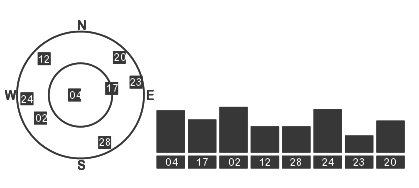
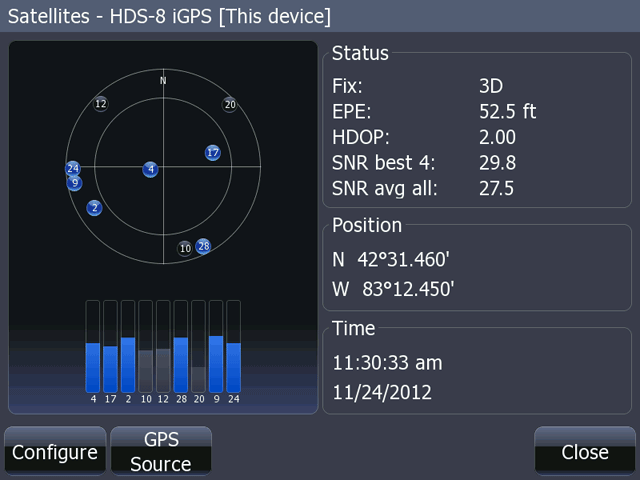
On October 4, 2012 a United Launch Alliance Delta IV rocket at Cape Canaveral, Florida carried into orbit the newest United States Air Force GPS satellite, a GPS Block IIF design designated IIF-3 and SVN65. It has been given the psuedo-random noise coarse acquisition code number 24 (PRN24). Curiously the launch date was exactly 55-years after the launch of SPUTNIK 1 in 1957. SVN65's designated orbital plane is Slot-1 in Plane-A. For several weeks after launch the satellite was drifting into position. The satellite was built by Boeing. The launch was the first one for a GPS satellite in 2012. Around October 8 the L1 transmitter on SVN65 was turned on and began transmitting as PRN24, although the signal was marked "unuseable." On November 14, the status was changed, and PRN24 should now be showing up on GPS receivers. I checked on my two GPS receivers for a signal from PRN24, and found it was just in view on the western horizon:
You can see in the above status presentations that the signal strength from PRN24 is good even though it is very low on the horizon. The new satellite also carries an L5 transmitter. The L5 transmitter began transmitting on October 11. The L5 carrier in GPS is part of an expanded set of civilian signals that will be carried on GPS. The L5 signal will provide more robust radio-navigation service for all ground-based users (such as maritime) as well as for aircraft. L5 will increase precision and provide better protection to interference. At present the GPS constellation has three satellites in the in the Group II-F segment, SVN's 62, 63, and 65. A check on the status of the GPS constellation at www.navcen.uscg.gov shows that at present the new satellite is in operation and useable. The announcement was as follows:
|
| jimh |
posted 11-24-2012 11:28 PM ET (US)
For anyone who has interest in more details about the launch and the satellite, I recommend this excellent article: http://www.spaceflight101.com/delta-iv-gps-iif-3-launch-updates.html |
| jimh |
posted 11-24-2012 11:42 PM ET (US)
The new GPS satellite will take the place of GPS IIA-15. GPS IIA-15 was launched on September 9, 1992 by a Delta 2 rocket from Cape Canaveral—more than 20 years ago. Source: http://nssdc.gsfc.nasa.gov/nmc/masterCatalog.do?sc=2012-053A The operational life of 20-years was much better than the design target of the Group IIA satellites. They were designed for a life of about 7.5-years. |
| jimh |
posted 06-23-2013 11:32 AM ET (US)
Successful launch of another U. S. Air Force NAVSTAR GPS satellite occurred on May 15, 2013. The fourth GPS satellite of the II-F category (IIF-4), designated Space Vehicle Number 66 (SVN66) was sent into orbit from Cape Canaveral Air Force Station, Florida aboard an Atlas V rocket. The II-F GPS satellites provide improved navigational accuracy as a result of their improved atomic clocks. They also provide more robust signals for commercial aviation and safety-of-life applications that use the new civilian signal, known as the L5 carrier. The life expectancy is also improved; the II-F satellites are designed for a 12-year service life. SVN66 is assigned PRN 27. The satellite was declared usable on June 21, 2013.
quote: Check the satellite status page on your GPS receiver to see if PRN27 is visible. You can read more about the launch at |
| jimh |
posted 06-23-2013 03:37 PM ET (US)
Very detailed information about the launch and satellite payload can be found at http://www.spaceflight101.com/gps-iif4-atlas-v-launch-updates.html |
| swist |
posted 06-23-2013 05:28 PM ET (US)
What always amazes me is how these geosynchronous satellites remain so. Is it the precision of how they are inserted into orbit, or they have some correction facility if they drift off afterward? (At that altitude it would only take a small puff of thrust to move the orbit a hair) |
| jimh |
posted 06-24-2013 08:09 AM ET (US)
The GPS satellites are not in stationary orbits. They are in much lower orbits than the usual equatorial geo-stationary orbits which are about 23,000-miles in altitude. GPS satellites are about 12,500-miles up. The orbital mechanics for GPS spacecraft are arranged in six orbital planes, and there are four to five satellites in each plane. This SVN66 spacecraft is in Plane C Slot 5. For more about the space segment's orbits see http://en.wikipedia.org/wiki/Global_Positioning_System#Space_segment ASIDE: Satellites in a Clarke Orbit or geo-stationary orbit on the equator are subject to some wobble. Over North America it is typical for communications satellites to be maintained in very precise positions. If the satellites drifted, millions of receiver dishes would need to be repositioned! Also, antennas up-linking to the satellites typically share frequencies in common, so great care must be taken to only illuminate one satellite with the uplink signal. Therefore each satellite has to maintain its assigned position very closely to maintain proper spacing to the next satellite to give sufficient separation. Satellites sometimes have longer service lives than anticipated, and are still working when they are about to run out of fuel for positioning. Those satellites are allowed to drift out of position, and typically will slowly drift away from North America. In other locations on the orbital belt they can continue to function with more variation in their orbit. See |
| jimh |
posted 06-24-2013 02:01 PM ET (US)
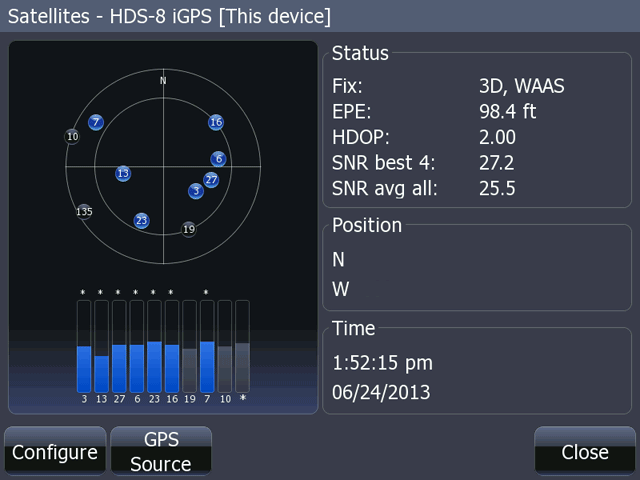
I left my chart plotter running on the bench this morning, waiting for SVN66 to appear as PRN27. Here it is:
|
| jimh |
posted 11-27-2013 09:17 AM ET (US)
The launch of a GPS satellite payload planned for October 23 was postponed by a decision to review the DELTA 4 rocket booster's upper stage engine. The space vehicle payload was GPS 2F-5, the fifth satellite in the Block 2-F series, which are described as an interim class of satellites being deployed in order to keep the system operational while a newer class, the Block IIIA satellites, becomes available. These Block II-F satellites weigh 3,600-lbs. The powerful DELTA 4 rocket can launch them directly into orbit. On its last mission, an October 4, 2012 launch of the GPS 2F-3, the DELTA 4 upper stage engine underperformed, producing less thrust than expected. Although the payload reached its intended orbit, the Air Force and United Launch Alliance have been conducting independent investigations into the cause of the anomaly. According to SpaceflightNow.Com, the launch of GPS II-F-5 has now been rescheduled for December 12, 2013. The launch of GPS-2F-4 was accomplished with a different launch vehicle, an ATLAS 5 rocket, on May 15, 2013. For more on the GPS 2F and GPS 3 series NAVSTAR satellites, see |
| Jefecinco |
posted 11-27-2013 10:45 AM ET (US)
[ASIDE:] I was surprised by the EPE on your last screen shot, particularly with WAAS turned on. Why such a large EPE? [Answer: The dilution of precision (DOP) is rather high due to satellite location geometry. That is probably the cause of the higher than expected uncertainty. --jimh] |
| jimh |
posted 12-02-2013 10:19 AM ET (US)
youTube has a nicely done recording and animation of the launch of the GPS 2F-3 satellite last October, available from https://www.youtube.com/watch?v=62LrwX-2u5k&noredirect=1 Watching the launch gives one a good impression of the enormous amount of effort that has to be expended to launch a GPS satellite. Billions of dollars are involved. |
| jimh |
posted 12-02-2013 11:09 AM ET (US)
The launch of GPS 2F-5 is now scheduled for December 12, 2013, less than two weeks from now. The satellite is numbered SVN-64 and will be launched into orbital plane D4 [actually it will be launched into orbital plane A3--jimh]. Its GPS signal will transmit with PRN 30. Currently PRN 30 is being sent by SVN-49, a GPS 2R-20 satellite. SVN-49 will be switched to PRN 06. The satellite currently using PRN 06, SVN-36 will be put into spare status. |
| jimh |
posted 12-11-2013 11:37 PM ET (US)
I was hoping that tomorrow, December 12, 2013, would see the launch of the United Launch Alliance DELTA 4 rocket that would put into orbit the U.S. Air Force NAVSTAR satellite GPS 2F-5. But now I see that on December 5 the launch was postponed again. This is the third postponement. Previously the satellite was also scheduled to be launched on October 17 and October 23 I cannot find any announcement of a new launch date. The current status is "to be determined" as reported by SPACEFLIGHTNOW.COM. |
| jimh |
posted 12-16-2013 02:11 PM ET (US)
I am watching the United Launch Alliance website at https://www.facebook.com/ulalaunch for any announcement of an update on the GPS-2F-5 launch. They have some great images of prior rocket launches there, too. |
| jimh |
posted 01-14-2014 09:27 PM ET (US)
According to information at http://www.spaceflightnow.com/tracking/index.html the launch of the GPS 2F-5 satellite (aka GPS IIF-5) by the ULA Delta 4 rocket is now on the schedule for February 20, 2104. This was apparently announced a few days ago, on January 8, 2014. |
| jimh |
posted 02-06-2014 07:01 AM ET (US)
I just noticed the launch schedule for the DELTA 4 carrying the GPS 2F-5 payload will put the launch into early evening on February 20, 2014. This is a rather impressive rocket launch, so if you are in the vicinity of Cape Canaveral it might be interesting to watch for this night launch. The launch is scheduled for 0140 GMT on 21 FEB 2014. That should be 8:40 p.m. on 20 February. |
| jimh |
posted 02-21-2014 10:05 AM ET (US)
After months of delay, the GPS 2F-5 was successfully launched last night. For details and many pictures see http://www.nasaspaceflight.com/2014/02/ula-delta-iv-launch-gps-iif-5/ Any eyewitness reports from the evening launch? |
| jimh |
posted 02-25-2014 01:41 PM ET (US)
For everything you could possibly want to know about the GPS-2F-5 launch, and more, all presented in beautifully drawn color illustrations, I highly recommend downloading this literature: http://forum.nasaspaceflight.com/index.php?action=dlattach;topic=30866. 0;attach=571871 For a nice recording of the launch with sound track, see |
| djahncke |
posted 02-25-2014 07:31 PM ET (US)
That pdf file is very well done. It even identified which TDRS satellites were used for telemetry. However, I must say I also enjoyed the launch video. Having witnessed several launches, the night time launches are my favorites. |
| jimh |
posted 02-25-2014 11:32 PM ET (US)
Re the literature: I thought it was a bit elaborate, but when one considers the cost of the satellite (a billion) and the cost of the rocket (half a billion), why not spend $50,000 on the brochure? |
| jimh |
posted 02-26-2014 12:21 AM ET (US)
This latest GPS satellite (GPS2F-5) has been designated space vehicle number (SVN) 64. That is a little odd because SVN65 and SVN66 are already in orbit. I guess this particular piece of hardware must have been pulled out of sequence for some reason and had just now gotten to the head of the line to go into orbit. SVN64 is going to take over psuedo-random number (PRN) 30, presently assigned to an existing satellite. Also, this satellite has been launched into orbital plane A3. The next GPS satellite launch will be SVN67 with GPS 2F-6, and the scheduled launch is for May 2014. You can keep track of all this at |
| |
Powered by: Ultimate Bulletin Board, Freeware Version 2000
Purchase our Licensed Version- which adds many more features!
© Infopop Corporation (formerly Madrona Park, Inc.), 1998 - 2000.