E-TEC 200-HP MODELS
Legacy E-TEC or G1 Small Block, 2.6-liter, 433-lbs
The legacy small block E-TEC or perhaps now the G1 small block E-TEC uses a 2.6-liter 60-degree V6 block. The engine block design was in use for many years with carburetor induction, before being adapted to the direct-injection methods used in the E-TEC family. This engine weighs 433-lbs. The engine was initially designed for mechanical throttle and shift controls, but was later re-fitted for the ICON EST (electronic shift and throttle) controls. I don't think there is much weigh variation in the ICON EST versions, as the removal of several mechanical components, their associated cables, and the multi-wire engine wiring harness probably takes off more weight than is added by the new assembly with servo motors and the single small cable that controls it. Gear ratio is 1.85:1.
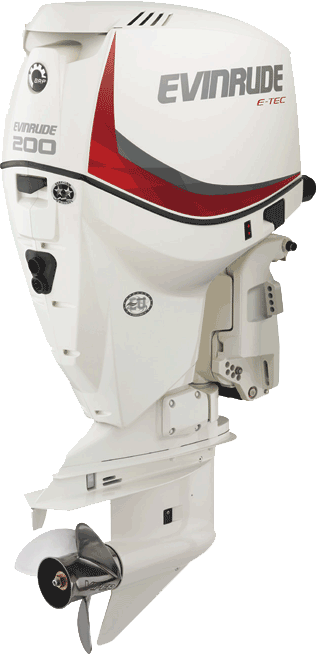
Full specifications at http://www.evinrude.com/content/dam/evinrude/Global/MY2017/Documents/Spec-PDFs/PY17-Ev-Specs_G1_200hp.pdf
Legacy E-TEC or G1 Large Block, 3.3-liter, 524-lbs
The legacy E-TEC or perhaps now the G1 E-TEC uses a 3.3-liter 90-degree V6 block. The engine block design was in use for many years, before being adapted to the direct-injection methods used with the E-TEC family. This engine is given the model designator 200 H.O. to differentiate it from a smaller displacement version (above). The engine weighs 524-lbs, or 91-lbs more than the small block engine. It was initially designed for mechanical throttle and shift controls, but was later re-fitted for the ICON EST (electronic shift and throttle) controls. I don't think there is much weigh variation in the ICON EST versions, as the removal of several mechanical components, their associated cables, and the multi-wire engine wiring harness probably takes off more weight than is added by the new assembly with servo motors and the single small cable that controls it. Gear ratio is 1.85:1.
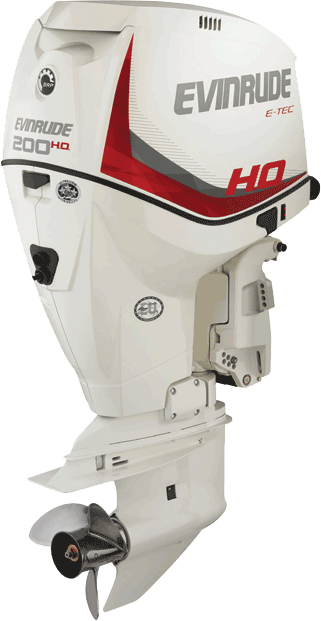
Full specifications at http://www.evinrude.com/content/dam/evinrude/Global/MY2017/Documents/Spec-PDFs/PY17-Ev-Specs_G1_200H.O..pdf
Newest E-TEC G2 2.7-liter, 541-lbs
The newest model, introduced in Summer 2016, uses a 2.7-liter 66-degree V6 block. The engine block is a new design, developed for this application, and it uses mirrored-bank layout. The control system uses the ICON II EST system, and no mechanical controls are available. The engine also includes an innovative engine mounting system that provides its own, integral, hydraulic steering actuator called Dynamic Power Steering (DPS). This eliminates the added external weight of the typical SeaStar center-mount hydraulic steering actuator. And the engine includes an electrically-operated steering boost pump, all contained in the mount. Again, this eliminates the external weight of an electrically operated hydraulic boost pump, several hoses, the fittings to connect together the external actuator and the boost pump, and the electrical cables to run the system. With those weight savings in mind, the engine weighs 541-lbs. This is actually 17-lbs more than the G1 large block, but the legacy engine has none of the integral steering features. Gear ratio is 2.17:1.
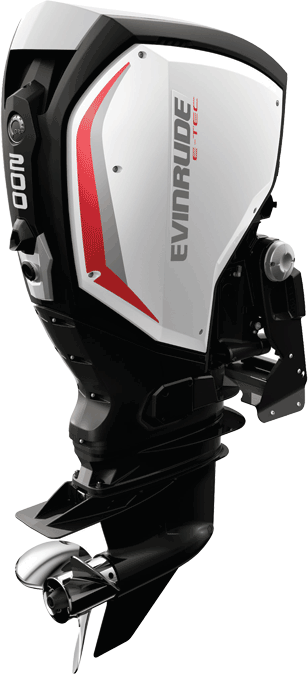
Full specification at
http://www.evinrude.com/content/dam/evinrude/United-States/Documents/Spec%20Sheets/Evinrude_Specs_200HP_G2_020317.pdf
Newer E-TEC G2 3.4-liter, 558-lbs
The new G2 engine was introduced in June 2014 and uses a 3.4-liter 74-degree V6 block of completely new design. This engine is given the model designator 200 H.O. to differentiate if from the smaller displacement version (above). Unlike all the other engines discussed here, this V6 does not use a mirror-block design. Instead a starboard-starboard block design is used, that is, the same layout of the cylinder ports is repeated on each side instead of being mirror or flipped. This control system was designed around electronic shift and throttle actuators. It uses the ICON II EST system, and no mechanical controls are available. The engine also includes an innovative engine mounting system that provides its own, integral, hydraulic steering actuator called Dynamic Power Steering (DPS). This eliminates the added external weight of the typical SeaStar center-mount hydraulic steering actuator. And the engine includes an electrically-operated steering boost pump, all contained in the mount. Again, this eliminates the external weight of an electrically operated hydraulic boost pump, several hoses, the fittings to connect together the external actuator and the boost pump, and the electrical cables to run the system. With those weight savings in mind, the engine weighs 558-lbs. This is 34-lbs more than the G1 large block, but the legacy engine has none of the integral steering features. Gear ratio 1.85:1
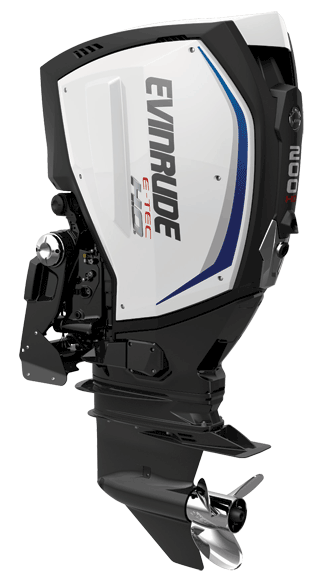
Full specifications at
http://www.evinrude.com/content/dam/evinrude/Global/MY2017/Documents/Spec-PDFs/PY17-Ev-Specs_G2_200H.O..pdf
SOME COMPARISONS
In the evolution for G1 to G2, the displacement has increased. For the small block engines, displacement increased to 2.7-liter from 2.6-liter. In the large block engines, displacement increased to 3.4-liter from 3.3-liter. (Note that a 3.4-liter variant of the G1 was available in the 250 to 300-HP models.) The G2 engines use new block designs, based on 66-degree and 74-degree, compared to the G1 designs using 60-degree and 90-degree V-blocks.
In this comparison of four 200-HP models, we see the weight varying from 433-lbs to 558-lbs, a gain of 125-lbs to heaviest from lightest. The progression is
G1 200 = 433-lbs
G1 200 H.O. = 524-lbs
G2 200 = 541-lbs
G2 200 H.O. = 558-lbs
The advantage of the G2 engines over the G1 models is apparent in several areas:
--the fuel economy of the G2 is improved compared to G1
--the exhaust emissions of the G2 are lower than the G1
--higher torque is available over a wider engine RPM band in G2 compared to G1