1969 NAUSET 16: Sloshing Water Under the Deck

Repair or modification of Boston Whaler boats, their engines, trailers, and gear
redpillbluepill
Posts: 3
Joined: Tue Nov 11, 2025 10:56 pm

1969 NAUSET 16: Sloshing Water Under the Deck

Postby redpillbluepill » Tue Nov 11, 2025 11:08 pm

Q1: what could cause a sound of sloshing water to be heard and appearing to come from inside the hull at the aft starboard corner when the hull is rocked while on the trailer with the aft starboard corner being the lowest point?

Q2: even though the sump appears dry, could free water being hiding [in the Unibond hull]?

Q3: on a 1969 NAUSET 16 can there be a depressed area in the rigging tunnel or trapped debris in the rigging tunnel that could hold a shallow pool of water in the tunnel aft of the console where it cannot be seen?

Q4: could a a small delaminated cavity [in the Unibond hull] trap enough free water to make noise?

Q5:[if a small delaminated cavity in the Unibond hull is possible and could trap enough free water to make noise, where] on a NAUSET 16 [is the most likely location of such a cavity]?

Q6: what would YOUR first action be with a 1969 NAUSET 16 [to find the source of a sloshing noise in the aft starboard corner]?

BACKSTORY
[Recently I purchased] a clean 1969 NAUSET 16 that was cosmetically solid, had intact bottom paint with no scars, a transom that felt rock-steady, and decks that are firm and have no soft spots. I saw no evidence of prior, The boat had not been in the water for a while. But here is a mystery:

With the boat on a trailer and on an incline so that the aft starboard corner is the lowest point, if I gently rock the boat on the trailer I hear a distinct sloshing at the aft starboard corner, coming from under the deck. There is nothing obvious topsides, there is no puddle in the splash well, there is no standing water in the sump I can see, and peeking into the console opening with a mirror I don’t see water in the rigging tunnel either. Yet the sound is there, like a few gallons sloshing back and forth somewhere that I can’t quite access.

MY PLANS

  • I will orient the trailer so the boat is bow-high, remove the overboard drain in the sump, and see if I can coax anything to move or drain;
  • I will iInspect the drain in the sump, the splashwell, and the bow locker for pitting and looseness; I will check the bedding and replace the bedding if questionable;
  • if the noise persists and nothing shows, before I go down any drastic path, I may weigh [the hull in order to] to rule out meaningful water mass.
jimh
Posts: 13285
Joined: Fri Oct 09, 2015 12:25 pm
Location: Michigan, Lower Peninsula
Contact:

Re: 1969 NAUSET 16: Sloshing Water Under the Deck

Postby jimh » Wed Nov 12, 2025 8:57 am

redpillbluepill wrote:Q6: what would YOUR first action be with a 1969 NAUSET 16 [to find the source of a sloshing noise in the aft starboard corner]?
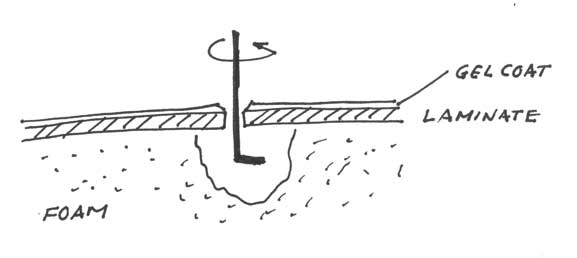
In the location where you think the sound is occurring, and with the boat oriented on the trailer so that area is the lowest point in the cockpit, I would drill a 0.25-inch diameter hole through the deck, just deep enough to penetrate the gel coat and laminate layers, and drill into the foam interior perhaps another 0.25-inch, and then immediately observe if any water flows out.

I would also check to see if there was a strong bond between the laminate and the foam.

If there were any doubt, I would remove some foam below the deck to intentionally create a void or pocket, and then see if that void fills with water. Figure 1 below shows how a small an Allen wrench can be used to remove foam below the laminate through a small diameter hole.

Image
Fig. 1. Use an improvised tool like a small Allen wrench to remove foam below the deck through a small hole. Remove the loose foam through the hole with suction from a vacuum.

You can also inspect the removed foam to see if was wet with water.

If you drill the hole in an area that is not a non-skid pattern, you can very easily repair the hole with some thickened resin, such as epoxy resin that has been tinted to a close match to the gel coat color. You might even find some small quantity of pre-tinted epoxy resin that was a close match, such as a tiny 2-ounce bottle of a product sold as "White Marine-Tex" that sells for $21. But a much better choice is to get a WEST Systems fiberglass repair kit for about $23, which is more versatile and includes enough material to be used for many small future repairs. See

https://defender.com/en_us/west-system-handy-repair-pack-101?

redpillbluepill
Posts: 3
Joined: Tue Nov 11, 2025 10:56 pm

Re: 1969 NAUSET 16: Sloshing Water Under the Deck

Postby redpillbluepill » Wed Nov 12, 2025 2:50 pm

Thank you for the reply.

I jacked up the trailer tongue, and I drilled a few quarter-inch holes on the deck. [Water began to flow out from the deck holes].

I drilled a few [more quarter-inch holes] on the hull, [and I got the] same [outcome, that is, water flowed out from the holes.]

waterFlowFromHull.jpg
Fig. 1. Water flow from hole intentionally drilled into the hull.
waterFlowFromHull.jpg (8.96 KiB) Viewed 508 times


[The water has] now [been flowing out of the deck and hull] for about ten minutes [with] no sign of letting up.

Q7: after the water stops draining from the holes, should I [weight the hull]?

The hull is bare now which would help. I got a good deal on the boat, but now I know why.

Q8: [based on what I have described so far] is this [boat] is a lost cause?

--Alex

jimh
Posts: 13285
Joined: Fri Oct 09, 2015 12:25 pm
Location: Michigan, Lower Peninsula
Contact:

Re: 1969 NAUSET 16: Sloshing Water Under the Deck

Postby jimh » Thu Nov 13, 2025 9:19 am

The location of the hole you drilled in the hull as seen in Figure 1 is located rather high on the hull side. It is possible that water will stop draining from that hole but more water will remain below the hole.

redpillbluepill wrote:Q7: after the water stops draining from the holes, should I [weight the hull]?
If you can conveniently weigh the hull now and later repeat that exact same method, having a log of the change in boat weight after various remedies to remove more water from the hull will be a good way to measure success in removal of the water


redpillbluepill wrote:Q8: [based on what I have described so far] is this [boat] is a lost cause?
I don't think that after ten minutes of seeing water drain you are in a position to know what further repairs may be needed. You need to wait for a week and see at what rate water has continued to flow out. Also, you probably need to drill more holes in lower parts of the hull so that you continue to test for the presence of water.

Removal of water from a Unibond hull that has a large volume of water contained in its foam interior can be a long process. You should read about another hull that was de-watered and the time it took. See

Cetacea Page 67
https://continuouswave.com/whaler/cetac ... age67.html

Alaskan Squall - 17 years of drying out
https://continuouswave.com/forum/viewtopic.php?t=4593

Alaskan Squall - The End
https://continuouswave.com/forum/viewto ... 033#p47033

In the case of the 11-foot SQUALL about 100-holes of 0.5-inch diameter were drilled as part of the de-watering process.

redpillbluepill
Posts: 3
Joined: Tue Nov 11, 2025 10:56 pm

Re: 1969 NAUSET 16: Sloshing Water Under the Deck

Postby redpillbluepill » Fri Nov 14, 2025 3:45 pm

Thank you Jim for your replies.

Q1: Given your experience with waterlogged whalers, does many gallons of standing water in the hull necessarily mean I have exceedingly saturated foam?

My thinking is that the water must have fully saturated the foam, or there must be a cavity in the hull where the fiberglass has separated from the foam. Otherwise, there would have been no sloshing sound.


I do not have a *convenient* way of weighing the hull, though I may try to float it and mark the waterline to gauge my progress. I plan to hoist the bow up to an extreme angle, and drill several holes at the lowest point in the hull. Let drain naturally for a week. Then use a shop vac fanned out to the holes to vacuum as much moisture out as possible. I also had the thought of drilling a few holes on the deck nearer the bow, and placing some kind of inverted container with a space heater blowing into it. The idea is the vac will be pulling warm dry air through the boat.
Alex