Hello. I have a Revenge 22 W-T with a 1995 Yamaha Saltwater Series 225 [two-stroke-power-cycle engine]. Late last year the engine started surging in the mid-range RPM band. Engine speed would fluctuate up and down and the engine wouldn't hit full throttle. I had the engine serviced at the end of season last year: new plugs and filters [were installed] and all fuel lines checked. No [problems were found].
I just launched the REVENGE 22 W-T with Yamaha 225-HP Saltwater Series, now with new fuel, [new] filters, and Ring Free [fuel additive]. [The engine is] surging again. [The engine surging is] not too serious but is a concern. The engine speed drops, then surges back, then drops again at about mid throttle. Also, [the engine] still can't [accelerate to the recommended] full RPM.
Any ideas would be helpful!
Thanks
Yamaha Saltwater Series 225 Surging
Yamaha Saltwater Series 225 Surging
Owner of a 1987 22' Revenge W/T. 1995 225 Yamaha Saltwater Series
Seattle, WA
Seattle, WA
Re: Yamaha Saltwater Series 225 Surging
Your efforts to provide a remedy to the engine speed surging up and down have so far been limited to the fuel system. Another cause of the engine speed surging at mid-throttle engine speeds could be from loss of a cylinder. Combustion in a cylinder could be dropping out due to loss if spark. I recommend you employ an in-line spark test tool to verify that each cylinder has good spark during those times when the engine is surging. You could have no spark on one cylinder. Electrical problems can come and go very suddenly. Electrical problems can be caused by loose connections. Electrical problems can also be brought on by heating of the components. An in-line spark tester is a simple diagnostic tool that will permit you to verify each cylinder has good spark.
In a spark ignition circuit you generally find the following components:
--plug
--high-tension wire
--coil, high voltage or secondary winding
--coil, low-voltage or primary winding
--low-voltage wire
--coil driver circuit
--driver circuit timing source
--driver circuit voltage source
The driver circuit timing source is usually a pick-up coil under the flywheel which is excited by magnets. These coils are sometimes called the "timer base." The driver circuit voltage source is usually one or more coils under the flywheel which are excited by magnets.
All these coils are sometimes integral with other coils and are called "the stator." On some motors there may be dual coils for generating the driver circuit voltage, each optimized for a certain engine rotation speed range, and these are sometimes called "the low speed stator" and "the high speed stator."
If you are not getting spark, begin at the spark plug and work backwards toward the stator. If you have an engine with multiple cylinders you have a source of alternative parts to swap into the circuit for testing for many of the elements.
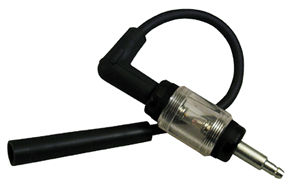
An in-line spark tester is a good way to determine if your cylinder is getting spark while the engine is running and the spark plug is in place. An in-line spark tester is a test device which can be inserted in the high-voltage spark wire. They typically have one connector which mimics a spark plug electrode and another which is a spark plug boot connector. You can remove a spark plug wire from the spark plug and insert the in-line spark tester on that cylinder. The tester has a small spark gap contained inside a transparent glass cylinder. This allows you to visually observe the spark. You can typically find these at stores that sell automotive supplies. I got mine from master mechanic David Zammitt at Lockeman's Boat and Hardware.
20610 LISLE In-line Ignition Spark Tester
In a spark ignition circuit you generally find the following components:
--plug
--high-tension wire
--coil, high voltage or secondary winding
--coil, low-voltage or primary winding
--low-voltage wire
--coil driver circuit
--driver circuit timing source
--driver circuit voltage source
The driver circuit timing source is usually a pick-up coil under the flywheel which is excited by magnets. These coils are sometimes called the "timer base." The driver circuit voltage source is usually one or more coils under the flywheel which are excited by magnets.
All these coils are sometimes integral with other coils and are called "the stator." On some motors there may be dual coils for generating the driver circuit voltage, each optimized for a certain engine rotation speed range, and these are sometimes called "the low speed stator" and "the high speed stator."
If you are not getting spark, begin at the spark plug and work backwards toward the stator. If you have an engine with multiple cylinders you have a source of alternative parts to swap into the circuit for testing for many of the elements.
An in-line spark tester is a good way to determine if your cylinder is getting spark while the engine is running and the spark plug is in place. An in-line spark tester is a test device which can be inserted in the high-voltage spark wire. They typically have one connector which mimics a spark plug electrode and another which is a spark plug boot connector. You can remove a spark plug wire from the spark plug and insert the in-line spark tester on that cylinder. The tester has a small spark gap contained inside a transparent glass cylinder. This allows you to visually observe the spark. You can typically find these at stores that sell automotive supplies. I got mine from master mechanic David Zammitt at Lockeman's Boat and Hardware.
20610 LISLE In-line Ignition Spark Tester