 ContinuousWave
 Whaler
 Moderated Discussion Areas
ContinuousWave: Whaler Repairs/Mods
Teak Finish
Moderated Discussion Areas
ContinuousWave: Whaler Repairs/Mods
Teak Finish


search | FAQ |
profile | register | author help
|
|
ContinuousWave Whaler Moderated Discussion Areas
ContinuousWave: Whaler Repairs/Mods
Teak Finish
|
| Author | Topic: Teak Finish |
| jimh |
 posted 12-09-2007 01:46 PM ET (US)
posted 12-09-2007 01:46 PM ET (US)  
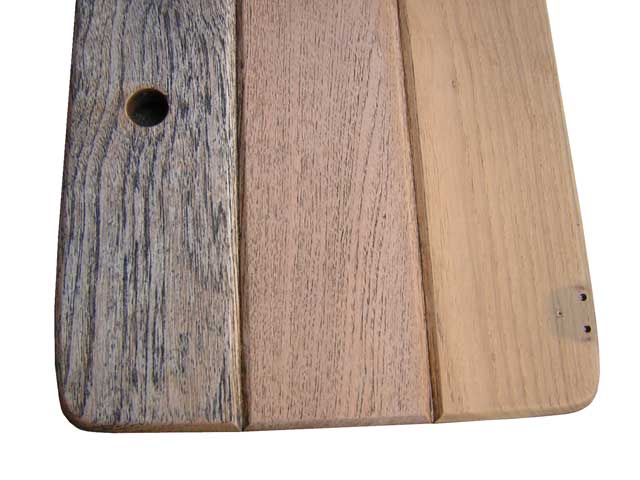
This season I noticed the teak on my boat was beginning to weather. In August we would attend a Boston Whaler dealer-sponsored rendezvous event, so I wanted the 1990 Boston Whaler REVENGE 22 W-T Whaler Drive boat in Bristol condition--or at least as close to Bristol as you can get in Northern Michigan. The teak had not received any special care in about two years. It was time for some refinishing. In the process I took a couple of photographs to document the work. Below is a photograph of a hatch cover which shows three stages of the project. On the left side is the weathered teak. The finished had degraded to this state after about two seasons of use. The boat spends most of its time indoors, and often it is also covered. In any case, it is out of direct sunlight and rain. But even with that protection, the teak had weathered. The wood had begun to turn gray and black lines infested the grain. In the middle section of the hatch the teak has been scrubbed and cleaned using a popular teak cleaning solvent, Amazon Teak Cleaner. The wood is wetted and the cleaner applied with a scrubby-sponge. This removes most of the black grain lines and generally brightens up the teak. On the right section the teak has been both cleaned and sanded. The sanding was done with a vibrating type sander and used paper of about 120-grit. (I am afraid I don't have a sample of it handy to verify the exact grade and coarseness.) This step removes some wood, so you don't want to sand too often. Also, teak saw dust can be quite irritating. I wear a mask and sand outdoors.
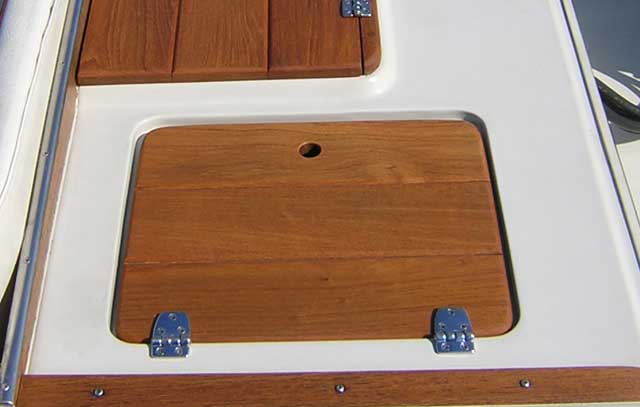
The next photograph shows the hatch on the stern deck of the boat. The teak has been treated with a preparatory product, Amazon Teak Prep, which seems to be a very light oil with some volatile solvent. It is supposed to help remove any trace of the cleaner and neutralize the wood. This coat tends to evaporate off the wood, although it does darken it and leave a bit of finish. After the Prep has dried, the teak is oiled with Amazon Golden Teak Oil. I have had this particular bottle for years, so it may not be the freshest possible oil. Several coats of oil are applied and allowed to soak into the teak.
The finish that results is a nice, light, not-too-dark natural teak color. If you look closely you can see a slight greenish tint, and this is not an artifact of the photograph. This is evident in the wood when it is first oiled, but it seems to fade with age. The trim strip in the foreground was finished in-place. The same technique was used, but the sanding was done by hand. During the boating season additional coats of oil were applied. This area of the boat generally does not get wet from spray. Most of the water that falls on it probably comes from the heavy dew we get on cold summer mornings in the northern Great Lakes. However, even in a few seasons the teak can become weathered and will need attention. |
| whaler710 |
posted 12-09-2007 03:11 PM ET (US)
Thanks for sharing your results of the product application that you used and the sanding process on your Whaler. . what a difference your efforts made. great pictures and great looking teak. |
| DeeVee |
posted 12-09-2007 07:11 PM ET (US)
Jim, Your teak looks great. My 1989 Outrage did not have much teak on it from the factory. Previous owners had removed the teak console doors and replaced with rather shoddily fabricated black starboard doors. I have acquired a console side door and am currently looking for the aft console door. One day I will have it looking nice again. My brother in law's Outrage 25 with the 40" Super Console and Super Leaning Post is loaded with teak. It has no teak gunnel caps, but many teak access doors. We have also added teak to the horizontal dash surfaces of the console (including fiddle rails so items don't fall off the dash easily) and the top of the electronics box. When everything is oiled up, it looks great. I love teak! |
| jmorgan40 |
posted 12-10-2007 07:10 PM ET (US)
Jim, Thanks for the pictues and how to on the teak. I also was curious why the teak weathers and gets the black streaks even when taken care of. My teak is oiled 3-4 times per year and the boat always kept in covered storage. Even with this care I usually must treat with a cleaner and sand at least every second or third year. Joe |
| PeteB88 |
posted 12-10-2007 10:17 PM ET (US)
Freaking nice Jimh, thanks for such an illustrative thread. |
| prj |
posted 12-10-2007 11:40 PM ET (US)
That is a beautiful image of various teak conditions using your 3-plank hatch cover. It has been written on this website that some (or all by nature of their purpose?) of the teak cleaners or restorers appreciably degrade the teak, etching out the soft grain and leaving it uneven. Did you find this to be the case at all? Clearly sanding removes some wood, but I think that can be substantially reduced through selecting proper fine grits and, more importantly, keeping the teak oiled and protected. |
| jimh |
posted 12-18-2007 12:31 AM ET (US)
Using the teak cleaner does tend to make the wood swell slightly and raises the grain. Some of this raised grain has to be sanded down in the next step in finishing. So in one sense, the cleaner step adds to the sanding step. I also plan to try Tri-Sodium-Phosphate (TSP) as a cleaner when I next work on the teak. I have also used a brush with bristles to apply the cleaner, trying to get it into the darker grain areas. I make a compromise between sanding down far enought to completely remove every last trace of black in the grain, and preserving more of the wood. So the final finish still has a bit of black in the grain. Oiling teak as a finish requires more frequent re-applications than if a varnish finish is used. Varnish tends to require more work in the initial application, but if a nice varnish finish is built up, it may be easier to maintain. On the other hand, if a varnish finish is ignored too long, it will have to be completely removed, and this will required a lot of sanding. |
| andygere |
posted 12-18-2007 01:22 AM ET (US)
Nice brightwork Jim. I have had pretty good luck keeping teak looking good with a Amazon's one step non-acid teak cleaner. It's some type of detergent, and does a pretty good job of getting it clean, providing you don't let it go too long before cleaning. The wood needs to be re-oiled afterwards. |
| dfmcintyre |
posted 12-18-2007 07:37 PM ET (US)
For about 10 years, we owned a 25' Revenge with the teak covering boards. Also mounted a teak swim platform. I too, used the solution that would either remove some of the softer grain or raise the harder grain, take your pick. About every third year, I'd remove all the hardware, i.e. grab rails, etc and sand down with 120 then 220, then apply oil. The other years was just using the solution with bronze wool. Do not use steel wool, as small bits of wool will lodge in the grain. Using bronze eliminates any rust appearing. Best - Don |
| jeffs22outrage |
posted 12-28-2007 12:27 PM ET (US)
Jim, Here is my process for teak oiling: I learned to finish fine teak and mahogany furniture from one of my professors at art school. And figured if it worked on furniture is should work on boats. I always had great success with it. This process should be used if you are finishing a new piece of wood or have stripped / sanded an old piece back down to new wood. I recommend using I recommend either The star bright premium teak oil I have found to be just down right poor. After a week the finish is already starting to look bad again. Process First 4 coats should be done every 15 minutes with a Jersey-knit rag. The rag should be soaked and leaving a heavy coating each time. Let the wood sit for an hour. Second 4 coats should be done every 1 hour with a Jersey-knit rag. The rag should be soaked and leaving a heavy coating each time. Let the wood sit overnight in temps above 50 degrees. In the morning using a heavy terri-cloth rag remove any oil still on the surface. Last four coats should be done every 2 hours with a Jersey-knit rag. The rag should have a medium amount of oil on it just leaving a fine film of oil on each coating. After the last coating let the wood sit for 2-4 + hours. Go back after that time with a heavy terri-cloth and begin to work the excess oil on the surface of the wood to and matte - semi gloss shine by a heavy back and forth polishing action. Let the parts cure for a day before getting the wet. If they get wet before cured they will have water marks in the finish. If you can let them bake in the hot sun that is the best for curing. With this process my teak on my 22 outrage stayed in the matte - semi gloss state for nearly the entire summer under a mooring cover. To redo the teak may require a light sanding of 400 - 600 grit paper. I used wet sand paper and wet sanded the wood and finish. Sometime I just recoated over the finish as is. I applied one heavy coat and let it sit for a half hour and finished with a lighter one and let it sit for an hour or two then polished the remaining oil back to this type of finish. Here is a photo of the finish I get after polishing the final coat of oil. http://img.photobucket.com/albums/v427/jeff_rohlfing/ 22%20Outrage%20cleaning%207-07/DSCN4693.jpg http://img.photobucket.com/albums/v427/jeff_rohlfing/ 22%20Outrage%20cleaning%207-07/DSCN4688.jpg http://img.photobucket.com/albums/v427/jeff_rohlfing/ 22%20Outrage%20cleaning%207-07/DSCN4689.jpg http://img.photobucket.com/albums/v427/jeff_rohlfing/ 22%20Outrage%20cleaning%207-07/DSCN4697.jpg http://img.photobucket.com/albums/v427/jeff_rohlfing/ 22%20Outrage%20cleaning%207-07/DSCN4690.jpg |
| jimh |
posted 07-20-2009 09:26 AM ET (US)
This spring at an Art show I found a woodworker who had crafted many fine wooden pieces, typically ornate small cabinets, with a beautiful oiled wood finish. The finished appearance of these fine woods was exactly as I would like the teak on my boat to appear. I asked him about his technique of applying the oil. The procedure he described was very similar to what Jeff has detailed above: multiple coats, lots of hand rubbing, and some sanding between coats, too. Jeff--Can you elaborate on precisely what is a Jersey-knit rag? Can I get them at MURRAY"S DISCOUNT AUTO? |
| jimh |
posted 07-20-2009 09:28 AM ET (US)
I revived this two-year-old thread because the teak on my boat is back to the condition shown above. In just two years, the black mildew in the grain has reappeared. |
| jimh |
posted 07-20-2009 09:30 AM ET (US)
Also--Jeff: Is there a local woodworking shop that sells those fine teak oils? |
| JaySul |
posted 07-20-2009 10:13 AM ET (US)
Jim, For the last several seasons I followed your same regimen of cleaning, sanding and oiling my teak with all the same products you used and ended up with darkened teak later in the summer. This year, however, I followed Tom W. Clark's lead and ordered a quart of Daly's Seafin teak oil (which it turns out can be ordered from West Marine) and could not be happier with the result. Like most teak oils, it has a bit of lacquer in it, but unlike any other it builds a semi protective coating after several coats and somehow keeps the wood bright. I will never use any other oil. By the way your wood looks great. |
| Slippery Eel |
posted 07-20-2009 10:46 AM ET (US)
I just saw the Watco product at my local ACE hardware. |
| Jeff |
posted 07-20-2009 10:54 AM ET (US)
Jim, A jersey knit rag would be like a cut up cotton T-Shirt like fabric. It is a tight knit cotton fabric. As for the products, I buy the Belhen product at Rocklers Woodworking supply at Webster (about 12.5 mile) on the east side of Woodward. I think they carry the Watco products now as well. If not I purchase the Watco oil at the Lowes at 12 mile and I-75. If you want a hand I would be willing to give you a demo of how I do this process. I can come over one evening or on the weekend. Jeff |
| L H G |
posted 07-20-2009 01:03 PM ET (US)
JimH has pointed out the reason I gave up on teak oils a long time ago. They just don't last and if you're a teak perfectionist like I am, you will end up sanding down all of your teak until the cross section is thinned out. Both Daly's and the oil Jeff is recommending have higher varnish content, which is where the protection. Jeff's method is simply letting the varnish dry and build up. the reason most teak oils recommend wiping off after 10 minutes, is to prevent the varnsih from drying and building up. So I just use varnish to begin with, and sand wood only once. In the long run, it's much easier to keep the teak looking dark and beautiful, and eliminates all the dirty work of continual sanding. What's not to like about this stern hatch cover: http://smg.photobucket.com/albums/v429/lgoltz/Outrage%2019/?action=view& current=R1-10.jpg . |
| TransAm |
posted 07-20-2009 01:22 PM ET (US)
If you do not like the high gloss finish of traditional varnish, Epifanes makes a matte finish varnish. I re-milled and installed all new wood trim this spring and treated it first with 2 coats of epoxy, 6 coats of regular gloss varnish and 2 coats of matte varnish. It came out great with a nice, warm look of oiled wood. |
| Jeff |
posted 07-20-2009 02:55 PM ET (US)
Larry, Yes, the oils I use have additives that allow the oil left on the surface after the wood is saturated to dry to a hard surface (kind of like a varnish). Cheap oils, basically non furniture grade and marine oils dry to a gummy finish when over saturated. The problem I have with varnishing teak is that if becomes a very slippery surface when wet. Varnished teak walk on surfaces have been down right dangerous in some instances with my experiences. The oil allows more grip when wet and dries to a satin like luster (which I perfer on teak). This is mainly because the oil seals over the grain texture instead of filling and building over grain like a varnish. This filling of the gain requires a lot of material removal if you ever want to go back to an oiled finish. What is right and what is wrong is up to personal preference. I have always felt the teak should be left in an oil finish while mahogany should be varnished. That said, I finished all the new sapele mahogany parts I made for my Newport in a quality spar varnish and it has been maintenance free. Which is nice, I just am not looking forward to the day I have the revarnish. Which is more of a pain, a little sanding an oiling ever year or, a major stripping and revarnish every so many years? |
| Narragansett Outrage |
posted 07-20-2009 04:12 PM ET (US)
Jeff, I certainly don't have long term personal experience to back it up, but I did an enomrous amount of research on varnish before deciding to go with the brand that I eventually chose. One of the issues that has held me back in the past from varnishing is the thought that if water ever got under it, I'd have to remove every last bit of varnish before re-varnishing. And also that, even if it didn't start to chip, it would eventually yellow, requiring the same process. I was turned on to Le Tonqinois by a person at the Yacht Restoration School in Newport. I'm not sure if it's all marketing, but apparently this varnish does not yellow with exposure to UV, and if it ever chips, you only have to sand out the part that chipped and recoat. In their FAQ, they also specifically say that it is not slippery. http://www.letonkinoisvarnish.co.uk/VarFAQ.html Truth? Don't know. Will let you know in ten years, though. |
| jimh |
posted 07-20-2009 08:33 PM ET (US)
When I first met L H G and saw his beautiful WHALE LURE, all the teak was oiled. At that time Larry was an advocate of oiling teak, but, as he notes above, he eventually switched to varnishing the teak. As mentioned, in the long run if the varnish is applied to a very thick layer, say at least six coats and perhaps more, the durability of the varnish is quite good. A boat with varnished teak can go more than two seasons without needing much attention. Some elements of the boat certainly can tolerate a high gloss and varnish finish. However, as Jeff mentions, some elements like the gunwales are not really suited to a high-gloss varnish finish. In fact, when stepping aboard a boat where the gunwale wood has been finished to a high gloss, you tend to feel like you should not step on the gunwales because they are too highly finished. It would be like walking across the lid of a piano. I plan (someday) to re-finish some of the wooden components on my boat with varnish, but I may leave some with an oiled finish. Jeff--Thank you for the pointers to local sources of fine teak oils, and also for the offer to help someone like me who is still in the novitiate period of wood-working with the process. One thing I have learned from many rendezvous and other gatherings: there is nothing that draws a crowd like a classic Boston Whaler with its teak or mahogany in perfect condition. |
| Orca |
posted 07-21-2009 12:34 AM ET (US)
Has anybody used paint base #4 instead of varnish as a superior UV inhibitor? I am experimenting on mahogony now but the results will take some time. |
| |
Powered by: Ultimate Bulletin Board, Freeware Version 2000
Purchase our Licensed Version- which adds many more features!
© Infopop Corporation (formerly Madrona Park, Inc.), 1998 - 2000.