 ContinuousWave
 Whaler
 Moderated Discussion Areas
ContinuousWave: Whaler Performance
A 3-way Propeller Comparison on the 160 Dauntless
Moderated Discussion Areas
ContinuousWave: Whaler Performance
A 3-way Propeller Comparison on the 160 Dauntless


search | FAQ |
profile | register | author help
|
|
ContinuousWave Whaler Moderated Discussion Areas
ContinuousWave: Whaler Performance
A 3-way Propeller Comparison on the 160 Dauntless
|
| Author | Topic: A 3-way Propeller Comparison on the 160 Dauntless |
| Marlin |
 posted 09-24-2006 07:55 PM ET (US)
posted 09-24-2006 07:55 PM ET (US)  
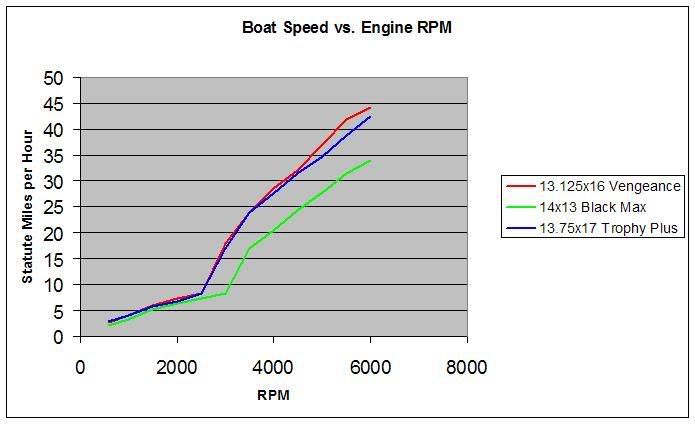
This year I had the opportunity to test three different propellers on my 2003 160 Dauntless with a Mercury 115 4-stroke. I hope that others may find this information useful. As those who have read my other posts know, I'm a pretty big fan of this boat and engine. However, the boat is certainly prone to porpoising, particularly at low planing speeds. I've added an SE-200 hydrofoil on the lower unit with good results, with the engine mounted one hole up from the lowest position. The 115 EFI 4-stroke is fairly quiet and extremely fuel efficient. For the last two seasons, my overall fuel usage has been just under 2 gallons per hour, and there's not a lot of trolling wrapped up in that number. The engine is not a torque powerhouse though, and seems to need to wind up pretty well to deliver real power. Overall, it's not terribly unlike any typical normally aspirated inline-4 DOHC engine that you might find in a compact car. The engine has a 2.07:1 gear ratio. First, some qualitative information: 13-1/8 x 16 Vengeance The boat was delivered with a 13-1/8 x 16 Vengeance, a fairly basic 3-blade stainless steel propeller. I've always thought that this prop was a pretty good match for the boat, as it winds up to 6,000 RPM or perhaps 6,200 if the boat is very light. However, I've never been thrilled with the boat's acceleration with this propeller; with 4 or more adults on board and a full 45-gallon tank of fuel, it can sometimes be difficult to get the boat on plane without banishing passengers to the bow seat. Interestingly, this prop seems to have a higher "effective pitch" than the 16 inches indicated by its stamp. In various tests of speed vs. RPM, the prop consistently shows extremely low (indeed, sometimes negative) pitch at higher speeds. Overall, it appears to perform like I'd expect from an 18 inch pitch. Still, it's a pretty good match for the boat and motor, allowing a comfortable 24 MPH cruise at 3,500 RPM, with a top speed of 44.5 MPH at 6,000 RPM. 14 x 13 Black Max This season we started doing some waterskiing with the boat. It was immediately obvious that the 16 inch Vengeance just wasn't going to get the job done. Even with the boat fairly light with two people and a half tank of fuel, it was an incredible chore to pull up a skier. So, in the midst of our vacation on Lake Champlain in upstate New York, I went looking for a suitable ski prop. What was available at a somewhat reasonable price was a 14 x 13 Black Max 3-blade aluminum prop. I was concerned that the pitch might be too low, but was equally concerned that a 14 x 15 might not be low enough, since I was already running the 16 inch Vengeance. The 13 inch Black Max turned out to be a real stump-puller. The boat instantly jumped on plane, and it was no problem at all to pull up skiers. Mission accomplished for vacation! Of course, the acceleration came at a hefty price -- my comfortable 25 MPH cruising speed now had the engine running about 4,700 RPM, and top speed was down to only 34 MPH. In addition, trim range was severely restricted since this propeller would ventilate quite easily when trimmed up, in sharp turns, or during acceleration. Once the prop got hooked on air, it usually required throttling way back to get a good bite on water again. It was pretty clear that this wasn't going to be an every-day prop, though in fairness that wasn't the point when I bought it. The search for a do-it-all prop continued. 13-3/4 x 17 Trophy Plus Late in the summer I finally got my hands on a fairly inexpensive used Trophy Plus 4-blade stainless steel prop. This propeller uses Mercury's "Performance Vent System" (PVS), which allows exhaust gasses to vent through holes in the hub to cause the prop to ventilate at low speed. The objective is to allow the motor to quickly spin up into its peak power range. The vent holes have various-sized plugs -- solid, small, medium, or large holes. For extra-large vents, I suppose one could just leave the plugs out. Since I had to start someplace, I installed medium vent plugs. The acceleration performance of the Trophy Plus was immediately obvious. The boat leapt out of the hole much more quickly than the Vengeance! Trim range was noticably extended, as the Trophy Plus would keep a good bite on the water when trimmed out much further than either of the other props. The Trophy Plus is described as having good bow lift; I'm not sure I buy into the whole bow lift thing, but I must say that at WOT there doesn't seem to be very much of the boat in the water, and the ride is smoother and more controllable than WOT with the Vengeance. Running at high speed (about 35 MPH) in one-foot chop was reasonably comfortable; in the past the same thing has been painful with the Vengeance. Top speed is slightly lower than the Vengeance at 42.5 MPH. In general, the prop seems very well suited to this boat and motor. Now for some quantitative information: The graph shows the boat speed across the RPM range for each of the three props. The Vengeance and Trophy Plus have remarkably similar performance, with the Vengeance pulling out in front a bit at very high RPMs. In fairness, this may be partly due to the fact that one blade of the Trophy Plus has a little 1/4 inch bend at the tip; I'll get that fixed in the off season. This similarity in performance confirms my thoughts that the Vengeance performs as if it had a higher pitch than its listed 16 inches. The Black Max, of course, is far below the other two props due to its very low pitch. Speed data was collected in fairly similar conditions, with 1 or 2 people on board and about half a tank of fuel. Speed was measured with a WAAS-enabled GPS and averaged over reciprocal headings. More interesting is the boat's acceleration performance:
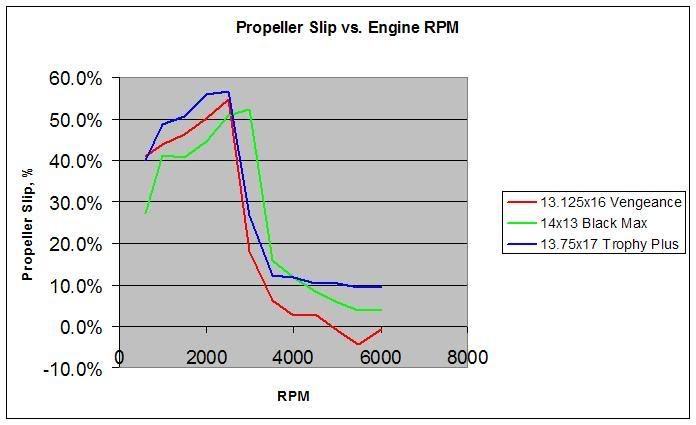
Measurements are taken with WOT starts from idle in gear. Let me note that while GPS receivers are very good at accurately measuring speed, they're not so great at accurately measuring acceleration. My GPS only provides data at 1-second updates, and my gut feel is that the speed measurement lags even a bit more than that. However, the data is still useful for comparison purposes, since the GPS presumably shows the same lag regardless of which prop is on the engine. The solid red line shows the boat speed with the 16 Vengeance, while the dotted red line shows the engine RPM during acceleration. We can see that the engine is held down in the 3500 RPM range while the boat is planing off; this is well below the peak torque and horsepower speed for the engine, and the boats acceleration suffers accordingly. The green lines show the speed and RPM using the 13 Black Max. As expected, the engine speed winds right up into the power band, and acceleration is much faster than with the Vengeance. Indeed, one must watch the tachometer carefully with this propeller. The blue lines show the speed and RPM for the 17 Trophy Plus. The hub vents appear to be effective in letting the prop ventilate to bring the engine RPM up more quickly than the Vengeance. The engine fairly quickly gets into Finally, for anyone who might care, is the comparison of propeller slip:
It's clear from this chart that the 16 Vengeance has strangely low slip numbers; the numbers work out much better if I plug in a pitch of 18 inches instead. Both the Black Max and Trophy Plus look reasonable, with the Trophy Plus vent holes presumably contributing to its high slip numbers below 3000 RPM. In both the qualitative and quantitative data, the Trophy Plus comes out looking pretty good. I haven't had the opportunity to pull a skier with it yet, and with water temperatures here dipping into the 60s, that will most likely wait until next year. Until then, I'll build some more experience with this very promising propeller. -Bob |
| an86carrera |
posted 09-24-2006 09:00 PM ET (US)
Wow!!...Nice data Just tried a 20" pitch Mercury HighFive prop this weekend. Extremely solid is all the report data I have. Oh yes it went 2.5 miles an hour faster than the 22" pitch michigam wheel aluminum I had before. And it felt safe vs. the 22". I raised the engine 4" higher than the aluminum would allow. I think it can go higher. See pics in profile. Len |
| Marlin |
posted 09-29-2006 09:50 PM ET (US)
Today I made a 94 mile round-trip on the Potomac River from near Mount Vernon to the Rt. 301 bridge and back. Weather was a mix of sun and clouds in the high 50s with a water temp of 68, winds from the NW at 20 with gusts over 30. Mostly the river was 1 foot close-packed whitecaps, with some areas reaching 2 feet where there was more fetch. The Trophy Plus really runs the boat well in these conditions. I made much of the run at about 4,200 RPM, reading about 28 MPH on the GPS, with the boat fairly comfortably skipping across the wave tops, both upwind and downwind. It's not that the Vengeance couldn't push the boat this speed, it's just that it was too darn painful to keep it up for very long. For whatever reason, the 4-blade Trophy Plus just makes for for a much smoother run in the chop. It's a keeper! I really recommend that other 16 Dauntless owners give this prop a try. I got a used one in good condition on Ebay for under $200. -Bob |
| jimh |
posted 01-07-2007 10:26 AM ET (US)
I must have missed this article when it was initially posted; I think I was on vacation that week. Wow--What an excellent contribution to the website. My thanks to Bob for collecting and presenting this data. I find it very interesting. The influence of the propeller on the boat's general ride characteristics is particularly interesting. Bob's observations that his boat rides differently with different propellers echoes the comments of others who have tried these four-blade propellers from Mercury in the Trophy Plus series. These propellers seem to be able to give the hull lift, getting it higher out of the water and letting it ride across the wave tops instead of through the waves. I also find the data on acceleration to be very interesting and unique. I do not recall seeing a plot of speed versus time like Bob has presented. |
| Yiddil |
posted 01-08-2007 08:58 PM ET (US)
Marlin, Great work you did here...now all we have to do is find out witch one to get for the Nantucket!... |
| Marlin |
posted 01-08-2007 10:00 PM ET (US)
Well, you've been running a 16 Vengeance if I remember correctly, so we can try out the 17 Trophy Plus in the springtime. -Bob |
| Yiddil |
posted 01-10-2007 08:53 PM ET (US)
MArlin...hehe, you remembered, I must be getting old:) Yes, I would love to see what the difference will bring.... Actually, used the Aluminum most of last season, guess I was lazy to remove it....and it was pretty good...but the year before I got a good deal on the SS so I got one... what do you figure the differnce might be...??? |
| Marlin |
posted 01-11-2007 09:42 PM ET (US)
Based on my charts, the performance difference from going from the 16" Vengeance to the 17" Trophy Plus is: 1) a very little bit less speed |
| Marlin |
posted 09-25-2007 08:54 PM ET (US)
Just in case anybody cares, here's an update of the prop situation on my Dauntless 160. This season we tried some waterskiing with the 17" Trophy Plus. The performance was merely fair -- much better than the 16" Vengeance, but nowhere near as effortless as the 13" Black Max. So, the final arrangement is keeping the Trophy Plus as the cruising prop, the Black Max for skiing, and I sold the Vengeance. I also tried the Trophy Plus with the vent plugs removed, to see if that would help with initial acceleration when skiing. Unfortunately, the excessive amounts of exhaust gas over-ventilated the prop blades, allowing the engine to wind way up without generating too much useful thrust. The medium vent plugs went right back in. -Bob |
| Yiddil |
posted 09-27-2007 09:27 PM ET (US)
Bob, Even at this late date, this is still an excellent put together........Ill have to try your or another and see how it goes...funny, I used the Black Max that came with DAS BOAT again this year over the same SS you sold...It just felt better for some reason...... Still boating so I hope I will have time to try a new prop through Nov... My Best on a great post...Henry |
| trackertom |
posted 09-05-2009 10:10 PM ET (US)
I realize this is a very old thread, but I have a question about it. I currently run a black max prop and at WOT the slip is acceptable but not stellar 13% The problem is that at 4000 rpm it is 25%. At 4500 it is still 23%. This makes my cruising speeds low and irritates me. Anyway, the slip %'s in the data above shows slip %'s that look more like 12% in the 4000 range. That would give me the difference that I'm looking for. The odd part is that the black max on here shows only about 16% at 4000. Gaining 4% in slip wouldn't be that impressive, but if I really went from 25% to 12% it would be fantastic. Any ideas? Tom |
| |
Powered by: Ultimate Bulletin Board, Freeware Version 2000
Purchase our Licensed Version- which adds many more features!
© Infopop Corporation (formerly Madrona Park, Inc.), 1998 - 2000.