 ContinuousWave
 Whaler
 Moderated Discussion Areas
ContinuousWave: Whaler Performance
Water Jet Propulsion
Moderated Discussion Areas
ContinuousWave: Whaler Performance
Water Jet Propulsion


search | FAQ |
profile | register | author help
|
|
ContinuousWave Whaler Moderated Discussion Areas
ContinuousWave: Whaler Performance
Water Jet Propulsion
|
| Author | Topic: Water Jet Propulsion |
| jimh |
 posted 01-05-2013 03:00 PM ET (US)
posted 01-05-2013 03:00 PM ET (US)  
A water jet propulsion system is used on several cost-is-no-object boats. For example, on the Hinkley Picnic Boat and on the new United States Coast Guard 45-foot Response boat. I recently came across a very nicely produced presentation that shows the Hamilton Water Jet operation in detail. Many features of the Hamilton Water Jet are explained. There are several features were are not particularly intuitive or obvious, and, as I am sure many readers will be, I was completely unaware of them. For example, I did not realize that: --the typical Hamilton Water Jet goes not change the direction of the pump shaft rotation when going into reverse. This means that the propulsion can be shifted to Reverse from Foward without concern for a crash shift in a gear box, as is typical in outboard propulsion; --that the reverse deflector can be lowered into intermediate positions which will permit a combination of foward, sideways, and reverse thrust to be produced, which can be useful in maneuvering a vessel. I highly recommend watching the presentation on the Hamilton Water Jet to learn more about its operation and features. http://www.youtube.com/watch?feature=endscreen&NR=1&v=qg14dKSByM8 |
| jimh |
posted 01-05-2013 05:30 PM ET (US)
The USCG 45-boat I saw uses a Kamewa water drive made by Rolls Royce Oy Ab of Finland. |
| boatdryver |
posted 01-06-2013 12:21 AM ET (US)
"A water jet propulsion system is used on several cost-is-no-object boats." Water jet propulsion is of course also used on thousands of boats priced for ordinary consumers for use in shallow and white water rivers, typically for fishing, but also for workboats and law enforcement. Hamilton from New Zealand is one of the major suppliers of water jet pumps for consumer level boats. Our 22 foot Fish-Rite welded aluminum boat had a Hamilton 212 pump coupled to a multiport fuel injected 5.7 liter V8 GMC 325 HP Vortec. We used it for salmon fishing in the upper Sacramento River where white water rapids are ubiquitous.The models of this size use manual steering and bucket controls instead of hydraulic. The vast majority of these consumer level craft don't have the jack shaft pictured in the video. The pump is bolted directly to the engine, which is in the stern, similar to an outdrive setup. In addition to the fact that the direction of pump rotation is constant and that the bucket is what causes the vessel to go into reverse (similar the thrust reversers on a jet aircraft), there are a couple of other things that are different in handling one of these boats. First, there is no "neutral". If the engine is running, the pump is rotating. The vessel is held stationary by lowering the bucket partially such that forward and reverse thrust are equal, usually with the engine idling. There is no "detent"in the throttle lever position for neutral. One has to look at stationary object, such as a tree or a dock and move the throttle lever into a position that results in the desired effect. Secondly, when backing, the steering wheel must be moved in exactly the opposite direction compared to backing a propeller boat. These two things take a little getting used to, especially the backing part when one has been running a propeller boat all summer and suddenly switching to the jet pump boat in the fall. It was great fun learning to master one of these things and learning to run white water and do high speed shallow river travel in general. JimL |
| daveweight |
posted 01-06-2013 05:09 AM ET (US)
As an aside to this thread, modern warships have no reverse gear either utilising variable pitch propellers to change direction of thrust. Dave Weight |
| jimh |
posted 01-06-2013 08:52 AM ET (US)
I did some reading on the Hamilton and Rolls-Royce websites. It seems that water jet propulsion becomes more efficient than propeller drive at vessels speeds above 20 to 25-MPH. On commercial ships that routinely operate at those speeds, like fast ferry ships, a water jet drive would be preferred. We don't see many water jet drives around the Great Lakes. I understand they are more popular in the West. I think the Hamilton USA dealer is in Washington State. |
| macfam |
posted 01-06-2013 10:05 AM ET (US)
Here is a shot from the back deck of a high-speed ferry. I've taken the several trips to Nantucket on two of these vessels. Very impressive to say the least. http://www.youtube.com/watch?v=9xn9L-sfsP4 [Changed link to standard player in youTube; it was pointing at some very weird player.--jimh] |
| boatdryver |
posted 01-06-2013 11:42 AM ET (US)
Regarding the fuel consumption with trailerable sized water jet craft, there is a belief among some that they are very inefficient. That wasn't my experience. My first exposure to "jet propelled" boats was back in the 70's during water ski days on lakes. There were quite a few "day cruisers" typically powered by the largest displacement carbureted Oldsmobile V8's coupled to first generation Berkeley jet drives. In water ski applications these setups were said to guzzle fuel compared to propeller boats. I owned an I/O prop drive then. By 2003 when we bought our Fish-rite with the Hamilton 212 pump, water jet technology was on about the third generation of design. The rpm profile in salmon fishing was 95% up on plane at 3700 rpm and 5% at idle. The kicker was used to maintain position while fishing. There was no need for GPS so speed was never known. As best as I could determine, my fuel consumption was 4.5 gallons per hour. That's pretty decent for a 3,000 lb boat. To clarify my comments in the post above about neutral and reverse, some of these boats come with separate levers for throttle and bucket position. They are different in length to avoid errors. Ours had a single lever setup which controlled both the throttle and bucket. When approaching a dock one just turned the wheel toward the dock in forward, then when the bow is where you want it, shift the bucket into reverse position, keep the wheel turned toward the dock, and the stern tucks in to the dock. Pretty slick. JimL |
| Bobs66 |
posted 01-08-2013 10:56 PM ET (US)
One of the better assignments I had in my 37 years with the Nassau County Police Dept (Long Island,NY)was to buy two new patrol boats for our Marine Bureau in 1998. We had been using all fiberglass boats (Bertram etc.)with conventional props and shafts.The very shallow water on the South shore was always a challenge .There were no jet boats anywhere near us that I could find but the Corps of Engineers had a survey boat in Savannah Ga.I spent two days with them and came away convinced this was the way to go. We ended up going with Kvichak Marine in Seattle to build two 38x15 boats with 3126 Caterpillars and Hamilton jet drives.Both companies were great to deal with .I took a lot of heat from the Division of Puchase...why did I have to go across the country and why did we need "jet engines".And there were some skeptics.among the cops too.No more! The maneuverability afforded by those jets and "buckets"(deflectors)in the hands of a skilled pilot is incredible not to mention the ability to operate in shallow water and the safety when working with the search and rescue team. I was very happy to learn that Kvichak got the contract for the new USCG utility boat...jet and I understand NYPD has also ordered a jet boat from Kvichak. Our boats were in NYC by 1100 on 9/11/01 and were flawless. |
| jimh |
posted 01-09-2013 08:33 AM ET (US)
The United States Coast Guard Response Boat, Medium, a new 45-foot design has Rolls Royce jet propulsion. It is being built by TEAM RB-M, which was formed by Marinette Marine and Kvichak Marine in 2002 to bid on the project. I had an opportunity to tour the new 45-foot Response Boat at Coast Guard Station Belle Isle in the winter of 2011. It is an impressive boat, especially when seen out of the water--a monster! |
| Chriscz |
posted 01-10-2013 05:41 PM ET (US)
My office is a stones throw down the Ship Canal from Kvichak Marine's production facility and I go by on my way to work everyday. I have seen some pretty cool boats in their yard as well as going up and down the ship canal. Just the other day I was thinking of dropping by to see what type of projects they were working on now. Now I know, thanks to continuousWave. This reminded me about a comment I wanted to make about this site. As some of you on this site who might listen to NPR (clearly not everyone on this site) would know, during pledge drives they ofter refer to situations were folks say "I was listening to NPR and heard a story about....." Well continuousWave keeps coming up in my conversations in a similar fashion. "I was surfing on continuousWave and learned........" Of course most folks ask what's continuousWave and I have to admit my obsession with Boston Whalers, but the point is how useful so much of the information on this site can be. Of course there is a lot of grumpy old man stuff and politization of virtually every topic, but still great info in between. On the topic of jet propulsion, I have fond memories of learning how to operate such a system on a vietnam era surplused boat, with a twin jet system each with independent controls (except steering). A lot to keep track of but increadibly maneuverable once you get the hang of it. |
| jimh |
posted 01-10-2013 10:14 PM ET (US)
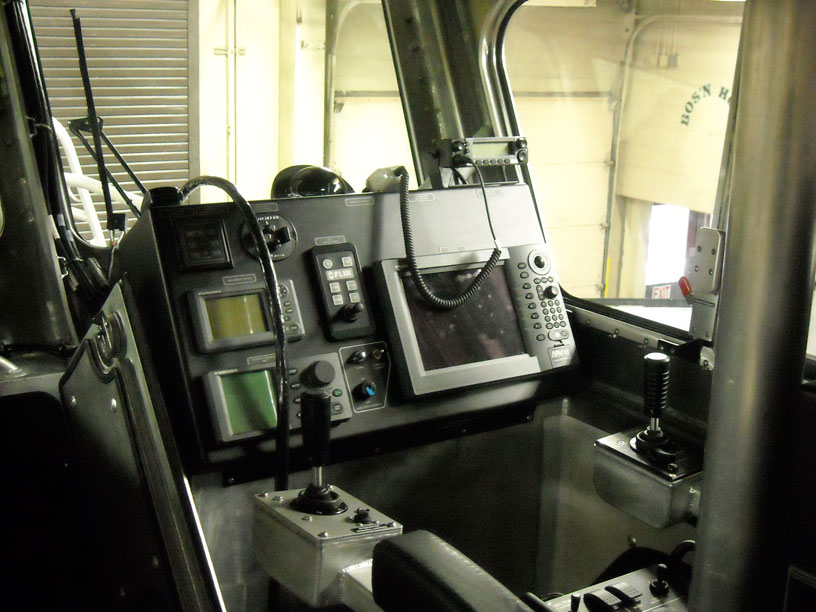
You would be right at home at the helm of the 45-foot Response Boat. There is no steering wheel or engine throttle controls. The helmsman's seat has armrests, and there are two joysticks that control the MTU diesel engines and the Rolls-Royce water jet propulsion drives. Take a look:
|
| Chriscz |
posted 01-11-2013 10:17 AM ET (US)
Wow, that looks like fun. Maybe I should go over to Kvichek and see if they ever take along extras on any of their sea trials. Also a bunch of longer triple axle trailers recently appeared in their yard, I wonder what is in store for them. |
| Jefecinco |
posted 01-11-2013 11:04 AM ET (US)
I hope the helmsman can strap himself into that seat. In rough conditions I find myself hanging on to the steering wheel for dear life while underway to keep myself aboard. I imagine using the joystick in the rough would be almost impossible without being secured in the seat. Butch |
| |
Powered by: Ultimate Bulletin Board, Freeware Version 2000
Purchase our Licensed Version- which adds many more features!
© Infopop Corporation (formerly Madrona Park, Inc.), 1998 - 2000.