 ContinuousWave
 Whaler
 Moderated Discussion Areas
ContinuousWave: The Whaler GAM or General Area
VERADOSAURUS
Moderated Discussion Areas
ContinuousWave: The Whaler GAM or General Area
VERADOSAURUS


search | FAQ |
profile | register | author help
|
|
ContinuousWave Whaler Moderated Discussion Areas
ContinuousWave: The Whaler GAM or General Area
VERADOSAURUS
|
| Author | Topic: VERADOSAURUS |
| jimh |
 posted 08-25-2011 09:12 AM ET (US)
posted 08-25-2011 09:12 AM ET (US)  
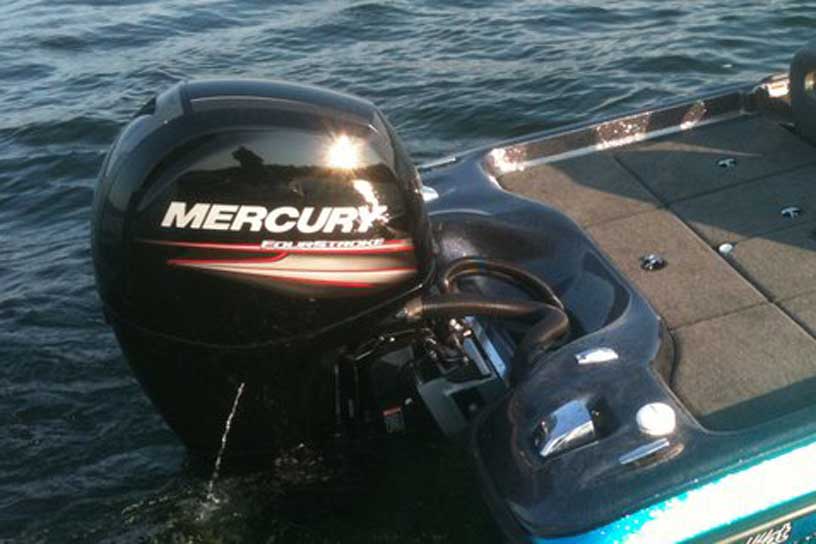
Here is a look at what is believed to be the Mercury VERADOSAURUS, the de-evolutionary four-cycle outboard engine that will be coming out soon as a 150-HP.
I call this the VERADOSAURUS because it seems to be de-evolutionary and a throwback to earlier times, back to the dinosaur age of outboard motors. It was rumored to be a new version of the VERADO in-line engines, but looking at the cowling shape seems to put the kibosh on that story. The cowling does not look like it contains an L4 or L6 engine. It looks more like a V-block. The VERADOSAURUS also is de-evolutionary because it won't have electronic throttle and shift controls, and will not require electro-hydraulic power boost steering. It has also been mentioned that the displacement will be around 3-liters and there is no supercharging. The engine weight is also supposed to be quite different from the VERADO--much lighter. The target weight for the 150 VERADOSAURUS is said to be about 460-lbs. |
| Robert V |
posted 08-25-2011 09:42 AM ET (US)
Jim, I read your post and was very curious about this new motor. I did a little searching and found this on a bass fishing board. Sounds like the poster tested the motor and was impressed. This is from the post: "No it's the new for 2012 150l 4 stroke, 3liter online 4 cylinder, pricing and weight is pretty comparable to a reg 150 optimax, we drove this in July and it's a torque monster and very attractive. The sound is nice n throaty, the footbal helmet styling had me confused at first but it's a nice change" A 3.0L is a big four cylinder motor, equivalent to the old Mercruiser/Volvo I/O four cylinder motors. I also read it should go on sale by the end of the year. It will be interesting to see how Mercury will position this motor relative to the Optimax and Verado. Thanks for the post and information. |
| Jefecinco |
posted 08-25-2011 09:42 AM ET (US)
Perhaps it's an engine aimed at the bass boat repower market with a lot less weight and much lower cost. The lower apparent profile suggests it is not an L4. It could possibly be an L3 or a V4? Lacking a Verado logo suggests it will not be marketed as member of that family. The Verado family engines certainly are an expensive repower option. If we have Veradito why not Veradosaurus? Butch |
| bluewaterpirate |
posted 08-25-2011 09:47 AM ET (US)
The Verado repower option is a lot less than I thought. I can get a 250 with all the digital controls, pump and gauges out the door for $22500.00 That's much less than a Yamaha 250 and about a $1000 more than an ETEC. Engine price is $18,000. |
| Peter |
posted 08-25-2011 10:24 AM ET (US)
3.1-liter is about what is needed to get the same power curve of a 2.5-iter two-cycle which is what the Optimax 150 is built on. Both Verado 150 and regular Optimax 150 are only CARB 2-Star rated motors so its seems likely that this would be their CARB 3-Star 150 general purpose motor. |
| Hoosier |
posted 08-25-2011 11:55 AM ET (US)
Kind of looks like Mercury is following in Suzuki's wake by coming out with big four cylinder engines. If the first one is a 150 can a 175 be far behind? |
| jimh |
posted 08-25-2011 12:00 PM ET (US)
If the VERADOSAURUS is an in-line four-cylinder motor with a displacement of 3-liters, it will need to have balancing shafts. Without balancing shafts an L4 motor of that size will not be able to run with low vibration. There was a time when you could sell outboard engines that had poor noise, vibration, and harshness (NVH) characteristics, but that time is also in the past, also in the age of the dinosaurs. We know that the VERADO family uses similar bore pistons. In the current VERADO L4 engine the displacement is only 1.7-liter. I don't think pistons of the same bore could be used to create a four-cylinder engine of 3-liter displacement. So it sounds like the VERADOSAURUS will not be using the VERADO family piston bore. We have already seen that the 1.7-liter L4 engine of the VERADO lacks the excellent NVH characteristics of the L6 engine. It is a 1.7-liter engine without balancing shafts. It seems unlikely that Mercury would try to take the L4 displacement to 3-liter and not use balance shafts. So, again, it sounds like the VERADOSAURUS will not be using the VERADO family no-balance shaft design. |
| Tohsgib |
posted 08-25-2011 12:10 PM ET (US)
Inline 6's are the smoothest engine combination due to the way an internal combustion engine works and hence why Jaguar, Mercedes, and BMW used them for decades. A V12 is basically 2 6 cyls so again VERY smooth. A 4cyl is the harshest and requires balancing shafts again due to firing order design. |
| tjxtreme |
posted 08-25-2011 12:19 PM ET (US)
"Inline 6's are the smoothest engine combination" What about flat and horizontally opposed engines? Obviously larger than comparable in-line engines. |
| jimh |
posted 08-25-2011 12:33 PM ET (US)
I doubt there is an opposing cylinder arrangement under the cowling of the VERADOSAURUS. We're discussing the de-evolutionary VERADOSAURUS here, if you please. |
| jimh |
posted 08-25-2011 12:40 PM ET (US)
Here is another view of the VERADOSAURUS, on a 18-foot TRITON bass boat, apparently at a dealer presentation judging from the paraphernalia on the dock:
|
| contender |
posted 08-25-2011 01:33 PM ET (US)
[Changed TOPIC to talk about prices of other outboard engines] tjxtreme: You need should have spoken to Ferdinand Porsche and Mr Tucker to get the insight on opposed cylinder engines. To bad they are no longer with us. |
| pcrussell50 |
posted 08-25-2011 01:33 PM ET (US)
+1 On the smoothness of straight sixes. They are smooth to both first, and second order harmonics, in both shake and moment. I had BMW's straight six in an ///M3 (until my wife wanted a 4-door). It was smooth as a turbine, (as I knew it would be, because I knew the physics before I bought it). BMW's execution of that motor has to make it one of the top ten best piston engines of all time. Sounded good, too. IIRC, Honda uses hydraulic motor mounts in it's amazing double VTEC straight fours, to tame that naturally horrible (from a smoothness POV), configuration. [Changed TOPIC to talk about outboard engine mount flexibility.] |
| Russ 13 |
posted 08-25-2011 03:04 PM ET (US)
Do you think the NEW Mercury is made here, or in a plant overseas?? |
| Perry |
posted 08-25-2011 03:31 PM ET (US)
[Said he does not like the name.] |
| jimh |
posted 08-25-2011 03:48 PM ET (US)
With the volume of business for VERADO engines going to government users like Homeland Security, Border Patrol, and Coast Guard--not to mention all the government subsidized state and local law enforcement boats--I have to wonder if Mercury has enough production capacity at Fond du Lac to make the VERADOSAURUS. Also, if the VERADOSAURUS does not really belong in the VERADO family, that is, if the engine does not use all the fundamental components of the VERADO, such as VERADO pistons, VERADO connecting rods, VERADO crankshafts, VERADO engine block castings, then one would have to wonder if Mercury could built the VERADOSAURUS on the same production line as the VERADO and VERADITO. Those engines have a lot of similar components used among the many models. We need more details and rumors. Perry--I think VERADOSAURUS is very catchy. It connects to VERADO but implies the de-evolution to this new engine that has occurred. Mercury needs help with model names for engines. You can't call everything a "FOURSTROKE" and expect people to immediately know all the particulars, and with the VERADOSAURUS I suspect there will be a lot of particulars to be learned. |
| andygere |
posted 08-25-2011 04:50 PM ET (US)
Is this the end of the Opti era? |
| martyn1075 |
posted 08-25-2011 05:34 PM ET (US)
andygere--I think [the introduction of this new engine] might be [the end of the OptiMax era] but [Mercury] still apparently sell quite a number of the OptiMax in certain markets. Not sure the numbers. They finally got it right with the OptiMax motor and now its outdated in regards to where the market is going in the four-cycle or maybe the VERADOSAURUS! Martyn |
| TC |
posted 08-25-2011 07:31 PM ET (US)
A very interesting motor, detais will be more so. When my old landcruiser still had its original inline six, it would idle down to 400 rpm while climbing up/through stuff inlow range- very torquey motor. |
| Russ 13 |
posted 08-25-2011 08:35 PM ET (US)
If you check out the lower edge of the cowling, it looks like an E-TEC, Oh no--a BLACK E-TEC. The world has gone crazy. |
| jimh |
posted 08-25-2011 09:02 PM ET (US)
Russ--Mercury already copied the cowling line of the E-TEC in other motors. That was noted several years ago when that detail first appeared. The uneven cowling line helps the cowling locate itself when the cowling is lowered onto the power head and fitted to the lower cowling. Peter--Your comment on the emission rating is interesting. All manufacturers need to strive for Three-Star ratings, especially in engines that will be selling in high volume. Martyn--No one has any data about unit sales volume for outboard engines, and not a prayer of a chance of ever getting any, especially unit sales volume for particular models. People invent numbers or allude to numbers, but people have no real numbers. It is all dock talk. |
| Tohsgib |
posted 08-25-2011 09:04 PM ET (US)
"Here is another view of the VERADOSAURUS, on a 18-foot TRITON bass boat, apparently at a dealer presentation judging from the paraphernalia on the dock" :Still looks like crap! |
| jimh |
posted 08-25-2011 09:29 PM ET (US)
I am hesitant to embrace the notion that the OptiMax era is going to end. The end of the OptiMax was already very strongly rumored a few years ago, but the OptiMax survived and evolved into The OptiMax The Next Generation (TNG). The OptiMax TNG motors have been well received, and then they themselves evolved into a new line of OptiMax ProXS motors, which, or course, were not really Pro and not really XS, but instead were non-Professional consumer motors which were hopped up variants of the regular OptiMax. The OptiMax customer is typically a bass boater who wants to go fast, and the appeal of the ProXS motor is strong for that sort of customer. Bass boaters will talk all day about, and--more importantly--spend money like mad trying to go 2-MPH faster than their fishing buddy's boat. Even if the ProXS was not much more than a new decal on the side of the OptiMax cowling, it would probably sell more motors. This brings me to the VERADOSAURUS. We know that if you want performance you get the supercharged VERADO. It makes no sense to sell the VERADOSAURUS on the promise of going faster. I think the VERADOSAURUS is aimed at the re-power market and at buyers who must have a four-cycle motor. On the other hand, Mercury has traditionally tried to sell its motors on performance, so they must have something to offer in the VERADOSAURUS. How will they get performance out this four-cycle engine? It seems likely they will have to follow the other manufacturers in four-cycle engines and the usual techniques: --bigger displacement I look forward to hearing more details on the VERADOSAURUS. In the past we know that Mercury has gone to a clean-sheet-design approach. Will the VERADOSAURUS be an entirely new design? Will be it based on existing blocks and power heads? Let us know if you have details. Someone must have more good information. |
| L H G |
posted 08-25-2011 09:56 PM ET (US)
Since the so-called Veradosaurus apparently has NO relationship to the Verado engines at all, not even a block, other than basic old fashioned 4-stroke design, it seems like Jim has again jumped to an improper description. Perhaps just MERCURYSAURUS would work for Jim, since now they have a lower (than Verado) tech, non-DTS engine to compete with the existing de-evolutionary 150HP ETECSAURUS, OPTISAURUS, YAMAHASAURUS, SUZUKISAURUS and HONDASAURUS, also none with factory DTS. This series of engines should help Mercury fill a gap and compete with the other fast selling Japanese "Saurus" de-evolutionary/throwback engines out there, and probably bring Mercury's combined market share over 50% once again. I'm happy to see an American company now fully competing with the foreign products across the board. One more choice for the consumer that wants 4-stroke power and wants to buy American. |
| Peter |
posted 08-25-2011 10:01 PM ET (US)
If this is a real product, as it appears to be, I suspect that emissions and weight are drivers for its creation. At 525 lbs, the Verado 150 is not competitive even if it has a strong power curve. For the same weight as the Verado 150, one could hang an E-TEC 300 on the transom. Also, all the other manufacturers have CARB 3-Star rated products for the general 150 HP market. Merc only has its Optimax ProXS at the CARB 3-Star level. The Verado and Optimax 150s are only 2-Star rated so the number of annual sales are probably limited by regulation, particularly in light of the more restrictive 2010 EPA regulations. |
| Peter |
posted 08-25-2011 10:10 PM ET (US)
"...also none with factory DTS" Larry, you need to go back and check your facts once again. The 150 E-TECSAURUS as you call it, can be had with or without fly-by-wire ICON controls (total consumer choice). Last year, my dock neighbor had a pair of E-TEC 150s with the ICON controls on his 24 foot center console. He loved the controls. He upgraded his boat this year to a 26 foot center console with a pair of E-TEC 225s also with the ICON fly-by-wire controls. |
| Tohsgib |
posted 08-25-2011 10:11 PM ET (US)
Wow...coming from a man who owns a "bunch" of old school engines. Buy just ONE and the you would get some credibility for Christ's sake. |
| jimh |
posted 08-25-2011 10:15 PM ET (US)
I don't see how we could possible talk about the E-TEC as de-evolutionary. The E-TEC evolved from the FICHT and expanded the technology into greater sophistication. The reason the VERADOSAURUS is de-evolutionary is that it takes the VERADO engineering and moves it back twenty years--no supercharger, no electronic controls, no power steering, no super smoothness, no super quiet either most likely, and no amazing power. I think the re-power market is a big target for VERADOSAURUS. There are many Mercury owners who want to maintain their ecclesiastical affiliation with Mercury, but they don't want an OptiMax, and they can't handle a VERADO. They don't like the OptiMax because of all the dock talk they've heard about it. They can't handle the VERADO because of the cost, the weight, the complexity, and the rigging requirements. With VERADOSAURUS they get a black motor with a Mercury logo that they can rig on their transom. This VERADOSAURUS might be the perfect motor for a 25-foot classic Boston Whaler. The transom weight might be a stretch--pushing 900-lbs or more--but the improvement in fuel economy would be wonderful. |
| captbone |
posted 08-25-2011 11:37 PM ET (US)
You can make fun of it with your foolish names all you want but there is no denying that Mercury is going after a large market segment and this engine looks like it will fit the need perfectly. We always talk about how we need a light weight, affordable repower engine for older boats. Well here it is. The majority of customers want four strokes, to keep price down they skipped DTS, and its 450lbs (lightest four stoke 150hp). It has nothing to do with "Mercury owners who want to maintain their ecclesiastical affiliation with Mercury" but instead with consumers looking for the best power choice for there needs. Yamahas 150hp four stoke has been a very successful engine and this engine beats it in size, weight and displacement. It is de-evalutionary because that is what the consumers have been asking for. I hope they make a larger version. To call it a veradosarus is just ignorant since it has nothing to do with the verado. That would be the same as me call an Etec the crossflow-grandson. |
| L H G |
posted 08-25-2011 11:53 PM ET (US)
I guess this brand new, light weight, naturally aspirated engine design from Mercury indicates that slowly but surely, the 4-stroke outboard is taking over the new engine outboard market. Everything I have read from those who have run it indiates it performs every bit as fast in acceleration and top end as the hot and economical Mercury 150 Optimax. Sounds like a great new power option for classic 18/19 Outrages, classic 21's, and 22WD's and 25's in twin configuration. I have also noticed that Mercury has a new, small diameter, 4-blade aluminum performance propeller, in two series, for engines 25-125HP, called the Spitfire. It supposedly uses technology developed from the Enertia series. |
| martyn1075 |
posted 08-26-2011 12:28 AM ET (US)
Larry stole my thunder I was just going to say that yes these motors would be a great choice for a classic Whaler that someone felt a need to add twins. I posted an article on a boat that had Twin Verado L4's on a 22 Revenge WD model which described how the boat was heavily weighted that the drive was nearly submerged. These new whatever you want to call them would have been perfect alternative. Personally I don't know if I would run out and buy the first models out but give it couple of years and maybe these small beasts will make a big splash. Martyn |
| captbone |
posted 08-26-2011 12:41 AM ET (US)
I would say with confidence that Four Stroke outboards certainly out number Two Strokes in new engines sales today in the United States by a large margin. |
| pcrussell50 |
posted 08-26-2011 03:21 AM ET (US)
quote: An E-TEC of today, will still have to be running 35 years from now in order to deserve the right to claim a genetic connection the crossflow. -Peter |
| Russ 13 |
posted 08-26-2011 03:37 AM ET (US)
Four strokes today outsell two strokes......BECAUSE.... There are very few two strokes available to purchase. Other than E-Tech. & Opti. what choices do you have?? Thanks to the "great e.p.a.", all our two strokes have been taken away, truely a SAD day, I must say! |
| Mambo Minnow |
posted 08-26-2011 07:14 AM ET (US)
Well said, Capt Bone. My 1999 Optimax is aging, and while economical and powerful, the number one request my family has for a repower is quietness so we can engage in a casual conversation underway. I have considered both the Suzuki and the Yamaha fourstrokes for repower. I will be very interested in a 200-250 HP variant of this new motor. |
| contender |
posted 08-26-2011 07:40 AM ET (US)
Russ You are 100% correct...Its the EPA not the choice of the buyer, buyer is force into a 4 stroke so they sell more. personally: I do not care about Mercury, Like I said before just read all of the threads on this site and there are more Mercury Outboard problems than the other makes. They may have improved their product but I would never purchase one do to the history of their product....PS and I still think they do not last in salt water as an Evinrude or Yamaha will...To each their own... |
| jimh |
posted 08-26-2011 08:18 AM ET (US)
Martyn says:
quote: Huh? I think I said that.
quote: I am afraid I have not read a single word from anyone who has run this motor, although I would be pleased to hear about it, and I think it is a bit early in this motor's life to give it all the kudos that have been already proffered by the usual Mercury fan base. Before we declare the VERADOSAURUS the greatest motor on earth we perhaps ought to actually run one and have some performance data. If the VERADOSAURUS is filling a huge gap in the Mercury product line, you have to wonder why it has taken until 2012 for the motor to appear. Maybe they should have made this motor before they made the VERADO. |
| Peter |
posted 08-26-2011 08:52 AM ET (US)
"Maybe they should have made this motor before they made the VERADO" Exactly what I was thinking. This motor is late to the party by at least 6 to 7 years. Almost seems like they got the development cycle backwards. They had the Optimax 150 and the Evinrude Ficht 150 as the performance bench marks for power curve to weight ratios and cost. As I said way back in early 2004 when they came out with the Verado that the weight would be a problem essentially leaving the door wide open for the competition. Over the years, the competion has stampeded right through that door with some of the competition's motors with fly-by-wire control producing twice the amount of power for the same weight as a Verado. Now it looks like they are trying to close the door after the competition has already got inside and taken root. |
| jimh |
posted 08-26-2011 09:05 AM ET (US)
Mercury seems to think the 150-HP VERADOSAURUS is going to take sales away from competitors, but what about sales of Mercury's own 150-HP VERADO engines? If we believe the Mercury fans that this motor will deliver the performance of the 150-HP VERADO, it is going to kill sales of the 150-HP VERADO. If it is lighter and less expensive, how will Mercury sell the 150-HP VERADO? And, this motor may also take away sales of the 150-HP OptiMax, if the performance is on par. And if the performance is on par, what was all that fuss about supercharging a tiny displacement engine on the VERADO for? |
| Mambo Minnow |
posted 08-26-2011 09:29 AM ET (US)
Perhaps Brunswick is looking at the Verado 150 sales as strictly installs on new production hulls and this new VERADOSAURUS for the repower market. I have only read of a few repowers on older Whalers with Verado. I could possibly do it, because the Ventura 21 hull was powered new with a Verado 225 HP in the last few years before the Ventura line was discontinued. I suspect there is very little crossover in lost sales between the new install and repower markets. BRP, Suzuki have taken advantage of that gap. Now when Yamaha developed the new 4.2L V-6 line, they kept the classic F150 fourstroke in producion for repowers. Mercury appears to be following on the heels of Yamaha, their largest competitor. This might also be a reflection on the overall poor economy, where the manufacturers realize many folks are keeping their old boat longer and repowering vice buying a completely new boat-motor-trailer package. |
| Mambo Minnow |
posted 08-26-2011 09:30 AM ET (US)
Perhaps Brunswick is looking at the Verado 150 sales as strictly installs on new production hulls and this new VERADOSAURUS for the repower market. I have only read of a few repowers on older Whalers with Verado. I could possibly do it, because the Ventura 21 hull was powered new with a Verado 225 HP in the last few years before the Ventura line was discontinued. I suspect there is very little crossover in lost sales between the new install and repower markets. BRP, Suzuki have taken advantage of that gap. Now when Yamaha developed the new 4.2L V-6 line, they kept the classic F150 fourstroke in producion for repowers. Mercury appears to be following on the heels of Yamaha, their largest competitor. This might also be a reflection on the overall poor economy, where the manufacturers realize many folks are keeping their old boat longer and repowering vice buying a completely new boat-motor-trailer package. |
| Peter |
posted 08-26-2011 09:47 AM ET (US)
As fuel prices continue to climb, boat manufacturers are going have to start taking weight out of their boat to make them more efficient. Consumers will demand it. As the weight of a boat goes down, the weight of the outboard hanging on the transom becomes more important and the Verado I4 will become increasingly uncompetitive at the 150 HP level. Power to weight ratio has always been important and will continue to be important. Some manufacturers have never lost sight of that. |
| Tom W Clark |
posted 08-26-2011 09:58 AM ET (US)
So it appears the new 150 HP Mercury FourStroke is the "aluminum propeller" of outboards; inferior in all respects, but manufactured because it costs less. |
| Jeff |
posted 08-26-2011 10:09 AM ET (US)
Maybe I missed it but, I do not see ANYWHERE on the motor an indication that it is marked as a Verado. I only see a new notation of the model as a FOURSTROKE. |
| Tom W Clark |
posted 08-26-2011 10:14 AM ET (US)
Jeff -- VERADOSAURUS is just another of Jim's made-up names. Jim loves made-up names for products...unless, of course, somebody else makes up a name for a product, in which case he scolds and chastises the offender in the most public way possible. |
| Jeff |
posted 08-26-2011 10:26 AM ET (US)
Tom, I know.... I was just trying to point out the new nomenclature of the model which seems to be all caps with a bolded F and S in FOURSTROKE. Not the FOURSTROKE of old... |
| jharrell |
posted 08-26-2011 10:57 AM ET (US)
Funny when Mercury comes out with a lighter motor with less moving parts it's the de-evolved aluminum propeller of the marine world. That must make the Etec a Precambrian wooden propeller of engines ;). |
| andygere |
posted 08-26-2011 11:09 AM ET (US)
I do not think this motor was developed for the repower market. That is a tiny portion of the market, and in this economy I can not imagine Mercury investing heavily in R&D, tooling and manufacturing to meet that segment. I think this is Mercury's price point motor, aimed at entry-level bowriders, aluminum walleye skiffs, bloated pontoons and any boat available via the Bass Pro Shops catalog. With the disappearance of the carburated 2-stroke line, Mercury needed something to bolt to the transoms of lower priced new boats produced by Brunswick. This is smart if Merc can keep production costs, and therefore price, low enough. The Verado, love it or ridicule it, is an expensive machine, and a heavy one at that. The Optimax is a 2-stroke, and as much as I love DFI 2-strokes, the average Joe buying his first boat off the floor of the local boat show has been given one bit of advice from his knucklehead boating buddies: "4-strokes are the only way to go, dude." Overall, I think it's a sound strategy, and if a few of these are eventually available as loose motors for Whaler enthusiasts to bolt on to our favorite old boats, good for us too. I gotta say, I'm always amazed at how quickly a discussion about outboard motors gets the hackles raised around here...but it makes for entertaining reading. |
| boatdryver |
posted 08-26-2011 11:12 AM ET (US)
Marketing of this new line of motors from Mercury is going to be interesting. They use the word "FourStroke" in marketing their Verado and "Veradito line of normally aspirated motors based on the Verado block, 90 and 115 HP. The word "FOURSTROKE" is placed on the cowling of the new mystery motor. Currently, their outboard motor products in the USA are divided into three categories: Verado, FourStroke, and Optimax on their web site. I can't wait to see what they'll call this new line of mystery motors. Current rumors are that it is a 3.0 or 3.1 litre 4 cylinder normally aspirated block, almost twice the displacement of their 4 cylinder Verado line, which weighs a WHOPPING (big deal) 50 lbs less than their 4cylinder Verados. Why spend development costs on a new line just to save 50 lbs? Maybe the pricing is the real reason, which brings up the question: In what country is this thing made? So far this whole thing is reminiscent of the speculation on a new mystery spy plane the CIA has at Area 51 . It will be nice when the manufacturer releases some information. JimL |
| jimh |
posted 08-26-2011 11:29 AM ET (US)
I am afraid VERADOSAURUS will have to be the working name until we learn the official name, much like PROJECT-X was the name of the VERADO motor before its actual name was revealed. Mercury will need a name for the VERADOSAURUS other than FOURSTROKE, because, as boatdryver has so nicely observed, Mercury has already used FOURSTROKE to designate a confusing array of outboard motors of various designs using various components. It would be even more confusing to add the moniker FOURSTROKE to the VERADOSAURUS. Imagine what that will lead to: Mercury owner: I have a Mercury FOURSTOKE outboard engine, and I'd like to know.... Mercury service: Excuse me but could you clarify which FOURSTROKE. Do you have --the FOURSTROKE made by Yamaha and painted black; --the FOURSTROKE made by Tohatsu (already painted black) with Mercury decals; --the FOURSTROKE that is a derivative of the VERADO; or, --the FOURSTROKE that is newly announced and is a de-evolutionary motor without electronic throttle and shift, without power steering, without supercharging, with large displacement, but light weight, and delivers the same power and performance as out great OptiMax The Next Generation Pro XS motor? Mercury owner: Well, I am not clear on that, it just says "FOURSTROKE" on the cowling. I am just trying to help Mercury avoid this sort of problem in product identification. VERADOSAURUS is a good name. |
| jimh |
posted 08-26-2011 11:34 AM ET (US)
When products have real names, I do strongly prefer to use them, but sometimes I get a bit weary having to type in extremely long qualifying dependent clauses following a name in order to properly identify a product, and, to help out, I create a new name. Imagine if Boston Whaler called all of their boats with the model name WHALER and dropped the model year designators. We'd have a blast talking about our WHALER instead of talking about our 1988 Boston Whaler REVENGE 25 Walk-Through. Wouldn't that be the perfect world, every one a WHALER and no model year designators. I think I will pass this to headquarters. |
| WT |
posted 08-26-2011 11:46 AM ET (US)
The motor is coming out probably January 2012, but hoping for December 2011. It is a, 150 hp, 3 liter V6, 4 stroke, built from the ground up. Mercury may eliminate the 4 cylinder Verado if this block can be pushed to 200 hp. Initially the 150 Verado will probably fade away like the 135 Verado. The guy said when potential customers hear the word "supercharger", many think "high maintenance". So it seems jimh maybe right, Mercury may be going retro, in that they are going to be producing "simpler" (normally aspirated) outboards with this motor. Warren |
| Peter |
posted 08-26-2011 12:56 PM ET (US)
3L V6. Interesting. There have been lots of 3L V6 4-stroke automobile motors made over the years. My 1990s era Nissan Pathfinder and/or Maxima each had one. Nissan outboard motors are nothing but rebadged Tohatsu outboard motors. Maybe there is a Nissan --> Tohatsu --> Mercury connection here. ;) |
| dgoodhue |
posted 08-26-2011 02:18 PM ET (US)
[Changed TOPIC to begin a discussion of the website instead of the new Mercury motor.] |
| jimh |
posted 08-26-2011 02:31 PM ET (US)
Warren--Many thanks for adding to the knowledge about the new Mercury motor. It's coming in 2012 and has a V6 block. That is very interesting news. |
| jimh |
posted 08-26-2011 02:35 PM ET (US)
Here we are at 60 articles on the VERADOSAURUS. This thread has to be the best information collection available. Please keep adding information. ASIDE: If you want to complain about the website, just write your thoughts down in an email and send it to me. The website does not discuss itself, we discuss boating. |
| Perry |
posted 08-26-2011 03:48 PM ET (US)
It was all misinformation until 4 posts ago when Warren decided to call Mercury marine to get accurate information from the source. A 3 liter V6 4 stroke platform at a decent weight should be a good seller if it is priced right. |
| jimh |
posted 08-26-2011 04:19 PM ET (US)
Actually I think Warren added "2012" to the prior information. Everything else was spot on, just like most articles here. |
| L H G |
posted 08-26-2011 04:19 PM ET (US)
If this engine is really "de-evolutionary and a throwback to earlier times, back to the dinosaur age of outboard motors", it would have to be a 90 degree V block, like the de-evolutionary and a throwback to earlier times, dinosaur age of outboard motors, 90 degree V of the Evinrude 200HO-300HP 3.3 liter E-tec engines. But I'll bet it's a modern 60 degree block, since Mercury never has made a DINOSAUR 90 degree outboard block, ever. Instead of trashing a new American made product, only because it will compete extremely well with an Evinrude and further decrease the purchases of 2-stroke engines, maybe we should just wait and see and let the product sell, or not sell, itself. And Tom, since this 4-stoke will be the "aluminum propeller" of 150HP outboards, does that include the similar naturally aspirated 150's from Yamaha, Honda and Suzuki? |
| WT |
posted 08-26-2011 04:27 PM ET (US)
Yamaha, Suzuki and Honda 150 hp four strokes are 4 cylinders. The new Mercury 150 hp four stroke might be a outboard. Maybe a 6 banger 150 hp four stroke is evolutionary? Maybe it'll have more torque than the competitors? Warren |
| dscew |
posted 08-26-2011 04:36 PM ET (US)
I'd have to agree with LHG, why trash this engine before it's even released? Reflexive bias is close-minded and a bit SAURUS itself. And on aluminum props, what's wrong with them? At least if you have a propellor strike with aluminum, it doesn't typically take the shafts or gearcase with it, like stainless will. And, shouldn't it be "devolutionary" in the same vein as "evolutionary" or "revolutionary?" I hope for all of our sakes it will be made in America. |
| Perry |
posted 08-26-2011 04:45 PM ET (US)
quote: All the information prior to Warren's post was rumor and speculation. It consisted of information like..."L3, L4, L6, V4, 460 lbs. 3.1 liters. Facts from the source are accurate information, internet rumors are not to be regarged as accurate information. I'd like to hear some more facts regarding this new 150 HP 4 stroke Mercury outboard motor. |
| jimh |
posted 08-26-2011 04:54 PM ET (US)
Come on, Larry, you know that no one could make a 60-degree anything after Mercury got their patent on the angle of 60-degrees. I don't think anyone has "trashed" the VERADOSAURUS. We are still learning about it. I don't think talking about it automatically means the VERADOSAURUS is being trashed. Maybe we are supposed to talk about VERADOSAURUS like it was a new breakthrough in engineering. I haven't heard anything particularly revolutionary about the engine. Everything about it seems to be de-evolutionary compared to the VERADO. Let's go over the features: --in-line six cylinder, the perfect balance, devolves to vee-six, not the perfect balance; --supercharging devolves to natural atmosphere pressure intake; --electronic controls devolve to mechanical cable-linked controls; --innovative engine mount with integral power steering devolves to standard mount and no power steering; --small displacement fuel-efficient devolves into large displacement not so fuel-efficient--check out how many car manufacturers are putting larger engines in their cars than older models; they're not. Cars are going to small displacement with power boost on demand.
|
| Buckda |
posted 08-26-2011 07:27 PM ET (US)
Something that has always puzzled me about Mercury lately is their naming terms for the newer engines. A company that brought us "thunderbolt" ignition systems, "black max" motors and even the VERADO can surely come up with a better name than "Fourstroke" or "FourStroke" or "FOURSTROKE". There is a disconnect here in my mind. Other than that, I'll be interested to see where these motors fall along the lines of performance and pricing. We've already seen that the company is willing to allow dealers to aggressively price the premium VERADO motor, and the OptiMax, as well - either due to an inventory-related situation, or a simple need to move motors. Will this cut-rate pricing on a "premium" product continue? ...and perhaps a more academic question: at what point does the aggressive pricing undermine the "premium" product positioning altogether? People complain about the high costs of the E-TEC and Yamaha, and yet they seem to sell plenty, or at least "enough", inventory to satisfy their model and product positioning. As for providing the name VERADOSAURUS....that seems a bit more pejorative than VERADITO. VERADITO really simply implies "little Verado", whereas VERADOSAURUS definitely implies a negative connotation. Let's hope Mercury comes up with something better than "FOURSTROKE" so that we can use their nomenclature and understand what motors we're talking about... |
| Waterwonderland |
posted 08-26-2011 07:57 PM ET (US)
[Repeatedly tries to change topic. These off-topic posts are deleted. Please stop trying to derail the discussion--jimh] |
| jimh |
posted 08-26-2011 08:19 PM ET (US)
Dave--You have raised an important topic which had not been previously discussed in this thread. It has been shocking to me to see how Mercury has been unable to raise the price of the VERADO, truly a premium cost product, and they continue to sell VERADO at a price that is very close to the competitors' engines, which lack some of the features of the VERADO. The margins of profit on the VERADO must be thin. We have read the corporate reports from Mercury for years now where margins on marine engines have been steadily declining. With the VERADO engine Mercury has not been able to change the market for outboard motors and get the true premium price that this premium cost engine should be sold for. Even their bold effort to get the government of the United States to intervene in the importation of outboard motors from Japan was not successful in correcting the price of outboard engines in the United States. The VERADO has been and continues to be sold at less than its fair market value, a value earned by its many advanced engineering features. Now we have a new engine, which from all accounts must be priced below the VERADO. I say this because, as we see, the new engine lacks all of the premium features that distinguish the VERADO. Even L H G has said that this new engine "...apparently has NO relationship to the Verado engines at all, not even a block." This says to me that the VERADOSAURUS is going to be positioned in the market at a much lower price point. As Tom Clark said, in his cruel metaphor, as the aluminum propeller of the [four-stroke] outboard [engine market]." Oh, sometimes a phrase is turned which just sums things up so beautifully! You must admire the phrase, the design of its language, even if you don't want to take up its charge. Touché, Tom. |
| jimh |
posted 08-26-2011 08:24 PM ET (US)
Dave--If you find VERADOSAURUS to have a negative connotation, how about this: JURASSIC FOURSTROKE? |
| L H G |
posted 08-26-2011 08:25 PM ET (US)
This new engine platform should be a huge seller if it can perform like an Optimax or Evinrude 2-stroke 150, as indicated. It will be even if it can't. We needed a relatively lightweight American naturally aspirated 4-stroke in this HP range for people to buy, instead of having to buy Japanese, or 2-stroke DFI. Other HP options will probably show up also. I'm sure it will quickly be offered on new Whalers, like the 190 Montauk and Outrage. I agree that the 150 Verado may disappear, and the L4 Verados will all be 200's. It will also probably have a DTS option, for those that want it. Unlike some brands, I'm glad to see Mercury continuing to bring out new product and new cylinder block platforms. As Dave indicates, calling it a Veradosaurus is definitely trashing it. The competition must be worried. |
| captbone |
posted 08-26-2011 08:26 PM ET (US)
The new 150hp Four Stroke Mercury is an Inline 4 cylinder 3.0 liter and its not a v6. |
| jimh |
posted 08-26-2011 08:43 PM ET (US)
An in-line L4 with 3.0-liter! That is a big four cylinder engine. Do you know if it has balancing shafts? I am throwing my hat into 'bone's ring because I know where he works. |
| captbone |
posted 08-26-2011 08:54 PM ET (US)
My local dealer had the info sheet and it said 3.0 liter inline 4 with balance shaft. That is all the information I got. |
| jimh |
posted 08-26-2011 08:54 PM ET (US)
Larry--I am curious why it makes you glad to have Mercury bring out a new cylinder block configuration. I would appreciate it if you could explain what there is about a new cylinder block that is something we should be perpetually pleased to see in the marketplace. I am something of the opposite. I would ask why we need a new cylinder configuration. It is not like a 150-HP outboard is a new concept. Also, will you still be pleased if the new engine has an in-line four-cylinder configuration instead of a 60-degree V-six configuration. The in-line four cylinder at three-liters would be very large displacement for an L4. Do you agree? |
| jimh |
posted 08-26-2011 08:56 PM ET (US)
'bone--Thanks for the information. I suspected that balance shafts would be critical to maintain modern NVH characteristics. |
| Perry |
posted 08-26-2011 08:58 PM ET (US)
Spot on information in this thread? I've heard this new motor may be a L3, L4, L6, V4, V6, 460 lbs. 3.1 liters, 3 liters. Rumors and speculation. How about some facts? |
| captbone |
posted 08-26-2011 09:02 PM ET (US)
Jimh Like you said the balancing shaft is required otherwise it would be a shaker. Alot of information is all over the bass boat forums as alot of the OEM guys got to run it at the sales meeting. |
| jimh |
posted 08-26-2011 09:42 PM ET (US)
It is hard for me to read the bass boat websites because I get distracted by the NASCAR advertisements. |
| Peter |
posted 08-26-2011 10:12 PM ET (US)
Ah darn, it looks like the Nissan --> Tohatsu --> Mercury link might be weakened. I must admit that I was having my doubts about a 3L V6 at 460 lbs. An I4 is much simpler and cheaper to design and build. It would have less parts to ship back and forth over the Pacific Ocean should there be a decision to assemble overseas. |
| ericflys |
posted 08-26-2011 10:14 PM ET (US)
As I have stated in the past in other ares of CW, the new 150 was designed for the repower market, specifically to take on the the #1 selling 150, the yami. It was designed to best the yami in every category. It will have a price point $1000 more than the Opti. |
| WT |
posted 08-26-2011 11:22 PM ET (US)
I suppose I could have heard wrong. But another bit of information was that the new motor will be just 40 pounds lighter than the 150 hp Verado. I would guess if Mercury introduces a new block, they would eventually offer that block in different horsepower configurations. Would it be easier to get 200 hp out of a 3 liter inline 4 cylinder or a V6? Warren |
| Waterwonderland |
posted 08-26-2011 11:32 PM ET (US)
VERADOSAURUS most certainly has a negative connotation. How many times have we heard an old, worthless and obsolete piece of equipment, like a computer, referred to as a “dinosaur”. While we don't have the specifics of the new Mercury, I am sure it will use at least some of the latest FourStroke technologies or construction shared by other outboard manufacturers. I don't see it as de-evolutionaty either. GM makes different cars with different purposes, features and price points. A new smaller Chevy will lack the state of the art equipment and technology of a Cadillac. but we look at it as different model not something “devolved” from the Cadillac. Furthermore, if we are looking for a name that represents past technology, logically it would be more appropriate to pick something from the last twenty years not a billion years ago. |
| number9 |
posted 08-27-2011 04:36 AM ET (US)
I'll play the spin doctor's VERADOSAURUS game and keep my ideas to partially Verado based designs. This type of design would increase parts commonality and reduce costs substantially. First thought was Verado L6 based with the pounds of "evolutionary" parts shed and height de-emphasizing cowlings. If the photos are not altered, highly unlikely. Most probable design thought is a small displacement V-6. It would fit the photo's cowing better than a L4 and less expensive to develop. It would use many of the L6 parts and then heads/cams shortened/redesigned to fit the block. The 2.6 DOHC engine could easily put out the 150 hp and still weigh in at the 460 lbs. Number crunching with the weights leads me to believe this what we will soon see. Available numbers indicate a conservative approximate 40 lb. weight savings compared to the same hp Verado. Weight's usually a small factor to the consumer and boat builder compared to cost. This engine should be a good fit in their lineup, less expensive to purchase and rig. You can forget about this motor needing to or using any exotic materials or designs. Expect to eventually see 175 & 200 horsepower versions of whatever this motor is.
|
| Peter |
posted 08-27-2011 05:42 AM ET (US)
It's not the ultimate peak HP that is the design goal in an outboard motor. Rather, the focus is the torque curve from the bottom to the top at low to moderate engine speeds. That's why you don't see the 1200cc motorcycle engines that make 150 HP peak at 10000+ RPM used as outboard motor powerheads. The torque curve from a naturally aspirated DOHC V6 2.6L 4-stroke isn't going to be much better, if at all, than what you get out of the 2.6L Yamaha F150. The gold standard in the 150 HP range is what you get out of the 2.6L V6 2-stroke powercurve. Suzuki knew enough not to make their DF150 with merely 2.6L of displacement, as it wouldn't cut it for low end torque. In a V6 format, the motor will be heavier than the F150 unless more expensive manufacturing techniques like the sleeveless cylinder design is used. It will also be more expensive (more pistons, valves, intake or exhaust plumbing, cylinder heads, etc.). I suspect that given this doesn't have all the bells and whistles of the Verado by design, they are looking to make this in as low cost mode and manner as possible. In all likelihood this is an I4 design as reported. All other 4-stroke 150 HP outboards are of the I4 design so this would meet the 4-stroke competition in terms of noise, vibration and harshness. They don't go to the V6 until they absolutely have to, which is displacements that are greater than 3L. Regarding one phantom de-evolutionary aspect, at the 150 HP level, the Verado does not have the pedestal mount like the I6 Verados. It uses the tried and true traditional mounting method. |
| jimh |
posted 08-27-2011 08:41 AM ET (US)
Let us review the 150-HP four-cycle outboard engines already on the market and from which the VERADOSAURUS will have to take away sales: YAMAHA F150 SUZUKI DF150 HONDA BF150 COMMON FEATURES COMPETITIVE ADVANTAGE Other than the Mercury brand, what feature of the VERADOSAURUS would be likely to attract buyers away from these other brands? So far the only mentioned specification which is advantageous is weight. While the weight of the VERADOSAURUS is less than the 150-HP VERADO, it is not significantly less than these competitive engines. I don't think a difference of 15 to 20-lbs will change anyone's mind. If VERADOSAURUS employs variable cam phasing, I believe it will be the very first Mercury four-cycle engine to have that technology. Predecessor four-cycle engines, even the advanced VERADO, that Mercury has manufactured have all avoided variable valve timing or cam phasing. However, there has been no mention of this technology, so far, in any information being put out about the VERADOSAURUS. |
| WT |
posted 08-27-2011 10:36 AM ET (US)
The Triton SE online brochure shows 22 pictures of the boat, many of which show the "new" Mercury motor. http://www.tritonboats.com/boat/399.aspx Warren |
| WT |
posted 08-27-2011 10:48 AM ET (US)
The beam of this Triton SE is 94 inches, perhaps we can get measurements from the photo? Especially the aerial photo of the Triton SE with the "new" motor. Are there any Photoshop experts out there that can figure out the dimensions of the "new" motor as compared to the other Triton photos with OptiMax ProXS motors? Warren |
| number9 |
posted 08-27-2011 11:03 AM ET (US)
Warren, after seeing the additional photos I'm going back to my first thought. Probably Verado L6 based 2.6 engine with the "evolutionary" parts shed to easily get the weight to the 260 lbs. Bill |
| Peter |
posted 08-27-2011 11:10 AM ET (US)
Good find Warren! In the profile views looks a lot like a black E-TEC with Mercury FOURSTROKE decals. |
| WT |
posted 08-27-2011 11:34 AM ET (US)
Since I don't think they would go through the trouble of making a single decal and the decals on the "new" motor take up most of the space on the cowling, I'm thinking the name of the new motor is going to be Mercury FOURSTROKE. Not to be confused with my Mercury 90 hp FourStroke. :-) Warren |
| ericflys |
posted 08-27-2011 12:43 PM ET (US)
number9, the new merc is a 3L engine. |
| Slick 50 |
posted 08-27-2011 01:06 PM ET (US)
The attached Triton site mentioned the Mercury 150L Four Stroke will not be available until December. Sure hope it turns out to be a simple fuel efficient engine built in the USA. Rick |
| John from Madison CT |
posted 08-27-2011 03:25 PM ET (US)
[Changed TOPIC. Article deleted] |
| WT |
posted 08-27-2011 04:09 PM ET (US)
Here is the shape of my Mercury FourStroke normally aspirated 1.7 linter inline 4 cyclinder 90 hp outboard. I'm guessing, but I do not think the shape of the new Mercury 150 hp FOURSTROKE is an inline 4 or 6 cyclinder. Warren |
| Buckda |
posted 08-27-2011 05:01 PM ET (US)
Allow me to throw Mercury Marketing a bone: how about the M150, or the 150M? Something more original than FOURSTROKE, please? With so little enthusiasm placed into the naming/marketing of this and other motors, it makes me wonder if it isn't really much to write home about. Honestly, VERADITO is FAR better than "FourStroke". We're getting a ho-hum lately on product names?! I'm still generally opposed to VERADOSAURUS, as I think it is negative. I kinda like the M150. Or how about just "The 150. From Mercury". ?? |
| boatdryver |
posted 08-27-2011 05:34 PM ET (US)
Number9, I don't think this motor is tall enough to be an inline 6. Those L6 Verados are HUGE. JimL |
| jimh |
posted 08-27-2011 06:03 PM ET (US)
The VERADOSAURUS would be a good platform for Mercury to drop its SmartCraft closed engine instrumentation and join the rest of the modern outboard engine manufacturers in supporting NMEA-2000 engine data. I hope Mercury does this, otherwise their new 150-HP will be at a competitive disadvantage compared to all the other 150-HP engines. They all seem to support NMEA-2000, except Mercury. Mercury engines currently need a specialized gauge and gateway option which adds about $700 to the cost of an installation. That is a $700 price disadvantage for the new Mercury to overcome compared to competitor engines. Since there has been a presumption that the price point of this motor will be an important factor in its acceptance in the marketplace, it will be important to deliver the new motor at a competitive price. |
| sosmerc |
posted 08-28-2011 11:30 PM ET (US)
The latest SmartCraft systems are now NMEA 2000 compliant...including the basic MercMonitor. |
| GSH |
posted 08-29-2011 08:16 AM ET (US)
After reading this very interesting tread about this new outboard from Mercury, I hopped over to the Mercury Marine website to see if there would be any more info already, but no. However, I dawned on me that really, why talk about what this outboard will be called? Mercury has the Verado line up, the Optimax line up and the Fourstroke line up. How does the addititon of a non-verado related and naturally aspirated L4 four stroke outboard change this? What I’d like to know: where will they make it? (I’m guessing the U.S.) And will they offer units for sale under the Tohatsu brand (out side of the U.S., that is)? Tohatsu could really do with something bigger than the 115. |
| jimh |
posted 08-29-2011 08:39 AM ET (US)
Unless there has been a huge (and unannounced) change, Mercury engines are not NMEA-2000 compatible unless used with the MercMonitor gauge. The MercMonitor gauge is sold in four different tiers of data conversion, and it is quite expensive, adding about $700 to the cost of rigging. What I am talking about is for Mercury to begin to make their engines NMEA-2000 capable, so you won't need to spend $700 to be able to connect a Mercury engine to a NMEA-2000 network. My information comes from Mecury's literature: http://www.mercurymarine.com/media/mercury/documents/ 2010_Marine_Gauge_Products_%20Brochure.pdf The only mention of NMEA-2000 is in conjunction with the MercMonitor instrument and gateway. |
| jimh |
posted 08-29-2011 08:57 AM ET (US)
GSH asks three good questions: --"..why talk about what this outboard will be called?" I agree. Too many respondents seem to be hung up on the name. Like you, I am interested in information. --"...I’d like to know...where will they make it?" Mercury has taken advantage of the desperate employment conditions in the United States of American, and played off its workforce in Wisconsin against its workforce in Oklahoma, in order to gain concessions and reduced wage agreements with its manufacturing workers, while at the same time shipping a very significant percentage of its outboard engine manufacturing overseas to locations in Asia and Asian sub-contrators. The manufacturing location for this new 150-HP outboard engine will be an interesting choice. At the moment, the manufacturing of Mercury outboard engines seems to be split between Wisconsin and Asia on the basis of horsepower. Engines of about 75-HP and lower are made in Asia, and the more powerful engines are made in Wisconsin. If this trend continues, then the new engine will likely be made in Wisconsin. But I don't see that choice as a sure bet. The new engine has been mentioned as being a "clean design," which would mean it is not a derivative of any existing engine, and therefore it is unlikely that the new engine will utilize components shared with other current Mercury engines. This poses a manufacturing problem for Mercury. Making an entirely new engine in Wisconsin will require adding new capabilities to the manufacturing center there. Will Mercury invest in Wisconsin? Or in Asia? --"will they offer units for sale under the Tohatsu brand...out side of the U.S..? I have the same question. And, if the engine is a product of co-development and co-manufacturing with TOHATSU, there is a good chance it will be made in Asia, at the TOHATSU manufacturing center in Komagane, Nagano Prefecture. |
| sosmerc |
posted 08-29-2011 11:37 AM ET (US)
We may be splitting hairs regarding Smartcraft and NMEA 2000. It is my understanding that the engine computers on most, if not all "SmartCraft Ready" engines after 2008 are capable of comunicating with NMEA 2000 guages of a variety of brands as long as the proper "gateway" is used. The complaint being voiced apparently is over the increased cost of the gateway. I am sure that this cost is priced competitively with other brands. At least Mercury has not made its use a requirement. In most applications you can even use existing analog guages without any hassle. I recently rigged a new F115 Mercury on an older 1998 Ventura and was able to easily use all of the existing guages and controls. This saved alot of time and expense. |
| jimh |
posted 08-29-2011 12:31 PM ET (US)
We're not splitting hairs. It's more like splitting heads. Just about all modern engines now support direct connection to NMEA-2000 networks. No gateway needed. Those engines send NMEA-2000 data directly to the network. Mercury, the lone exception, does not support NMEA-2000, and their engines need an expensive and optional device, a gateway, to translate their data for use by NMEA-2000 devices. This drawback could be overcome in the new engine if Mercury began to embrace NMEA-2000. It is almost 2012, and the NMEA-2000 standard has become very widely adopted in marine electronics. |
| Russ 13 |
posted 08-29-2011 12:50 PM ET (US)
Maybe it is the basis for Tohatsu to increase their HP range up to 150. I agree that 115 HP is not a high HP Mark to be competitive in todays Market. |
| egres |
posted 08-30-2011 02:30 AM ET (US)
Seems like there is a lot to be said about the State Of The Union these days.. I can easily understand that Jim's preferred brand of outboard have proven itself from well..years of trust and service. From his well stated opinion to the Mercury brand: "Mercury has taken advantage of the desperate employment conditions in the United States of American, and played off its workforce in Wisconsin against its workforce in Oklahoma, in order to gain concessions and reduced wage agreements with its manufacturing workers, while at the same time shipping a very significant percentage of its outboard engine manufacturing overseas to locations in Asia and Asian sub-contrators." Will show; to my opinion; |
| L H G |
posted 08-30-2011 02:13 PM ET (US)
By consolidation, Mercury is simply trying to compete with BRP/Evinrude's much lower costs due to their refusal to hire union workers. Mercury employees are union members. |
| WT |
posted 08-30-2011 04:37 PM ET (US)
Now I just heard from a boat manufacturer that the 150 hp FOURSTROKE is a 3 liter, inline ,4 cyclinder. V6 or inline 4? I'm getting some bad info from someone..... Warren |
| egres |
posted 08-30-2011 08:08 PM ET (US)
Larry, "much lower costs due to their refusal to hire union workers. Mercury employees are union members". We all have to be very careful when talking about Union Workers. After all it is a proven fact that "Trade" wages will be union wise negotiated through contract agreements. Non union workers within the industries will take example from the unionized gains and index their own hourly wages to the unionized target. |
| jimh |
posted 08-30-2011 08:18 PM ET (US)
When Mercury uses desperate employment conditions to force their workers to accept wage concessions, they effectively move their cost of manufacturing back a couple of decades, back to wages paid in the 1980's, perhaps fitting to make engines with 1980 technology. The workers gave up wage increases they fought for over many contract negotiations to save their jobs from export. Brunswick has played Oklahoma against Wisconsin against China against Japan. The union workers have thrown their brothers under the bus with two-tiered wages to save their own jobs. It is not a pretty picture. It is hardly anything to use to endorse buying Mercury engines. It is actually shameful. I can't believe anyone would try to build enthusiasm for Mercury based on their relationship with their workers. I doubt Mercury's own employees would even speak up for them. |
| jimh |
posted 08-30-2011 08:30 PM ET (US)
Larry--You need to read this: "The Twisted Saga of Mercury Marine" http://www.wisconsinsfuture.org/publications_pdfs/tax/ MercuryMarineOct2009.pdf Also read the union that represents Mercury employees view of this: http://www.goiam.org/index.php/imail/latest/ 6242-the-twisted-saga-of-mercury-marine This will give you insight into the relationship between the union workers, Mercury, and the State of Wisconsin. You probably will not want to cite the relationship again as an endorsement of Mercury outboard motors after you read it. |
| dscew |
posted 08-30-2011 08:36 PM ET (US)
Justifying your dislike of Mercury by going after their wages and benefits tactics doesn't hold any water unless you know what BRP does with their wages and benefits. I highly doubt BRP is any more without shame here. And moving a cost structure back to the 1980s doesn't equate to building 1980s products because it doesn't account for gains in technology or productivity. I doubt Mercury has gone back 30 years in either. How do BRP's employees feel about their company? I'm not here to support Brunswick, but let's not get too excited about how any other megaprofit corporations treat their own these days. You're right about one thing, though, it ain't pretty out there. |
| jimh |
posted 08-30-2011 08:37 PM ET (US)
L H G also spins more nonsense when he says that Evinrude "refuses to hire union workers." This shows Larry's naivety on labor law. The relationship between Evinrude and their workers is governed by the same laws that apply to all companies in the USA. They don't have any special status. Perhaps we could stop the nonsense and get back to outboard engines? Please. |
| jimh |
posted 08-30-2011 08:53 PM ET (US)
dscew write, apparently referring to me:
quote: You are totally wrong here. First, I do not dislike Mercury engines. Second, I did not raise the topic of union membership, wages or, benefits. There is no "tactic" involved here. The cost of manufacturing is an important consideration for the success of the VERADOSAURUS. Because we see VERADOSAURS being position as "the aluminum propeller of four-stroke outboard engines," that is, a less expensive alternative, the cost of manufacturing will be crucial. If Mercury Marine is to sell the VERADOSAURUS at a reduced price and still make a profit, its production cost must be kept down. This brought into the discussion the option of Fond du Lac or Asia. It is my observation--and I do not consider this to be particularly prejudiced--that Mercury, with skillful manipulation of the workers against each other, and by playing one state government against another, has been able to reduce the wages of its manufacturing workers in Wisconsin and obtain low-interest loans or concessions from the State of Wisconsin, to an extent that undoes many decades of wage increases earned by the workers. This puts the cost of manufacturing at Fond du Lac on a better footing for comparison to the cost of manufacturing in Asia. This makes the location of where the VERADOSAURUS will be built a real topic of discussion. In the past Mercury told its domestic workforce and the State of Wisconsin that the wages and taxes there were too high for them to complete, and they were forced to send all their manufacturing overseas to Asia. This argument seems much less likely to be seen as convincing now, with the workers having taken pay cuts and Wisconsin having handed over millions of dollars in incentives. If the VERADOSAURUS is not made in Fond du Lac, it will be quite a problem for Mercury to explain. |
| seahorse |
posted 08-30-2011 09:32 PM ET (US)
quote:
It may be the Verado replacement in a year or two if you think about it. Consider what it costs to produce the Verado with its power steering and supercharger besides all the normal 4-stroke parts needed. This new motor may be using GM engine parts to keep costs low. If you add 2 more cylinders, an inline 6 of 4.5Liters could be a 225, 250, or even a 300. Weight would be a lot less than a Verado as well as the cheaper production costs. The possibilities are endless. |
| phatwhaler |
posted 08-30-2011 09:48 PM ET (US)
Maybe were going to see a half of a GM LS 6.0L with overhead cams. Could use the same pistons and rods, probably a GM ECM which some of the stern drive motors already use. Talk about economies of scale. These LS engines seem to be pretty reliable even when modified to make way over 100hp/liter. Perhaps we'll be able to hook up to HP tuners and bump up the horsepower? |
| dscew |
posted 08-30-2011 10:05 PM ET (US)
It's my OPINION, Jim, not totally wrong. You're not ALWAYS right. |
| jimh |
posted 08-30-2011 10:15 PM ET (US)
Could we have a pointer to some background on the GM LS engine, please? Thank you. |
| Tohsgib |
posted 08-30-2011 10:18 PM ET (US)
The 6.0LS is 400+ at a V8. I can see a 4cyl at 150/200. I had this engine in my GTO. |
| sosmerc |
posted 08-30-2011 10:45 PM ET (US)
I confirmed with a reliable source today that the new engine is an in-line four-cylinder 3.0 liter, and the price will be about $500 more than an OptiMax 150-HP. It will be a very basic design, mechanical shift and throttle, a great re-power option. No doubt there will be higher power options built around this basic design. Actually, I'd like to see a variety of [lower] power options based on this design such as a 125 or 135-HP. Currently in the Mercury line-up there is a void between 115-HP and 150-HP in a four-cycle outboard engine. |
| jimh |
posted 09-01-2011 08:24 AM ET (US)
With a displacement of 3.0-liter it should not be too hard to make 150-HP. There are many modern four-cycle engines that produce more than 150-HP with less than 3.0-literdisplacement and don't use supercharging or turbocharging. For example, the FORD Duratec 2.5-liter four-cylinder makes 175-HP. With modern design, it should not be difficult to produce 150-HP from a 3.0-liter engine. Mercury Marine used to make a an in-line four-cylinder sterndrive engine with 3.0-liter displacement. That engine was actually half of a Ford 6.0-liter V8 block. It was in the Mercruiser product line at one time. That engine was probably a cast iron block and not suitable for use as an outboard. |
| Peter |
posted 09-01-2011 08:48 AM ET (US)
Perhaps they started with this 3L 4-cylinder 135 HP sterdrive motor www.mercurymarine.com/engines/inboards/sterndrives/tks3l.php , put it on its end, put an overhead cam on it, connected it up to an outboard motor leg and let it spin to 6000 RPM to make 150 HP. |
| Robert V |
posted 09-01-2011 10:29 AM ET (US)
That's the "old school" 3.0L 4-cyclinder that Jimh was referring to in his post. That block and motor has been around a long time, previously used as an industrial motor platform. It is an iron block and push-rod valve train motor. |
| jimh |
posted 09-01-2011 01:15 PM ET (US)
The old school four-cylinder in-line 2.5-liter automobile engines like the Pontiac GM IRON DUKE could only muster 92-HP in their stock configuration. You need a modern engine with dual overhead cams, plenty of valves, and turn the rev's up to 6,000-RPM to make more horsepower. |
| WT |
posted 09-01-2011 01:35 PM ET (US)
Ed's Superstore has said the new Mercury 150 hp FOURSTROKE in the 20" shaft, no controls and no prop will be priced at $10,100. They are hoping for a November release date. Warren |
| Tohsgib |
posted 09-01-2011 01:41 PM ET (US)
The old 2.5, now 3.0 was the original GM block that originated in the Chevy II back in 1962. Although it now musters up 130 or so hp, it weighs a friggin ton. Bulletproof engine and hence why it has been around 50 years. |
| Jeff |
posted 09-01-2011 01:47 PM ET (US)
In relation to all the available currently automotive basised powerplants, their power output and the likelihood of them finding their way into the marine world.. The Yamaha Designed and Yamaha / Toyota built 2ZZ-GE 1.8 liter Dual overhead cam inline 4 Cylinder motor is used in a wide range of vehicles including the Pontaic Vibe GT, Toyota Celica GTS, Matrix XRs Corolla XRs and Lotus Elise. It is a strong lightweight motor that produces 170 - 190 hp depending on it's stock ECU tune and vehicle use and is a normally aspirated (NA) motor. The motor employs variable valve timing that in engaged when the motor reaches 6,000 rpm and continues through the 8,200(ish) rpm reline. http://en.wikipedia.org/wiki/2ZZ-GE#2ZZ-GE With rumors of Yamaha producing a 150 - 200(+) hp inline 4 outboard line, I would not be surprised if this motor found it's way into that product. Also, the 2ZZ-GE in stock superchanged trim has an output of 240 - 260 hp. |
| adlert |
posted 09-01-2011 03:27 PM ET (US)
Jim, the early "old school" inline 4 bangers used in the sterndrive world were 2.5 liter engines claiming 120 HP. Guessing that was crank rated. Still, those engines run beautifully and lasted very well. |
| jimh |
posted 09-01-2011 11:13 PM ET (US)
Jeff--Thanks for the low-down on the Yamaha-Toyota 1.8-liter four-cylinder engine which is cranking out 190-HP or over 100-HP per liter. If Mercury can employ the same kind of engineering that Yamaha was able to use, they ought to be getting 300-HP or more out of this 3-liter engine, which is twice as much as they're going to offer in the initial 150-HP model. |
| OutrageMan |
posted 09-03-2011 03:23 PM ET (US)
[Changed TOPIC to discuss the thread, instead of discussing the real topic, the VERADOSAURS. Contact the moderator by email to discuss the thread. We have little interest in people's opinions of the discussions. The purpose of the discussion is to discuss boating, not to discuss the discussions and the participants. When people try to change the topic of discussion away from boating and onto the discussions themselves, the quality of the information goes to hell, and that is why I just throw those comments out--jimh] Let's not forget a few facts, shall we? 1) Brunswick owns a ton of transoms. 2) A few of these brands are also what could be considered as a "value brand." 3) A lower cost motor for the value brand transoms would be advantageous. 4) The boating industry is in a huge slump except for riveted aluminum boats - they are growing in market share. 5) Could it be that this motor is really a 1-2 punch? Meaning that it is not only being served up as a repower option, but a motor that could be put on the transoms of some newly acquired (or soon to be acquired) riveted aluminum boat brands? 6) Could it also be that a re-tool of a line in Fon du Lac, or in fact restarting old capacity is not really that big of a deal due to planning that was done a few years ago? But then again what would I know... ;-) [Changed TOPIC. New topic deleted--jimh] |
| jimh |
posted 09-03-2011 05:53 PM ET (US)
The current Mercury outboard line has a lot of value, particularly in the VERADO, which is really a premium motor that Mercury sells well below its real value because of the strong competition in the market from the imported four-cycle engines. The measure of a product is how easily its price can be raised. In the case of VERADO, the price can't be raised too much due to competition. Mercury seems to tend to sell their outboard engines on price. Even die-hard Mercury fans, like L H G, are always talking about how Mercury outboard engines are less expensive than others. If VERADOSAURUS is all about a low price point, it would be consistent with the general pattern of Mercury outboard engine sales as less-expensive alternatives to competitor engines. Of course, we'll have to wait to see the price, and we'll also have to wait to learn more about the VERADOSAURUS performance, before we can decide if it's a good value for the price. |
| jimh |
posted 09-03-2011 09:28 PM ET (US)
If the new engine turns out to have nothing in common with the VERADO at all, and if the new engine is a real runner that sells for a bargain price, maybe we can call it VALURADO, pronouned VAL-U-RAH-DO. |
| Buckda |
posted 09-04-2011 09:28 AM ET (US)
Jim - a picture of your youth is appearing in my mind. Something to do with bee hives and sticks...LOL |
| themclos |
posted 09-06-2011 08:56 PM ET (US)
It looks like this motor will be available on the soon to be released 210 Montauk. See this thread: http://continuouswave.com/ubb/Forum8/HTML/004491.html Dan |
| phatwhaler |
posted 09-07-2011 08:15 PM ET (US)
[This article had no content but gave a URL to a video.] |
| jimh |
posted 09-08-2011 07:52 AM ET (US)
I'll see your non-hyperlinked URL and raise you this one: Mercury 150-HP In Europe |
| seahorse |
posted 09-16-2011 08:51 AM ET (US)
The following links are interesting bits of info on the new Merc 150. It looks like Merc made things easier for the do-it-yourselfer. http://www.boatingmag.com/engines/outboards/ first-look-mercury-150-fourstroke-outboard
|
| Owtrayj25 |
posted 09-16-2011 09:20 AM ET (US)
I think jimh is more in step with this new Mercury 150 HP engine offering (VERADOSAURUS, as he call it) than even he realizes...all you have to do is look at the technology (or lack thereof) of this website. ContinuousWaVelociraptor maybe..??? |
| jimh |
posted 09-16-2011 09:21 AM ET (US)
Thanks for the links to the article and the video. I found them both to be extremely interesting and loaded with information. I think this discussion contains more information and links to information about the new Mercury 150-HP outboard engine than any other source! Of course, that's our goal: good information. |
| bdb |
posted 09-16-2011 09:26 AM ET (US)
Hmmm...hardly seems like any kind of "saurus" to me. |
| bluewaterpirate |
posted 09-16-2011 09:50 AM ET (US)
BZ to Mercury for listening to their customers ...... time will tell in regards to use and reliablity. Tom |
| boatdryver |
posted 09-16-2011 11:28 AM ET (US)
I agree with Tom. We will have to wait about three years for there to be enough experience with the new Mercury 150 HP Fourstroke concept for long term buyers to be comfortable that finally Mercury has sort of gone "back to basics". For me, maybe this will mean that if I buy a new Whaler, it will come with a motor that I can feel relaxed about owning for 10 -15 years and not worry about the longevity of a supercharger and electronic shift and throttle controls as the motor ages. I do wonder about those things now with my 175 HP Verado, as much as I love how it performs now at 4 years of age and 200 hours. In June we were up east of Ketchikan doing some cruising, and we came across one of those fly-in fishing lodges. They had 15 identical well seasoned 20 foot runabouts, each sporting a new looking 150 HP Yamaha outboard. This place had no road access and was 500 miles from the nearest certified Verado/DTS technician. I can understand their logic in choosing a normally aspirated motor with manual controls One specification of the new motor that I really like is that the stated maximum rpm range is very broad-5000-6000 rpm. That should allow a wide range of propellor choices, making it easier to choose a propellor.
|
| Peter |
posted 09-16-2011 12:31 PM ET (US)
Well I'm not so sure that JimH didn't have it right with both the VERADOSAURUS and VALURADO. This motor uses a SOHC 2-valve head design so its a step backwards from the DOHC 4-valve head that the competition uses (the "SAURUS"), but they have attempted to make certain aspects of the motor (brake bleeder type drain valve for less oil spillage during oil/filter changing) more customer/user friendly (the "VALUE"). So perhaps this motor might be best dubbed a VALURADOSAURUS? ;) With all of the self-service aspects to it, I wonder how dealers feel about this motor? |
| jimh |
posted 09-17-2011 08:45 AM ET (US)
I don't think there has been any mention so far that VERADOSAURUS will employ cam phasing. Cam phasing has become a standard feature of high-performance overhead-cam four-cycle engines. |
| Buckda |
posted 09-17-2011 04:31 PM ET (US)
I was speaking to a STRATOS and EVINRUDE dealer today (looking for some fuel filler hose for my 25), and he said he couldn't wait for this motor to come out so he could sell some more E-TEC engines... Just sayin'...and that's no lie. I thought it was funny. Of course, he said "Roll Tide" after every sentence, much like a Southern Baptist Preacher might say "Amen" after every point...that unnerved me a bit. "Well, I'm looking forward to it. Roll Tide. Those boys can put them thangs on their hulls if they want to, but I'm gonna sell more motors because of it. Roll Tide. Hey boy, you gonna watch tonight's game?" It's going to be a long fall in Tuscaloosa. |
| Peter |
posted 09-17-2011 07:18 PM ET (US)
Has anyone employed cam phasing on a Single Over Head Cam, two valve design which is what this motor brings to the table? I don't think so. I think Mercury's approach here is simple. They do not try to employ a complex (yes I used that word intentionally) valve control system to try to squeeze as much out of a smaller displacement as possible. Rather, Mercury employs a simple brute force approach -- More Displacement (remember the old saying "There's no replacement for displacement" which seems to continue to ring true). Basically they exchange the weight of that extra cam shaft and the one or two extra valves and all supporting structure for those parts for a little bigger cylinder and pistons for more displacement. That design keeps the parts count down so they can keep cost down. Maybe they give up a little on fuel economy, we'll have to see. Pretty much everything in boating design is a trade off of one thing for another and this appears to be a less complex, more displacement, more compact, lower cost design which is probably a good trade off in today's economic environment. If this motor turns out to be reliable and a decent performer, I think it will eat into Yamaha F150 sales. But it will also canibilize Verado and Optimax sales too. At 455 lbs dry, however, I still wouldn't put one on my Outrage 18. |
| pcrussell50 |
posted 09-17-2011 08:18 PM ET (US)
Which street legal, GM LSx motor makes 100 bhp/liter or more? As for the Toyota/Yamaha 4 that makes (just) over 100 bhp/liter... (A fact that slipped under my radar), it joins BMW and Honda, who started that party early in the previous decade. ALL of them do it through stratospheric rpm though, and I was told in no uncertain terms that high rpms were not suitable for an outboard, even with suitable reduction gearing to keep prop speeds appropriate. In the interest of streamlining the thread, I took him at his word, without fully grasping his point. -Peter |
| jimh |
posted 09-18-2011 03:07 PM ET (US)
If I have understood correctly, all that stands between the engine lubrication oil and having it accidentally discharge via the drain is a quarter-turn of an exposed fitting. It that right? |
| adlert |
posted 09-18-2011 03:48 PM ET (US)
My thoughts exactly Jim. Doesn't seem right to me. I hope they've got some sort of secondary lock or a deterrent of some sort not visible in the pictures. |
| jharrell |
posted 09-18-2011 08:22 PM ET (US)
Well it does say half not quarter turn and is just like a brake bleeder as in the same as the 4 you have exposed under your car that would probably be much worse if one where to accidentally open. If you have a Seastar or Baystar hydraulic steering then you have two bleeder valves exposed that would cause loss of steering should they open. I would think if a normal oil plug opened a half turn, it would not take long for vibration to work it all the way out anyway, but I trust the bleeders on my car brakes and my Baystar anyway. I would think this one would work just as well and prevent one from accidentally loosing the plug when pulled out all the way since it stays in the engine. |
| adlert |
posted 09-18-2011 09:32 PM ET (US)
Agreed jharrel but for various reasons I don't get the feeling that the drain fitting is a torqued down compression-type seal like brake bleeds or an oil pan plug. They made it look more like an on-off valve in the sales material. We'll learn more soon. |
| Tom W Clark |
posted 09-18-2011 09:37 PM ET (US)
I do not think the oil drain fitting is exposed; it is behind a flush fitting cap. The quarter turn drain valve feature is very nice. Kudos to Mercury for adding that convenience. |
| jharrell |
posted 09-18-2011 10:00 PM ET (US)
The article states: "That annual task is made easier and less messy by a new oil-drain fitting with a nipple for a hose (so you can route it to a disposal container). The fitting opens with a half-turn of a wrench, like a brake-bleeder fitting." It will be interesting to see how it is implemented up close. |
| jimh |
posted 09-19-2011 08:22 AM ET (US)
Maybe the fitting is plastic or stainless steel. That would avoid problems with corrosion. I can't see a steel fitting ("like a brake-bleeder fitting") exposed to saltwater and located where it is chronically exposed to spray. It is a dandy idea and an improvement for routine maintenance. But the manner in which it was described caused me to take some alarm for concern over it being a bit too easy to drain the oil. |
| jharrell |
posted 09-19-2011 03:04 PM ET (US)
Seastar/Baystar bleeders are chronically exposed to spray. I believe they are brass. |
| jimh |
posted 09-20-2011 09:29 AM ET (US)
I did find the photographs and images of the engine itself with the cowling removed to be interesting. I like the appearance of all those intake and exhaust manifolds. I assume the intake manifold is molded with a composite material. The exhaust manifold looked like it was made of similar material, but I cannot image that it could be anything but metal due to the heat of the exhaust. The orientation of the cylinder bank at an offset angle from straight ahead was also interesting. It seems traditional for in-line outboard engines to always have their cylinders oriented precisely fore-and-aft. I assume that the offset angle was used to help reduce the cowling size. Would there be any other reason? |
| Peter |
posted 09-20-2011 10:15 AM ET (US)
One of the articles that I read says that the angle was selected to help make the powerhead cowl more compact. As most people have observed, the cowlings needed to cover 4-stroke power heads tend to be quite large relative to their 2-stroke counterparts. The size of these cowlings make the 4-strokes look out of place on the transom of some boats that were designed in the 2-stroke era. Almost everything in boating is about trade offs. So I wonder what the trade off is for positioning the powerhead so it is offset from the center line? |
| jharrell |
posted 09-20-2011 01:34 PM ET (US)
One of the articles talks about the offset: "And Merc got clever when it rotated the powerhead 11 degrees to port, so it fits more neatly into the corners of the pan and cowl. Twisting the powerhead created space in the aft starboard corner for a compact, scroll-shaped intake manifold." |
| captbone |
posted 09-20-2011 07:37 PM ET (US)
So now that we all know its called the "150 Four Stroke" are we going to change the silly name? Especially now that we know its the lightest weight, most compact, most displacement four stroke 150hp on the market. You have the 150 Optimax
|
| jimh |
posted 09-20-2011 10:02 PM ET (US)
I think you have the name wrong. It is "FourStoke" with no spaces and with embedded capital letters. There is a reasonable basis for adopting 150 FourStroke as a unique identifier for this engine, although the VERADO model was also marked as a 150 FourStroke. Let's see what Mercury says when it hits their website in a few weeks or months. |
| jimh |
posted 09-20-2011 10:03 PM ET (US)
You also got the "150 Optimax" name wrong, too. It also has an embedded capital letter, thus OptiMax 150. |
| pcrussell50 |
posted 09-20-2011 10:13 PM ET (US)
Jim sez:
quote: FourStoke? I bought mine "for stoke", but it still says "FourStroke". ;) stoke: a California term, probably coined by surfers, to represent an elevated state of joy. -Peter |
| captbone |
posted 09-20-2011 10:36 PM ET (US)
Pcrussell50 This explains it http://www.youtube.com/watch?v=Zf0ZyoUn7Vk |
| jharrell |
posted 09-21-2011 11:01 AM ET (US)
Spelling words with no spaces but with capitals is actually called Camel Case: http://en.wikipedia.org/wiki/CamelCase
|
| Tom W Clark |
posted 09-21-2011 11:08 AM ET (US)
Yes, it's just like ContinuousWave. |
| jimh |
posted 09-21-2011 08:42 PM ET (US)
I don't think VERADOSAURUS is particularly silly. It was carefully crafted and is a wonderful example of a portmanteau word. (That should send a few readers to their WIKI dictionaries.) |
| jimh |
posted 09-21-2011 11:51 PM ET (US)
As far as "silly" goes, a model name for a four-cycle outboard engine could not get much more silly than "FourStroke." Imagine if General Motors introduced their newest automobile and said the model name was going to be "AutoMobile." Next thing you know they'd be hiring Dinah Shore (or maybe Celine Dion) to sing: See the U-S-A, in your AutoMobile... |
| ericflys |
posted 09-22-2011 01:18 AM ET (US)
VALURADO I think is more fitting, as this motor promises to be a long term great value for the owner. It will burn less fuel than the F150, and is completely owner serviceable, a first for the industry (at least for the average boat owner). Like Verado, no valve adjustments and lube besides oil. Ever. Obviously, Mercury took notes from BRP and is attempting to break into the market for the folks that value low/inexpensive maintenance and is taking the Yami F150 head on, beating in in EVERY category. This motor is designed for longevity, and Whaler owners that have 30 year old Merc's hanging off the back, can expect that from this motor. Additionally, the lower than normal weight for a 4-stroke will appeal the classic whaler owners like me. I will tell you this, it is a very torquey motor and will set you back in your seat (should have been holding on better when they lit the coals) I am looking at repowering my Outrage 18 and was kinda leaning toward and ETEC (the 200 because it weighs the same as the 150) but and now shifting toward the Valurado after seeing what is has to offer. Fair warning, the initial demand for this motor is very strong and if you get on the list now, you may not see one for another year... |
| Peter |
posted 09-22-2011 07:34 AM ET (US)
"Obviously, Mercury took notes from BRP..." Exactly. It'a about time Mercury started listening to the "other" customer. Too bad the Valurado can't put itself to bed for the Winter with a turn of the key. That would save some valuable time and effort for boaters in the northern climates. |
| Owtrayj25 |
posted 09-22-2011 08:13 AM ET (US)
quote: Valuable time and effort???? Takes me about 2 hours to put my twin merc EFI's to bed for the winter. Gives me time to get re-acquainted with the look of the engines from under the cowl...tidy things up, make sure all is well. Some people cant make a cup of coffee in 2 hours. |
| Peter |
posted 09-22-2011 09:00 AM ET (US)
Yeah, valuable time and effort. I've got four V6 outboard motors in the family fleet to tend to every year. It would be nice if they all would simply put their powerheads to bed for the Winter. |
| Owtrayj25 |
posted 09-22-2011 09:33 AM ET (US)
It's my understanding that the Evinrude E-Tecs have a switch that automatically oils/lubes/fogs the powerhead for storage. That takes about 15 minutes. When you say "put itself to bed", do you mean the E-Tecs also drain and fill the gearcase, lubricate linkages, stabilize the fuel, lubricate the propeller shaft, etc.? The only winterization benefit I see from the E-Tec is the 15 minutes spent fogging the cylinders. |
| captbone |
posted 09-22-2011 09:34 AM ET (US)
Don't you flush them, pull the props, change the gearlube, add stabilizer to the fuel, clean them and prep them from winter? Does the magic winterization feature of [some other brand] do that for you? Or does it just inject extra oil to the idle cycle and call it a day? |
| captbone |
posted 09-22-2011 09:35 AM ET (US)
You beat me by 1 minute. |
| jimh |
posted 09-22-2011 03:34 PM ET (US)
The E-TEC engine burns so little fuel at idle that you cannot "winterize" it buy adding stablizer to the fuel during the "winterization" process. You should add stablizer to the fuel when you buy fuel in the later part of the season. This has two benefits: --you stablize the fuel when it is fresh --you have stabilized fuel already in the fuel system Adding stablizer to fuel that is already a few weeks old does not magically restore the fuel to fresh. It is good practice in seasonal boating areas to begin to use stabilizer in the fuel as the end of season approaches. You can never be certain that you will get out for the last day of boating, and your fuel might already be getting stale when you finally add stablizer to it. In the old days of the gas-guzzling two-cycle you could throw some stabilizer in the fuel tank, and, by the time you got done messing around with the fogging oil and other tedium, the engine would have consumed so much fuel that it would have drawn in from the tank the new fuel with stabilzer, but this strategy will not work with an E-TEC. A modern engine like an E-TEC only burns 0.1 to 0.2-GPH at idle. In order to draw in the stablized fuel from the tank and be sure you have circulated the new fuel to the entire fuel system, you probably will want to draw at least 0.5-gallons of fuel. That would mean you'd have to sit around with the engine running for an hour or two. I guess people who don't have modern engines with self-winterization are not the best source for advice on how to winterize them--you learn from experience, as I have, and that's why I want to straighten out this bad advice about winterizing an E-TEC. Also, the gear lube change is only suggested every three years. Of course, you can do it more often if you like or if you suspect there is a problem. The propeller shaft lubrication is not much of a problem for me because I usually change propellers several times during the season from testing of different propellers. The propeller shaft gear lube is always fresh. The problem with the four-cycle outboard engines is they need for an annual oil change as a minimum. Even if you only accumulated 25-hours on the engine, it is probably a good decision to change the oil at winterization. You can see that oil change procedure was clearly a focus of the design of the VERADOSAURUS, and Mercury clearly says they did this based on customer feedback. So for four-cycle engine owners the oil-change must be a procedure that they want to avoid or, at least, make as painless as possible. This is clear evidence that oil-change is a problem with four-cycle engines, and Mercury's attention to the procedure and attempt to improve it is must further confirmation of the drudgery that is an oil change. |
| captbone |
posted 09-22-2011 08:33 PM ET (US)
"This is clear evidence that oil-change is a problem with four-cycle engines, and Mercury's attention to the procedure and attempt to improve it is must further confirmation of the drudgery that is an oil change." Wow that sound pretty innovative. This engine must be pretty evolutionary. |
| Buckda |
posted 09-22-2011 08:44 PM ET (US)
The self storage feature on an E-TEC takes about 90 seconds for the motor to perform. If you've put less than 300 hours on the motor since the last gearcase oil drain and flush, you can simply pull the plug and check for water. If it's good, you close it up. Anyway - I'm impressed with the oil drain feature on this new motor from Mercury. On the one hand, it's the first time a four stroke motor manufacturer has basically admitted that oil changes can be messy - this is an attempt to make it less so. That goes against the howling protests of those here who insist it's quick, easy and spill free. Apparently, it's messy enough to introduce a feature to make it less so. On the other hand, I just think that it's a nice and convenient feature to have. I have a similar drain fitting feature on my Cub Cadet lawn tractor and it makes oil changes very easy and less messy. I really like it, and have NEVER worried about it coming loose and draining crankcase oil. I think this will be a big winner of a feature and hopefully we'll see it on other four stroke motors as well. I hope you are all happy. I've broken my own rule about replying to non-rendezvous threads that are longer than 75 posts... :) |
| Owtrayj25 |
posted 09-22-2011 09:00 PM ET (US)
quote: So what more would need to be done to say, a conventional 2-stroke EFI besides a 15 minute fogging exercise? I assume there is nothing magical about the E-Tec gearcase that allows longer intervals between gear lube flush and replacement. |
| Peter |
posted 09-22-2011 10:30 PM ET (US)
quote: I would not say magical but if you actually did a close inspection of a Magnum gearcase used on the V6 (comparing it side by side to the old Offshore gearcase of the OMC era, for example) you would probably better understand why they can specify 3 years/300 hours when used with the high end synthetic gear lube.
|
| captbone |
posted 09-22-2011 10:38 PM ET (US)
Please enlighten us to the difference of the gearcases. Then please explain why any engine built today could not go 300 hours without a gear lube change when using high end synthetic gearlube? What makes the Evinrude gearcase so much better and how does the lube stays fresher longer? |
| jimh |
posted 09-22-2011 11:38 PM ET (US)
The Evinrude gear case is better built than the competitors, based on the recommended service interval. It's the same with the water pump impeller. Respected Mercury service professionals tell you that you MUST change the Mercury impeller every year, and most do. With other brands, not so often. Why? Better quality. It is not that difficult to understand. |
| captbone |
posted 09-22-2011 11:49 PM ET (US)
Proof? This is all speculation and hearsay. Let me get this straight, we are determining quality based on manufacturers recommended service intervals? So going by your logic, if Suzuki came out and said that their lower units can go 400-hours and four years without changing the gearlube, they would then instantly become the best quality lower units? |
| martyn1075 |
posted 09-23-2011 01:56 AM ET (US)
quote: This is incorrect at least for the new modern day Mercury engines. Impellers should be changed every 3 years or 300 hours. Mine are due next spring and not looking forward to it. http://www.mercurymarine.com/media/mercury/documents/ 0911_maintenance-6CylVerado.pdf |
| Owtrayj25 |
posted 09-23-2011 08:14 AM ET (US)
c'bone--generally speaking, when you demonstrate the Evinrude cool-aid drinkers wrong, they usually start directing the discussion to the absurd in hopes that the truth will get lost. It's one of the most entertaining parts of this discussion board. Either that, or they just stop responding altogether rather than admit they might be wrong. One of my favorites is when the "imaginary, bashful correspondent" is introduced to legitimize an assertion. That was a classic! |
| jimh |
posted 09-23-2011 08:56 AM ET (US)
Good for Mercury if they've got a three-year interval on their new water pump. Isn't modern manufacturing great? With better designs, more precision in fabrication, and extremely consistent high-quality assembly, our modern manufactured products are better than ever. It is good to see Mercury progressing. Are those the gear cases made in China? Or the ones in Fond du Lac? |
| captbone |
posted 09-23-2011 09:01 AM ET (US)
I am starting to feel like I am the crazy one. The answer is obvious but everyone pretends like it does not exist. The Evinrude service period is a gimmick. Any 2 stroke engine can go that long without service, its just not the best idea. |
| adlert |
posted 09-23-2011 09:11 AM ET (US)
"The Evinrude gear case is better built than the competitors, based on the recommended service interval." Surely you don't actually believe in this line of logic Jim. I know you wrote it, but please tell us it was your keen sarcastic wit at work. |
| jimh |
posted 09-23-2011 09:15 AM ET (US)
I won't join the Mercury crowd here trying to bash Suzuki. I have been around long enough to remember what Suzuki did to outboard engine manufacturing and sales. At a time when Mercury was offering their engines with a one-year warranty period, Suzuki introduced their new four-cycle engines and included a six-year warranty against manufacturing defects. If there are manufacturers of outboard engine whose products have influenced others, you must include Suzuki if for nothing more than their warranty coverage. Before Suzuki a lot of Mercury outboard engines were covered for one-year. After Suzuki, I think you will see that no manufacturer dares to offer a new outboard motor with less than a three-year warranty, and it is very common to extend the warranty as part of a sales promotion to even longer periods. Thank you very much, Suzuki. Readers should use their own logic and sensibilities to make an appropriate inference about manufacturing quality among products based on offers like original manufacturer's warranty. One-year or six-years? Hmm, which manufacturer thinks their product has higher quality? All Kool-Aid can do here is make you ignore the obvious. Better put some Rum in that drink, Capitán. |
| captbone |
posted 09-23-2011 09:29 AM ET (US)
What are you talking about????? Just like the one year waterpump, you dont know what you are talking about. The warranties today from every manufacturer are all 5+ years. Mercury offers a total of 6 years when you purchase the extended warranty or get it during a promo like everyone else. |
| jharrell |
posted 09-23-2011 09:34 AM ET (US)
quote: Unless you run an E-TEC in salt water, then the recommended service interval is one year according to their own manual. Why is that note always left out of the discussion when proponents defend the service interval? |
| Peter |
posted 09-23-2011 09:54 AM ET (US)
How come the automakers were allowed to raise their oil/filter service intervals from 3000 miles to 10000 miles when they started using synthetic oil, but Evinrude can't raise their gear case oil change interval to 1/100 to 3/300 on gearcases that they build? These are the only two pictures I have when my port motor was equipped with an OMC Offshore gearcase and the starboard motor was equipped with a BRP Magnum gearcase. http://i177.photobucket.com/albums/w231/Whaler-Fleet/CW%20Posts/ offshore-Magnum2.jpg It's hard to see in the photos (but was not hard to see when looking at the gearcases side by side), but Magnum gearcase is just bigger in every respect to the Offshore gearcase. The bullet diameter is larger, the length is longer, the rim that surrounds the propeller hub is thicker. I use the Evinrude full synthetic oil in the gearcase and after 100 hours, the drained oil hardly looks different than the new oil in the jug. It doesn't have that used 90 weight dyno oil stink. So if Evinrude isn't to be believed on its 3/300 interval, why should we believe that a Yamaha 4-stroke can go 500 hours before it needs a timing belt change or that 100 hour interval for oil/filter changes under ordinary usage is safe? There is no reason that the other manufacturers can't do a 3/300 interval as long as they are confident that their gearcases can endure that. |
| captbone |
posted 09-23-2011 10:00 AM ET (US)
So the question remains. What makes an Evinrude gearcase any better then any other brand? Please give me specifics. I contend that any modern gearcase when using high end synthetic gearlube can do the exact same thing. There is nothing special about the gearcase except a marketing gimmick. |
| Owtrayj25 |
posted 09-23-2011 10:02 AM ET (US)
quote: As I recall, this trend for increased warranty protection was late 1990's/2000-ish. At least Mercury had a warranty to offer...cause OMC was too busy filing for Bankruptcy, in part to stop hemorrhaging what little cash they had left on FICHT warranties. So, which company has a better historical reputation regarding warranty coverage...the one who has stayed in business for over 70 years through thick and thin, or the one who stiffed it's customers in the late 1990's by filing bankruptcy? |
| adlert |
posted 09-23-2011 10:14 AM ET (US)
The obvious is that longer warranties tend to increase sales. Essentially ANY new non-leaking gearcase made by ANY manufacturer in the last 40 years will operate satisfactorally for normal non-commercial usage with 3-year intervals between lubricant changes. Except apparently, the E-TEC in salt water... :). They will all do so right up to the day they don't. I would expect the vast majority of them to last through at least 3 of these 3 year cycles provided they remained leak free which most would. Most would last much longer. This is not simple conjecture on my part. I am speaking from personal experience as a outboard mechanic for many, many years. So many customers I've had only got talked into changing their lower unit lubricant when forced to bring their engines in for repairs. Many were on the 6-10 year lubricant maintenance plan! Now those were obviously REALLY superior lower units! |
| jimh |
posted 09-23-2011 10:53 AM ET (US)
Capitán asks me:
quote: It is really quite simple. I am making a point that Suzuki, the target of your trash talk, provided a six-year warrant on their engine when Mercury was providing on a one-year warranty. According to the Mercury crowd, this was just another "marketing gimmick." Mercury's loyal faithful like to claim that any competitor products with features, offers, coverages, or improvements in their products which are lacking in Mercury products are to be dismissed as "marketing gimmicks" and held up for ridicule. Sorry, five years of longer warranty is not a marketing gimmick. I think it speaks directly to the confidence of the manufacturer in their product. This is a more reasonable inference than to conclude the two products are identical and one is just being promoted with a "marketing gimmick." |
| captbone |
posted 09-23-2011 11:00 AM ET (US)
I was not targeting Suzuki with "trash talk". I was using it as an example of how your logic of "The Evinrude gear case is better built than the competitors, based on the recommended service interval" is so dangerously flawed and did not make any sense. All manufactures have been offering 5 year+ warranties now for years. You are digging back to 1999 to get your information. As Aldert stated, any gearcase can really go three years without changing the gearlube proving my point about it being a marketing gimmick. |
| captbone |
posted 09-23-2011 11:01 AM ET (US)
Post # 200 on this thread. I guess the most innovative, game changing engine would be the post popular thread. ;) |
| jimh |
posted 09-23-2011 11:05 AM ET (US)
On a similar topic, when Mercury announced that it had created "the next generation" of the OptiMax engine, with regard to the 2.5-liter engine there were no announced changes or improvements in the engine other than the graphics on the cowling were changed. I would not consider a change in the cowling graphics to constitute a "next generation" of product, and, in that regard, you might be able to say that promotion of the 2.5-liter OptiMax engine as the OptiMax The Next Generation was perhaps a marketing gimmick. That type of promotion or marketing, where nothing has changed in the product but it is presented as being significantly improved, would, for me, qualify as a marketing gimmick. When Evinrude re-designed their gear case and told customers that the recommended oil change interval for normal recreational use was now three years, there were engineering changes and improvements. Even if the improvements included some small improvements, perhaps something as simple as changing the design of the filler port seals and cap screws, there were improvements, and these improvements were the basis for changing the recommended service interval, or at least that is my inference. Maybe we can get the head of Evinrude engineering to join the discussion and confirm. I am driving a fairly new car. It now has 8,500-miles. I called the dealership to ask them about recommended oil change service, and the service manager told me to call back at 10,000-miles, or sooner if the in-vehicle electronic monitor system informed me via the dashboard data screen that the oil needed changing. A decade or two ago my car would be approaching its third oil change. Since this engine was not made by Mercury, if I apply the principles invoked here by the Mercury fans, I am again the victim of a marketing gimmick. |
| captbone |
posted 09-23-2011 11:19 AM ET (US)
WRONG! The next generation had several changes including swapping from the 8 pin cannon plug to the 14pin connector eliminating the 10 pin CAN harness for the Smartcraft. Several smaller changes also took place including swapping over to studs on the exhaust tuner, newer injector and different bosses on the block just to name a few. Your car can get go 10k miles between oil changes now because it has synthetic oil in it. ANY car can do the same thing when running full synethetic oil. |
| jimh |
posted 09-23-2011 12:26 PM ET (US)
I agree with El Capitán: the VERADOSAURUS will be a "game-changer." It will very likely end sale of 150-HP VERADO and OptiMax The Next Generation engine in any significant numbers. |
| captbone |
posted 09-23-2011 12:31 PM ET (US)
Competition is a good thing for us. I gives us more options, choices and allows to debate the pros/cons of each. I think each engine will have its own market as does each manufacturer. Some people only want four strokes, some DFI. Options are a great thing. |
| Peter |
posted 09-23-2011 01:17 PM ET (US)
"Since this engine was not made by Mercury, if I apply the principles invoked here by the Mercury fans, I am again the victim of a marketing gimmick." You absolutely are. LOL. On the Valurado, Mercury has apparently done away with having to add grease to certain parts (like the steering pivot). They may have this on some other motors too. I think that is great but under the principals applied here in this thread, it must be a marketing gimmick because no one else has done it. If we applied the same non-believer principles then the very first thing that one should do after the purchase of a Valurado (or other Mercury outboard) is drill a hole or two in the housing of the steering pivot, tap them and install some grease zirks and grease them up just like the good old days. |
| martyn1075 |
posted 09-23-2011 01:25 PM ET (US)
quote: I think this may be incorrect. sosmerc:
quote: http://www.barrus.co.uk/news.php?id=112 Sounds like most changes were to their 3.0L engine but some were noted in the 2.5L as well. The lower gear case had some changes in the new Optimax. |
| jimh |
posted 09-23-2011 08:30 PM ET (US)
Many thanks for the further details about the changes made in the 2.5-liter OptiMax. I will collect and organize that information and present it elsewhere. Back to the new Mercury 150-HP four-cycle outboard engine without supercharging, without electronic remote throttle and shift controls, with only a single overhead camshaft, and without any variable valve timing or cam phasing as used in all competitor engines: we have heard reports that the price of this engine will be positioned between the OptiMax 150 and the VERADO 150. This represents a win-win situation for Mercury. I explain. The new Mercruy 150-HP four-cycle outboard without supercharging, without electronic remote throttle and shift controls, with only a single overhead camshaft, and without any variable valve timing or cam phasing as used in all competitor engines, AKA VERADOSAURUS, should have a lower manufacturing cost than the VERADO, which is natural, but it may also have a lower manufacturing cost than the OptiMax. The OptiMax is a complex engine. It needs six fuel injectors and six air injectors. It needs an air compressor. It needs a high pressure fuel pump. It needs high-pressure air distribution rails. It need high-pressure fuel distribution rails. It needs air pressure regulator valves. It needs fuel pressure regulator valves. Also, the OptiMax needs a very powerful engine control computer to run everything with split-second timing and very carefully crafted algorithms to get the best combination of power, economy, and longevity from the engine. And, finally, the OptiMax runs on someone else's intellectual property. Mercury has to pay a license fee to use the Orbital Combustion Process. This adds to the cost of each engine produced. The VERADOSAURUS does not appear to be anywhere near as complex technologically as the OptiMax. The VERADOSAURUS will need only about half of that stuff used on the OptiMax. There are less component to control, so its electronic controller will probably be comparatively simple, and thus less expensive. Overall, VERADOSAURUS may be cheaper to manufacture than OptiMax. If Mercury can sell it for a higher price, it will provide Mercury Marine with a nice source of profit. |
| jimh |
posted 09-24-2011 04:29 PM ET (US)
Looking at the digital images of the new Mercury 150-HP, it is clear to me that it is only making about 83-HP at the propeller shaft. I used the usual methods to come to this figure. |
| K Albus |
posted 09-24-2011 10:02 PM ET (US)
More like 83 times 2. |
| jimh |
posted 09-24-2011 10:47 PM ET (US)
I see Kevin used the same method I did, and arrived at a different number. Amazing how that works with that method. |
| L H G |
posted 09-27-2011 04:24 PM ET (US)
I have decided that I actually like the VERADOSAURUS REX name. It's much better than I thought. It reminds me of the great Age of Dinosours, and specifically the TYRANNOSAURAS REX, the highly evolved, predatory killing and eating machines of the Cretaceous period. That is exactly what this new Merc is going to do to the 2 and 4-stroke competition. |
| jimh |
posted 09-27-2011 05:44 PM ET (US)
VERADOSAURUS REX will be a good description when we have the first high-speed collision between two boats using the new Mercury 150-HP four-cycle outboard engine. |
| hauptjm |
posted 09-29-2011 02:40 PM ET (US)
Now this may upset a lot of folks, so please take it for what it is...FUNNY! Am I the only one to point out that the spansih word varado means: varado, -a adjective1. aground, stranded (Náut) (encallado); in dry dock (en el dique seco) I know there is a slight variant in the spelling, but that's funny! |
| OutrageMan |
posted 09-30-2011 10:19 AM ET (US)
[Changed TOPIC. Please contact the moderator for this topic.--jimh] |
| Owtrayj25 |
posted 09-30-2011 11:19 AM ET (US)
[Changed TOPIC. We don't use one thread to discuss another.--jimh] |
| sosmerc |
posted 09-30-2011 11:23 PM ET (US)
more details straight from Mercury: 3.0 litre inline 4 highest displacement in the 150hp Class Runs on 87 Octane Powerhead is offset 11 degrees to provide a narrow profile Mechanical steering or a variety of optional hydraulic/power steering choices. Time will tell, but it sure sounds like a winner and a great choice for repower of a wide variety of users. |
| David Pendleton |
posted 09-30-2011 11:31 PM ET (US)
Well, I'll be damned, Brian Blazer is still around. Hi, Brian. Nice to see you here. Dave |
| martyn1075 |
posted 10-01-2011 01:38 AM ET (US)
sosmerc we have a pair of these newer models and the changes have been nice and were much needed with exception of one, and that is the tilt trim system. its garbage and a known problem to the Mercury guys. People are having major problems with the trims in these motors and there is no fix as far as I know. I don't mind the engine but what are you going to do when they fail prematurely. and out of warranty. Its not like a 20 dollar bracket or pin that is failing its internal and there is no reason for it other than not to spec. Interesting I talked to our Boston Whaler dealer today about this and he said that the OptiMax will likely be put to rest in a couple of years. Does he really know not sure but its not a money maker and Mercury is no doubt in a battle to survive the Four Stroke market. Martyn |
| martyn1075 |
posted 10-01-2011 01:42 AM ET (US)
sosmerc... is the single ram external power trim system on the new versions different from the older ones? Could one actually fit one of the older style trims to their newer version Opti's? |
| Peter |
posted 10-01-2011 08:18 AM ET (US)
A 1.92 gear ratio coupled with a 6000 top operating RPM suggests to me that it should have nearly the same get up and go and top speed performance as the Optimax 150 (1.87 ratio, 5750 RPM) accomplished by using a propeller pitch one size smaller than would be used by the Optimax 150 for the same application. However, the 4.9 inch diameter torpedo may hamper its top speed a little relative to the Optimax (I think most people will give up a MPH for a sturdy gearcase). What is an "external" power trim system? Does that mean that the hydraulic pump is not located within the engine bracket frame? I anticipate that Yamaha will counter this motor by making their next generation F150 with increased displacement using the sleeveless cylinder technology. If they did that, it would be be lighter (about 440 lbs), have similar 3L like displacement but they would likely keep the modern DOHC 4-valve head design they currently use. |
| sosmerc |
posted 10-01-2011 11:18 AM ET (US)
I am guessing that the single cylinder power trim system is similar to what is currently in use on the L3 and L4 engines. The trim motor is an integral part of the trim unit. I see alot of problems with the 3 ram systems...and fewer problems with the single ram systems. When power trim units have problems it is a real pain sometimes to fix...no matter what system. They should at least try and design the system so that it can be removed from the engine easily for service. The larger gearcase may cause a slight speed loss on go fast boats......but if it is more durable, has a larger anti-cavitation plate, a superior water pump and additional cooling water intakes.....I'll take it! I hope this engine turns out to be a real "work horse". Also, I hope to see the many service friendly features pass on to the rest of the Mercury line. I also hope to heck that it will be built here in the States where so many people need good jobs. |
| sosmerc |
posted 10-01-2011 11:38 AM ET (US)
Martyn, can you be more specific about the trim problems you are referring to? I'm just curious to know whether you are talking about the 3 ram or the integral single ram. Merc does still make a high performance single ram with the trim pump that mounts inside the boat......but that's not the single ram system that I am referring to. I would question whether or not the current L4 single ram unit has enough umph to handle the weight and power of these new 3.0 litre beasts. (so maybe the new F150 gets a completely new beefed up single ram external system???). There is no question in my mind that ALL new engines are going to be very expensive to repair when there is a major component failure after the warranty runs out. Spending more for comprehensive insurance may become more important than ever.....or perhaps extended warranty...though I have never heard good things about that. |
| martyn1075 |
posted 10-01-2011 02:42 PM ET (US)
sosmerc... my engines are version 2007 OptiMax 225. When I bought the boat one had already been replaced due to sagging issue. It was under warranty and replaced it with a whole new system pump cylinder everything. I thought I was good to go. One year later I was welcomed to a sagging port engine. I just got this one in under warranty and then we pulled the boat out the mechanic checked the other one and it had damage as well and needed to be replaced. So now we are at three. just over one year later a I now have another one just starting to sag. Our dealer called Mercury and they will not support this repair even though its only a month out of warranty. Its probably a only a eight dollar seal and all guys at the dealer said you are not the only one. Is there a better fix rather than shelling out another 1500-2000 for a new tilt and trim with labour? I'm at one a year right now. The engine itself is good but the tilt trims are not unfortunately it happens to be very important part to a outboard engine and that is to keep the motor out of the water. Also I keep the boat on sticks in the winter engines down for 6-7 months the other months I keep them up after every use. |
| martyn1075 |
posted 10-01-2011 02:57 PM ET (US)
quote: I would say no if it is powered by a same technology unit to the OptiMax. I think that is the problem with it, not built strong enough to handle the load of the engine. The common repair is due to a internal seal in the cylinder. The Vearado tilt would be more appropriate I would think as it is built to handle 600 + pounds of weight. Trust me Mercury knows about this and although they appear to be moving on from the OptiMax and now to this new 150 and of course the Verado it doesn't look like its a part they are too concerned about to reinvent. However I would be shocked to see a Opti style tilt and trim on the new 150. |
| sosmerc |
posted 10-01-2011 07:19 PM ET (US)
I was referring the the L3 Optimax single ram system (75,90,115 and 125hp). The larger Optimax use the 3 ram and it is plenty strong, but still has problems from time to time...especially with the motor...and in most cases you have to remove the engine from the boat to gain access to the bolts that secure the trim motor to the pump...what a pain. And a PLASTIC manual release valve that often just break off when the time comes and you really need to use it!! |
| sosmerc |
posted 10-01-2011 07:26 PM ET (US)
There is a picture of what they are calling a new "focused mount system" and the illustration clearly shows a single ram trim system...but it doesn't look anything like the Verado system. It's probably the same as what they are using on the L4 Fourstroke 90/115. Merc dealers should all now have their new "Product Knowledge Handbook" and a "Sneak Peek" handbook on the new F150. I would think the Merc website will be all over this new model anytime now. |
| martyn1075 |
posted 10-01-2011 09:24 PM ET (US)
I would agree to disagree that it is plenty strong. At this rate I would be spending about 2-4k every year or so on a poor design that cant properly lift the engine. All my motors have been fine they are all seals that burst and start leaking fluid within the cylinder causing loss of pressure. I do give the new Opti praise HOWEVER, does it really make sense to keep pumping 2-4k into a bad part that will keep on breaking? It doesn't really matter how reliable the engine is if it cost this much for the average joe. At this point I am looking for a shed marina that can lift the boat in and out so I don't have to use the trim. Or sell them I guess is another way out or just keep repairing them and hoping it never happens again. |
| sosmerc |
posted 10-02-2011 12:30 AM ET (US)
Ok, now I know what you are talking about. I too have seen a number of V6 Mercs where the engine will leak down slowly over time. I have told more than one customer to just put the trailer support arm up whenever leaving the engine on the buoy. This is not a fix and I agree the situation sucks. Tearing the unit apart and trying to figure out precisely which seal or o-ring has gone bad is fruitless and expensive. When you are out of warranty you are up the creek. I am sorry Merc has not stepped up to the plate on this. I hate to say this, but maybe the most expedient solution is some kind of adjustable support arm that will hold the engine up at any desired angle during storage or swinging on the buoy. Does your trim unit fail to hold a trim position under load (while running)? I haven't seen many problems in that respect, just units that slowly leak down from the "trailer" position. Sucks just the same. |
| sosmerc |
posted 10-02-2011 01:03 AM ET (US)
Getting back to the original topic (the new Merc F150) I suggest it is a new family and I'd like to call it the 150 Valero XV. (Extra Value). |
| martyn1075 |
posted 10-02-2011 01:26 AM ET (US)
sosmerc... yes it holds underway. I can't see any fluid dripping not yet but it will just like the rest of them as it builds inside the cylinder and then opens up like a cut requiring stitches. In regards to Mercury? Its not good, I understand business so I don't take it personally but at the same time its not good to push away a customer with a problem that I think is really on their shoulders. Four bad ones in three years? Something to remember I guess and not in a good way. I will likely have to fix this when it fails and decide then what to do.
|
| sosmerc |
posted 10-02-2011 01:44 AM ET (US)
Martyn....if you haven't already tried, I would highly recommend pleading your case directly to Mercury customer service. Sometimes they will really go to bat for you. It can't hurt to try. Be sure to have all of your serial numbers and detailed information at the ready. If you strike out and end up trying to fix yourself "on the cheap"....I'd try finding a used unit off of a dead freshwater engine or perhaps a re-man unit from someone like OBR Parts Marine 251-645-2050. |
| martyn1075 |
posted 10-02-2011 02:09 AM ET (US)
Thats awesome Steve! I thought about calling as well it can't hurt I guess. Squeaky wheel sometimes gets the oil or new Hydraulic tilt and trim unit. Is there any product out there that can manually lift one of these beasts much like a jack for lifting a car to change a tire? If so I am assuming the weight of a V6 would be much too heavy for the trailer arm without hydraulic pressure correct? Therefore I would need a custom arm to hold it up. Thanks again! |
| sosmerc |
posted 10-02-2011 11:50 AM ET (US)
This new 150hp Mercury that is soon to be released will probably spawn a new family of engines based on its features and architecture. It deserves a good name. On another thread I proposed calling it the Valero XV. But after further consideration (and less red wine) I think Marathon would be more appropriate as this engine should prove to be quite robust and durable. So I am now voting for "Marathon Series". What do you think? |
| Mambo Minnow |
posted 10-02-2011 01:26 PM ET (US)
SOS, Do you believe they will offer 200, 225 variants? Not sure I'd want a four cylinder to push a heavy Conquest, but I will consider as a possible future repower option. I have analog gauges and controls that I'd like to keep to keep the costs down. I prefer to read analog vice digital screens while underway. I don't understand why Mercury has brand names like Verado and OptiMax, but keeps perpetuating this FourStroke generic terminology for everything else. |
| sosmerc |
posted 10-02-2011 02:35 PM ET (US)
I think this engine was carefully designed to compete head to head with the competition in this important hp range. I have no idea if they will soon introduce higher horsepower variants...but I would think it could easily be tuned for either more or less whenever they see the need. Looking down the road abit...maybe this engine was designed for easier modification to meet ever stricter emission regulations that are sure to come. Time will tell. |
| Jefecinco |
posted 10-02-2011 06:44 PM ET (US)
Upward tuning of a normally aspirated four cylinder four stroke is much more of a challenge than with a supercharged engine. The Verado four cylinder has increased HP from 135 to 200 by simply remapping the ECU. The supercharger boost setting is probably what makes this possible. Because the new 150 HP four stroke is in it's first year the tuning may be very conservative leaving some room for upward tuning. Next year we may see a 175 HP added to the line. Butch |
| jimh |
posted 10-02-2011 09:01 PM ET (US)
Combined a second thread on this same topic into this one. |
| sosmerc |
posted 10-02-2011 09:20 PM ET (US)
I hate the name Veradosaurus and that's why I tried to start a new thread on the new F150 from Merc. This engine is a complete departure from the Verado. The Verado will remain the high-end, high performance 4 stroke offering from Merc. But this new engine from Merc is different and deserves its own name and place in the lineup. But you are the boss and I'll have to respect that. |
| jimh |
posted 10-02-2011 09:43 PM ET (US)
There is a conflict with VALERO. That name is already in use as a gasoline retailer. |
| sosmerc |
posted 10-03-2011 01:17 AM ET (US)
So I suppose Marathon is out of the question as well since I believe there once was an oil company associated with that name as well? :) :) |
| jimh |
posted 10-03-2011 07:52 AM ET (US)
We should wait for Mercury to formally introduce this new engine and announce its model name. We can hope that they give this new model a distinctive model name so that we can easily distinguish this new engine from the many previous models of four-cycle outboard engine that Mercury has sold. Inasmuch as this new Mercury four-cycle outboard engine seems to be a completely new design and does not incorporate any elements of previous four-cycle outboard engines that Mercury has sold under the Mercury brand name, it ought to get a distinctive model name, just at the VERADO did. sosmerc--As a Mercury service professional, I would like to know how you will become proficient in servicing this new four-cycle engine. Will you have to attend a special training session to become familiar with the new engine? Will you have to buy specialized tools and equipment to maintain this new engine? The fantastic breadth and depth of the outboard engine products that have been sold under the Mercury name in just the last decade must present a challenge for a service department to maintain all of the tools, parts, and specialized knowledge required for service. I suspect that many Mercury dealers have still not become certified on the VERADO, which debuted more than five years ago. Will special certification be needed to work on the new Mercury 150-HP four-cycle outboard engine? (That the new engine that is without supercharging, without digital throttle and shift, without power steering, without dual overhead cams, without cam phasing, without grease fittings to lubricate the tiller shaft, and without NMEA-2000 certification, just to more clearly identify it from the other Mercury four-cycle engines.) |
| jimh |
posted 10-03-2011 08:26 AM ET (US)
Has there been any mention so far or any information contained in pre-release publicity about this engine that the design employs any knock sensors or oxygen sensors? Use of knock sensors has become extremely common on advanced engines. My outboard engine and my automobile engine both have knock sensors. Will this new Mercury engine have knock sensors? Oxygen sensors are typically used in fuel control systems that employ a closed loop control system. Oxygen sensors permit the control system to monitor the fuel-air mixture and made adjustments to it, usually with an aim to improve fuel economy. In automotive engines, Oxygen sensors are just about universal. In outboard engines use of Oxygen sensors has been limited. This may perhaps be due to the nature of the exhaust system having water injection. However, several innovative outboard engines have employed Oxygen sensors. Will this new Mercury engine have Oxygen sensors? |
| boatdryver |
posted 10-03-2011 10:16 AM ET (US)
Mercury created a problem for itself when it began selling the Verado line and required technicians to be "Certified" to service the product and sold these motors only through a few of its hundreds of retail dealers. This essentially created two classes of citizens among its dealers, not a good thing in the long term. If I'm right about this, then at least two problems followed: One, in the repower market, a buyer wanting a four stroke motor of more than 115 HP couldn't consider a Mercury product unless he were willing or able to buy from a "Certified" Verado dealer. So the repower market was tilted toward Etec and the Japanese competition. Two, buyers of new boats coming from the factory with a Verado motor could not get "proper" service unless they lived near one of these annointed Mercury dealers. Even then, these Certified Verado techs became like "free agents", able to relocate to better jobs, leaving the certified dealer without a certified tech until a replacement could be found. Not a good long term situation all around. So here we are today, with Mercury offering a conventional technology four stroke outboard only in 150 HP, presumable able to be sold to the repower market by all the 'little guys" out there-the ones who carry more than one brand. It seems logical that additional iterations of this new motor will follow with more horsepower. Then what will be the ultimate position of the Verado line? time will tell... JimL |
| ericflys |
posted 10-03-2011 12:21 PM ET (US)
Hopefully this [Mercury pre-release announcement FAQ] should answer some of your questions. You aren't going to see too many of these engines back at the dealer after they are sold. Mercury is standing firm on this engine being the most reliable 150 ever manufactured and is completely owner serviceable. |
| martyn1075 |
posted 10-03-2011 01:08 PM ET (US)
Maybe maybe not time will will tell. The truth will be seen. Talk is cheap in this market results are only what matter and that takes time. They could be great engines and one part one part only could be a major disappointment and therefore question how good this engine really is. I am sure they said the same thing when the OptiMax came out and look how that turned out in the first 5 years or so. The second version is good but still a few problem parts one which is VERY expensive fix and breaks down a great deal. Is it a good engine when you are the one who has to fix it, or the company selling it? Two different perspectives. I will take the the opinion of the owner based on their results after a few years in a working environment. I love talking to fishing camps because they use them all day almost everyday and their view is business. Does it work if not why and they will tell you. Martyn |
| jimh |
posted 10-03-2011 01:33 PM ET (US)
Mercury's description of the new engine as the "most durable" 150 FourStroke in the world seems to raise the question of how they were able to determine that rating. I recently heard some comments about some municipal or government boats racking up 11,000-hours of operation on four-cycle engines. I don't think the new Mercury 150-HP FourStroke could have exceeded that sort of endurance already, inasmuch as there are none delivered as of this writing. The FAQ does answer the question of naming the model. There won't be any distinctive name given. That is too bad. The engines previously sold under the FourStroke branding were mainly engines made by Yamaha or Tohatsu, or variants of the VERADO. Applying the same model name to four distinctly different types of engine seems to invite confusion. |
| wstr75 |
posted 10-03-2011 02:39 PM ET (US)
1. Large displacement - low relative power output is generally a good prescription for long motor life. Example: tractor engines from the 1930s - 1960s with low hp outputs and high torque outputs were all large displacement designs and last forever if properly maintained. This 3.0 liter/150 hp motor "should" have a long life. 2. The news release mentions it has 20% fewer parts than other four stroke engines in the 150 hp category. Hmm, maybe two valves per cylinder versus four valves per cylinder = 20% fewer parts? 3. I searched the U.S. Patent Office re: FourStroke name and the sole trademark is given at this time to a bicycle parts manufacturer: http://tess2.uspto.gov/bin/showfield?f=doc&state=4003:rigddi.4.1 In the USA (not Canada) several companies can have the same trademark name so long as they are not in the same industry, product category or otherwise seen in the consumer's eyes as being confusing. Bicycles and boats are widely separate but it is possible they could be viewed as being close enough in the "recreational space" so as to deny Brunswick a trademark for FourStroke. Am not a lawyer but I did sleep 6.5 hours last night. Bill in NC |
| Robert V |
posted 10-03-2011 02:50 PM ET (US)
Well, at least it will be made in the states, Wisconsin according to the release. That's a plus. |
| Mambo Minnow |
posted 10-03-2011 03:41 PM ET (US)
The fuel economy of this motor is superior to that of the Verado 150. It's also likely three star CARB rated to the Verado's two stars. The Verado is a technological marvel, but it's also known as a fuel hog at high rpms. In this economy and with the high fuel prices that is a major advantage for the new motor eating into Verado 150 sales. The go fast crowd with three engines on the stern likely will not care, because they can afford the gas bill, but this will make a big difference to the single outboard powered hull crowd. |
| sosmerc |
posted 10-03-2011 08:05 PM ET (US)
I am very glad to hear it will be built in the States. Merc should be applauded for that. I "rewarded" Brunswick by purchasing a few more of their shares today in hopes that there will be a turn-a-round one of these days. It looks like this should be a pretty user friendly engine regarding service and maintenance and that fact alone may sell a few folks on it. The new "model name" sure isn't going to scare anyone away :) |
| sosmerc |
posted 10-03-2011 08:18 PM ET (US)
"sosmerc--As a Mercury service professional, I would like to know how you will become proficient in servicing this new four-cycle engine. Will you have to attend a special training session to become familiar with the new engine? Will you have to buy specialized tools and equipment to maintain this new engine?" As a non-franchised independent service business it is solely up to me to provide my training and knowledge base. I generally purchase the factory service literature whenever a new model is introduced. I have all of the Verado service manuals, but I have yet to work on a Verado. I limit myself to smaller boats so that has not had any effect on my business. Since I am seriously trying to work into semi-retirement, I turn down more work these days and often the size of the boat is my excuse for sending them somewhere else. |
| sosmerc |
posted 10-03-2011 10:57 PM ET (US)
If you carefully scrutinize the Boston Whaler new 21 Montauk performance charts you will get a feeling for just how impressive the new F150 is. The report offers a comparison of how the boat performs with the new F150, a 150 Verado and finally, a 200 Verado. The numbers speak for themselves. |
| Peter |
posted 10-04-2011 08:20 AM ET (US)
Based on comparing the performance reports for 150 FourStroke and the Verado 150 on the new Montauk 210, I think the new name for the 150 FourStroke should be the CANNIBALRADO 150 because its going to cannibalize sales of the Verado 150 unless one has to have a DTS control. |
| Owtrayj25 |
posted 10-04-2011 08:45 AM ET (US)
I don't think Mercury is terribly concerned whether is sells a Verado 150, or a 150 Fourstroke, which seems to have a better profit margin anyway. Just like McDonalds doesn't care much whether you buy a Quarter Pounder with cheese, or a Big Mac. One thing is for sure...Mercury's sales far outpace that of all other manufacturers, with the exception of Yamaha. It's easy to continue to take shots at the big dog, when you are the little pup following far behind.....wanting to be the big dog. |
| jimh |
posted 10-04-2011 09:23 AM ET (US)
I wish all the experts who have access to the unit sales information would publish that information so we could all be so well informed. What I see is that a few people like to speculate, and their speculation always gives their favorite brand the advantage. In the case of Mercury, it is reasonable to infer that sales of Mercury engines into the re-power market were lagging behind competitors. Many new Mercury engines are sold onto the transoms of the new boats that are built by builders who are also owned by Brunswick. But sales for re-power were likely not very good. That is the rationale that explains this new engine. Why bother with the huge cost of designing and manufacturing a new engine if your sales into the re-power market were strong? It is not reasonable to conclude that Mercury sales are the highest. Their sales in the re-power segment and value segment must have been unsatisfactory. Why can't Mercury fans be happy with this nice new engine, and stop insisting that Mercury is the leader of everything without any factual basis? I also notice that Mercury has now unabashedly moved the VERADO engine into a new category: "LUXURY 4-stroke" (sic) outboard engine. Mercury now says: "Verado is a supercharged four-stroke platform designed for the luxury boater...." I anticipate that with the transition of VERADO to the luxury designation we will see a rise in its price. I think Mercury has been desperate to raise the price of VERADO engines for a long time. Because of the market competition Mercury has been forced to sell the VERADO at less than fair market value. It has been priced at very low margins, and the VERADO has been a nice bargain for consumers who could use the engine. I anticipate that VERADO prices will increase as the new 150-HP FourStroke moves into the product line. |
| prj |
posted 10-04-2011 09:39 AM ET (US)
quote:
quote: I wish all the experts who have access to the unit sales information would publish that information so we could all be so well informed. What I see is that a few people like to speculate, and their speculation always gives their least favorite brand the short shrift. See what I did there? [Yes--you pulled out quotes and omitted the qualifications that I made for those statements. Not particularly honest work on your part--jimh] |
| jimh |
posted 10-04-2011 09:46 AM ET (US)
I carefully explained my rationale. My conclusions are based on Mercury's own announcement. Mercury has informed us that their new engine is targeted at re-power applications. It is quite reasonable to conclude their sales into that segment must have not been very good. Again, why spend millions of dollars inventing a new product if the existing product sales were satisfactory. Clearly the existing sales were unsatisfactory. It is also quite simple to observe re-power sales based on reports here. I can only think of one or two instances where it has been reported here that a classic Boston Whaler boat was re-powered with a VERADO. In contrast, there are dozens and dozens or reports of re-power with competitors' engines. My inferences are entirely reasonable, and in no case did I give a ranking for Mercury. People who report that Mercury is the "leader" are presenting a ranking in which Mercury is better than all competitors. I made no such ranking. |
| Owtrayj25 |
posted 10-04-2011 10:07 AM ET (US)
Got it...I see now. When you begin a sentence with "is it reasonable to infer...." and continue with opinion and no factual basis for statements, it is O.K. But when a universally understood declaration is made (Mercury far outsells competitors, sans Yamaha), it is speculation, and unit sales information is demanded. I think most people "reasonably infer" sales information, when looking out over the outboard boating landscape, and see many black and gray engines, with a few white cowls mixed in. jimh further writes "But sales for re-power were likely not very good." Can you please provide unit sales information for your assertion? And please explain further what is meant by "not very good" and what would constitute "good" sales? Citations would be appreciated here as well. Further along, jimh hypothesizes "I think Mercury has been desperate to raise the price of VERADO engines for a long time. Because of the market competition Mercury has been forced to sell the VERADO at less than fair market value. It has been priced at very low margins, and the VERADO has been a nice bargain for consumers who could use the engine." I would appreciate reading internal Mercury memorandums or other reliable information suggesting Mercury is "desperate" to raise the price of the Verado. It would be more reasonable to assume EVERY manufacturer, of any good is desperate to raise the price of their respective goods today. I'm sure Walmart is not happy about having to continually "roll back" prices. Data regarding actual profit margins should also be offered to support gratuitous assertions regarding such. Audited financial statements would provide this information nicely. And what constitutes a "low" profit margin, or a "very low" profit margin, or a reasonable profit margin in today's marketplace. Some would consider a 7% profit margin to be historically low, yet when oil companies disclose such comparable margins, often lower than 7%, we are led to believe they are greedy, milking the public. I would also like to know what the Fair Market Value of the Verado is? Fair Market Value of a product is generally defined as that what a buyer is willing to pay to a seller in the market. No inclusion of cost is associated with assigning Fair Market Value, so its use in this discussion in the context given by jimh is inappropriate. This obsession with hanging on every word Mercury publishes, and then commence tearing it down, is really quite juvenile, as it the assigning its product line silly names. |
| themclos |
posted 10-04-2011 10:42 AM ET (US)
I think it is great that we, as consumers, will have another option to evaluate and consider for our outboard needs. A four stroke engine that is comparable in weight and power to the E-Tec and Optimax motors should be welcomed by those of us with older boats, for whom transom weight is a concern. As for the whole OMC/Johnson/Evinrude vs Mercury vs Yamaha vs Suzuki vs Honda brand loyalty wars, I have never understood the concept of extreme brand loyalty which so many people seem to display (on all sides of the fence). Similarly, I do not understand the Chevy vs Ford loyalty wars which take place on auto enthusiast's web sites. Buy the product that best meets your needs, or makes you comfortable and be done with it. One side will never convince the other. As with any new offering, time will tell if Mercury has hit a home run or not. On paper, the specifications and performance numbers look to be impressive. Thank goodness for those early adopters who will provide us with information regarding the motor's performance and reliability. Dan |
| ericflys |
posted 10-04-2011 11:35 AM ET (US)
For what it's worth, the test boats had a some new hydraulic steering systems on them, which also may be available around the time this outboard is released. Pricing on the units is said to be "very competitive". I believe that the Merc hydraulic steering systems are manufactured by UFlex, and this new one would likely be made by them as well. |
| sosmerc |
posted 10-04-2011 11:50 AM ET (US)
My product literature confirms that Mercury POwer Steering will be an available option as well as a Big Tiller Handle Kit. The engine will most likely be compatible with any steering system on the market. |
| jimh |
posted 10-04-2011 11:52 AM ET (US)
Mercury made an excellent case before the United States International Trade Commission (USITC) that four-cycle outboard engines in the United States were being sold at less than fair market value, and the USITC agreed. Mercury has reported to their investors for several years, beginning about at the time time of the shift in the outboard market away from the simple, old-technology, throw-back two-cycle outboards, that their margins on outboard engines were declining. Mercury's testimony before the USITC and their statements to investors is the basis for my conjecture that they wish to increase the margins on their "luxury 4-stroke (sic)" VERADO engine. I think I made this clear, and it is a reasonable basis for my statement. The statement that Mercury outsells all others is not supported by much in the way of facts or even reference to self-serving statements by Mercury themselves. I don't think that Mercury itself refers to their outboard business as outselling all others, and particularly not in the re-power market segment, which is the segment which I was discussing. Again, the Mercury fan-club members always want to characterize Mercury as the best. Does anyone really think that this new, untried, as yet undelivered engine is actually the "most durable" four-cycle outboard ever made? On what basis? The discussion about this engine has been quite reasonable, and I think many good comments have been made. However, it becomes wearisome to have to always hear that the Mercury products is the "best" or has "the highest" or the "most" of every quality or quantity. As I said, can you Mercury guys just be happy they have made a new engine, it looks like a nice product, and leave your superlatives for your next Mercury fan club meeting. |
| jimh |
posted 10-04-2011 11:56 AM ET (US)
I think when re-powering it is a reasonable practice to consider replacement of hydraulic steering components, too. If Mercury has a bundle price with this new engine and new hydraulic steering it should be an attractive option for boaters considering re-power. |
| ericflys |
posted 10-04-2011 12:20 PM ET (US)
Just to clarify, I said hydraulic not power steering. The Merc hyd steering to which I'm referring has not yet been mentioned in any product literature however it should be getting released around the same time as the new motor. It looks similar in function to the SeaStar. Of course the motor will be compatible with the Teleflex systems as well. |
| jimh |
posted 10-04-2011 12:25 PM ET (US)
Owtrayj25 asks me to adhere to completely contradictory standards. Firsts, he criticizes me because I supplied a name for the Mercury engine which had not yet been introduced and for which there was no name. Then he criticizes me when I use the precise words that Mercury uses. I don't see how I can comply with his contradictory requests. |
| OutrageMan |
posted 10-04-2011 02:53 PM ET (US)
Actually, jim, he simply asked you to put up or shut up. I politely asked you to do the same, but you essentially deleted my post. Neither of us asked anything of you that you don't of the other members here. I count as my inner circle of friends past and current members of the highest level of management and engineering at Mercury Marine and Brunswick. I also engage in private equity deals with these same people with companies in the marine industry, some of which do direct business with Brunswick and Mercury Marine. I have bitten my lip (or should I say fingers) through this (and other) thread to protect their identities, and any information I may or may not know or am not allowed to share for obvious reasons. So please understand that when I read your posts where you talk with authority and absolutisms, that I (and others) may challenge you. Again, only playing by your rules of precise, first hand, and cited information - not speculation. If you want to speak that way on topics such aas the English language or your position at the television station, I am all ears. But when you speak with authority on subjects that you can barely even see over a fence, and then publicly, and sardonically admonish others for doing just that through your gratuitous and self-serving editing or pejorative remarks, you'll forgive me for relegating you to the "dock talk" (your phrase) category. As an example, from what I know of you personally (from things you have told me in person), the way you write about other motor brands "between the lines", your past edits of people's posts, and your writing style that is used to emphasize certain perceived negative aspects of motor brands other than Evinrude, and other small details such as things I may or may not have overheard in my business dealings, I could hypothesize that you got a deal of some sort on your re-power. Since I have no real first hand, citable knowledge of your deal, and only have my hypothesis, I would never speak with authority on the subject, especially in an open and public forum such as this. All this reminds me of an old saying. "If one person tells you that you drink too much, that's on thing. But if 10 tell you the same thing, then maybe you should listen and do something about it." I'd venture to say that you have had more than 10 posts like this over the years. Jim, please understand that I, like you, want this place to be as good as it can be, and I say what I do to support that desire. I count myself as one of your original members, and if that holds any water with you, I simply ask that you sit back and just ruminate on what has been said here. Best wishes, Brian Jr. |
| Owtrayj25 |
posted 10-04-2011 03:07 PM ET (US)
How bout complying with these requests, in response to your statements. What is the Fair Market Value of the Verado engines? Here's a hint http://en.wikipedia.org/wiki/Fair_market_value Notice the distinction between Fair Market Value, Intrinsic Value and Imposed Value. How many Mercury re-power sales constitutes "not very good"? What have the margins been on Verado Sales? These are very simple questions, the answers to which I'm sure you have with supporting documentation, based on your assertions. Please, share with the group. |
| L H G |
posted 10-04-2011 03:36 PM ET (US)
Per several requests, some reasonably close numbers on outboard sales. Mercury says Optimax is the best selling line of 2-stroke DFI's: http://www.mercurymarine.com/engines/outboards/about/optimax/ Neither Evinrude, Yamaha or Tohatsu make that claim. Yes, Mercury could be lying, and Evinrude could be being polite and discrete, but considering the way they attacked Yamaha, I would doubt it. So let's assume Mercury is correct, with nobody suing them for false advertizing. Assuming it is true, Mercruy's Optimax division alone sells more engines than the ENTIRE OUTPUT of EVINRUDE. And Boston Whaler doesn't even sell boats with Optimax engines on them. Continuing, from reading here, let's say (VERY GENEROUSLY) that over the last 6 years when they first hit the market, 100 old Whalers have been repowered with E-Tecs, 40-250HP. During the same six year period, Boston Whaler, using a 2000 boat per year quantity, and including a few larger models with twin engines, sold at least 12,000 boats, 11'-37'. Including twins, that's about 12,200 engines. So, on old and new Whalers, we have have Mercury 12,200 Evinrude 100. Some old Whalers WERE repowered with Mercs too, but let's not count those. I personally have bought 4 new Mercs solely as re-powers. This new VERADOSAURUS REX engine, to borrow Jim's name which I personally rather like, seems to be perfectly timed to not only prevent sales losses to the Yamaha & Suzuki F150, but to meet a new and increasing demand as old Merc's wear out. Mercury sold thousands and thousands of 2.0 -2.5 liter 60 degree V-6's, carbs, EFI and Optimax, and this new engine would be the perfect replacement for old, outdated 2-strokes of those three types. They will bolt right up, have the same power, and not have a weight issue. That's why the large amount of money it takes to introduce a new engine platform, something Venture Capital financed BRP/Evinrude badly in need of a 4-stroke offering can't do, was done. For the sake of American jobs and the job killing Trade Deficit with Japan, let's hope it is a successful engine. |
| jimh |
posted 10-04-2011 04:11 PM ET (US)
I don't use absolutism. That is actually what I am complaining about with the Mercury fan club. I have stated several times the basis for my speculation. It is all from Mercury's own statements, and I mean their public statements. I do not attend cocktail parties with the senior management, and I don't have enough money to invest in private equity deals. As a result I don't get information via those private channels. Readers are welcome to review what I have said and see if they can find something where I expressed an absolute interpretation or failed to express myself clearly. It has gotten rather funny in this thread, as it has gone on, to see that once again I am being accused of having a bias against Mercury. Actually, I am providing free publicity for Mercury, and I am sure that Mercury themselves is quite appreciative. I have given this VERADOSAURUS (REX) as much publicity as I gave PROJECT-X, as it was known before it became the VERADO. I am a Mercury fan from the way back. I have purchased Mercury engines and accessories. One of the reasons that manufacturers seldom employ a public forum for discussion (like the one here on CONTINUOUSWAVE) is due to lack of control of the content. It is my opinion, and I think many readers will agree, that CONTINUOUSWAVE offers a rather well-written, educated, and informed commentary on topics like this, and you don't get just the press-release or regurgitated company line--you get some fairly informed opinions. If you want to read the press release, just read it. If you want some opinions with perhaps a different point of view, you can get them here. I will have to check the next Brunswick public SEC filing to see how engine margins are going these days. Perhaps they are trending upward. If they are, it is not from price flexibility. More likely it is from careful cost control. Brunswick has been on a severe cost cutting regime for several years now, and their costs should be lower than previously. I also find irony in these complaints about my comments re the VERADO and its margin. I keep heaping praise on the VERADO as an excellent engine at a bargain price (due to the fierce competition in the outboard market), and somehow this makes me a Mercury hater. That makes no sense to me. If I had a bias against Mercury, wouldn't I be telling people that the VERADO was an over-priced piece of junk? |
| jimh |
posted 10-04-2011 04:12 PM ET (US)
Larry--Thanks for your analysis of engine unit sales volume. |
| jimh |
posted 10-04-2011 04:20 PM ET (US)
(Oops--hit return too soon.) My reference to the number of people who have reported re-powering of a classic Boston Whaler boat with a particular engine was meant for use as a sampling or sample population of all outboard boat owners. The argument that Larry has presented relies using the total population of new Boston Whaler boats in opposition to a sample of a few boats reported here. His comparison is poorly made and unfairly drawn, and his conclusion is invalid. There is also a risk in making a presumption that market share must mean best product or highest quality product. The market share held by Audi is smaller than the market share of Ford. You will have an argument on your hands if you tried to insist that all Ford cars are better than all Audi cars. |
| jimh |
posted 10-04-2011 05:01 PM ET (US)
As far as privileged people claiming to have insider information from a publicly traded company such as Brunswick, if I were such a person--and I am not--I would be cautious about making such claims. There are rules against insider trading and disclosure of non-public information. All stakeholders in Brunswick should have access to the same information. For people to suggest that Brunswick management is spreading around insider information to friends is a dangerous situation for Brunswick to be put in. I would recommend against saying things like that to just try to lend authority to one's position in this on-line discussion of their products. |
| OutrageMan |
posted 10-04-2011 06:06 PM ET (US)
You are absolutely right, Jim. There are rules like you mention. That is why you will never read anything from me that: a) Has anything to do with the financial situation of Brunswick or any of its subsidiaries. b) Offer any advice to buy or sell any holdings in Brunswick. c) Anything covered by anyone's NDA or NCA. Further, I completely divested myself of any Brunswick securities almost 10 years ago. Also, discussion of manufacturing processes, marketing strategies, sales figures, EBITDA, or business unit structure, and a few other topics, is not considered inside information. As an example, I recently had a long and detailed discussion of the implementation of a lean/six sigma program that was first started on the original Optimax line and has since spread company wide. That revealed nothing that would be considered "inside information." Rather is was very educational as it centered on the convergence of lean/six sigma and JIT and the pros and cons and how to deal with the complexities of such an integration. Now if Dusty were to tell me of some imminent financial doom, and I took financial action as a direct result of that information, you are right, we would all be in a big world of hurt. I appreciate your concern and sage advice, but as the saying goes "trust me ma'am, I'm a professional." Brian Jr. |
| jimh |
posted 10-04-2011 08:39 PM ET (US)
Brian--Thanks for the clarification. If I understand what you've said: --you don't have access to any insider information, since that would constitute a criminal offense by Mercury management; --you have access to the same information that Brunswick or Mercury is willing to disclose to the public; and, --you have no investment or stake in Brunswick or Mercury. The latter I find surprising, given what appears to be very strong support for Mercury products, but, considering their financial and business situation, I can understand your reluctance to put your money where you mouth is. |
| jimh |
posted 10-04-2011 09:22 PM ET (US)
Let me get back to Owtrayj25 and answer a few of his questions. When I say that Mercury would like to increase the margins on the VERADO, I don't think this is an outlandish statement. If you talk to any manufacturing businessman, you will very likely find that they all would like to increase the margin on their products. Increased margins lead to more profit. Most businesses operate in a manner to maximize profit. A publicly traded company like Brunswick very likely operates to maximize profit. If they did not, shareholders would not be properly served. When I say that Mercury is "desperate" to increase margins on the VERADO, this is a further amplification of the general trend for increased margins. You can look at the situation with Brunswick stock value and see that the share price has fallen substantially in the past decade. The share price of Brunswick stock represents what investors feel the company is worth. One way to increase the value of the company is to make products that are more profitable. Considering the substantial loss in value of Brunswick shares, I suspect that the management is likely under pressure to increase the share value. Whether or not you could say they are desperate is subject to conjecture. However, if your read about the layoff of employees, the cut backs in wages, the closing of plants, and the disposal of complete product lines that has occurred in the last few years, I think that you could characterize those moves as all being done to save the company and maintain some value in the share price. If Mercury could raise the price of the VERADO and make its margin higher, I am certain that they would very much like to do just that, and there would be considerable motivation to do so for any manager involved in the decision. The desperation can perhaps be inferred from the share price and how far it has fallen from its peak a few years ago. Do some research on the price of Brunswick shares to get better insight into this. When I suggest that the VERADO is a premium quality engine and is being sold at a price below its true value due to the intense competition in the outboard engine market, you should not interpret this as a negative comment about the VERADO. It is unfortunate for Mercury that they have been forced by market conditions to hold the price of the VERADO down in order to maintain sales volume. As I heard Warren Buffet himself say once at a presentation he gave, the measure of a product is how easy its price can be raised. In this regard the VERADO is being constrained in price by competitors. I think the VERADO is a great product--the L6 engine--and its price is lower than it could be if it were sold at a fair market price. Mercury is the source of the claim that four-cycle outboard engines are being sold below fair market value. That was the basis of the claim to the USITC. You can read all the testimony and findings in the published literature. You should not hold me accountable for this claim. I am simply repeating what Mercury said, and what Mercury proved to the satisfaction of the USITC. Let us consider for a moment that Mercury and I are both wrong, and you are right. You are saying the VERADO is being sold at a fair market price. In this regard then you are saying the VERADO is not worth one cent more than its current price. What I am saying is the VERADO is worth more, and at its current price it is a bargain. How exactly does that make my position one that is biased against Mercury? I agree with Mercury, and you disagree with Mercury. And that shows my bias against Mercury? Your position on this is not logical. This is just like your contradictory complaint about my use of VERADOSAURS and "luxury 4-stroke" (sic). I am completely comfortable in my position here because my position is based on the public statements of Mercury and is a consistent position. Your position seems to be illogical, and its only consistency is you like to disagree with my position, even when my position and Mercury's position are aligned. |
| jimh |
posted 10-04-2011 09:36 PM ET (US)
It is regrettable that this discussion has been dragged far off its original topic. We are here to discuss the new Mercury engine, the 150-HP four-cycle engine shown and mentioned above. Several participants have decided to make me the topic of this discussion and have insisted on trying to show that I have some sort of bias against Mercury. As a general rule when a discussion turns from its topic to personal attacks on those participating in the discussion it is a sign that the side making the personal attacks has run out of things to say on the topic. Let's get back to the engine itself. Keep the personal attacks out of the discussion. If you really need to deliver a rant, send me an email. |
| OutrageMan |
posted 10-04-2011 10:06 PM ET (US)
Jim, At best it was very disingenuous for you to delete my post regarding your post where you try to summarize my statements. At the very least the honorable thing to do would be for you to remove the post of yours mentioned above that I replied to. B- |
| dscew |
posted 10-04-2011 10:19 PM ET (US)
But you didn't agree with him. |
| sosmerc |
posted 10-05-2011 12:16 AM ET (US)
Getting back to the original topic....the New F150 from Merc. I have ordered a new F150 for one of my customers today. It is a repower of a 19ft. Arima. His 2006 Optimax had a compressor break loose and the damage was extensive. We are moving "back to the future" in hopes that this primitive "new" engine will prove to be a solid, dependable motor for offshore use. This will be a good test. |
| WT |
posted 10-05-2011 12:21 AM ET (US)
sosmerc, what is the price of the new Mercury 150 FourStroke? Warren |
| sosmerc |
posted 10-05-2011 12:43 AM ET (US)
I am supposed to get a firm quote tomorrow. Was told roughly $500 over the cost of an Opti.....but I'd like to be more specific and will post when I know for sure. Availability is also a concern and I need to get that nailed down. |
| Peter |
posted 10-05-2011 07:34 AM ET (US)
Stevens Marine shows the following for 25 inch shaft length 150s: Optimax: $11,475 So according to these prices, the new 150 FourStroke will be about $400 more than the Optimax, although it may be less than that if one factors in the rigging on a new boat. The Optimax and the FourStroke will use the same binacle control but the Optimax will require an oil tank and hold down kit (probably about $200). So the net difference might be +$200 for the 150 FourStroke. The difference in price between a rigged Verado and the FourStroke, on the other hand, looks like it could be about $1,400 higher due to the required use of the DTS binacle control over the mechanical binacle control (about a $500 difference in price between the two). I'm not entirely confident that I haven't missed a component such as a junction box and so the estimated cost difference might be higher than that. With the performance of the 150 FourStroke appearing to be about the same as the 150 Verado, it seems that for the $1,400 upcharge for the Verado, all you are really getting is DTS controls and about 50 lbs of extra weight on the transom. Interestingly, I recollect from years ago that that the rigged price difference in hardware between the Optimax 225 and the Optimax 225 DTS was about $1,500. |
| jimh |
posted 10-05-2011 09:18 AM ET (US)
Brian--I did not intentionally delete your posting. It may have accidently been overwritten. You have my apology and are welcome to repost. ALL--This thread has been overwhelmed by a sidebar discussion which adds little information value and has become something of a personal attack on participants. I plan to remove all of the off-topic sidebar comments in order to restore the information content of this discussion to its original low-noise, high-signal condition. |
| jimh |
posted 10-05-2011 09:29 AM ET (US)
Peter--The prices you have posted show the thin margin on the VERADO engines. The $900 up-charge for the VERADO cannot possible cover the manufacturing cost increase necessary to make the VERADO. The VERADO has a supercharger and digital throttle and shift controls. Both of those components and their related systems must have a manufacturing cost that is substantial. We can approximate the cost:price ratio as 1:2, that is, if the price is $900 the cost must have been $450. The manufacturing cost of the supercharger, its electronic waste gate control system, its drive belt, pulleys, and other mechanical components like hoses will certainly cost more than $450. The digital throttle and shift system requires servo motors and an electronic controller. These also probably have a cost of $450 or more. I cannot see how Mercury makes a profit on the VERADO at that price. |
| Jefecinco |
posted 10-05-2011 09:51 AM ET (US)
When comparing the cost delta between an installed/rigged Verado and the new 150 FourStroke factor in the savings in cost and labor by the elimination of shift and throttle cables when DTS is installed. Admittedly a small savings but a savings nonetheless. Butch |
| tjxtreme |
posted 10-05-2011 09:58 AM ET (US)
I didn't see this posted yet, this (Canadian) blog shows suggested MSRP for the new Mercury outboard: http://www.boatguidecanada.com/news/article/100169/ Mercury-Introduces-New-150-HP--Four-Stroke "suggested retail ranges from $12,980 to $13,575 depending on configuration." This is US $12,288 to $12,851. |
| L H G |
posted 10-05-2011 01:37 PM ET (US)
I have an indication from a Dealer (that Jim won't let me link!) of $10,000 for the VERADOSAURUS REX. As everyone has indicated, this engine will be priced somewhere between the low end Optimax 2-stroke, and the premium Verado 150. This dealer sells the 150 Opti for $9250, and the Verado 150 for $10,650. In addition, the Verado DTS control is about $400 more than a regular Mercury control. The 150 Verado uses Teleflex hydraulic steering, like the Optimax does. Except for weight, at these prices, the Verado is a better bargain. This F150 EFI is definitely going to need to be priced less than the Yamaha F150, so once again, the 10K price makes sense. Seems like a price that will sell to me. |
| OutrageMan |
posted 10-05-2011 07:16 PM ET (US)
Jim, I think your cost analysis is bit off. Let me try to explain, but please excuse some generalities and a 30,000' view that I will use for the sake of brevity and space. Lets take a look at a simplified example. Assume for the moment that the cap x expenditures to get the optimax line running were $30mil. Now add labor, training, distribution and branding/marketing costs. We can easily say that added another $5mil to the project. If we were to use a straight line accounting method we can assume that the margins for an optimax engine would remain flat across the product lifecycle given all things being/staying equal. But this isn't really how this works. What really happens is that tool up and production costs are front loaded into the first years of production. Assuming demand remains constant margins actually rise over time. Several things contribute to that, some of which are as simple as getting better at building the product the longer you make it. Others can come in the form of depreciating the assets of the line over time or vendor price negotiations until you hit the point of ROI. After that if all goes well, you have a "printing press" on your hands. From the motorcycle world the Kawasaki KLR or the old generation Concourse are examples. They outlived their projected product life cycles with only di minimus changes, and once all those front end bills were paid the rest is gravy. Throw in some human efficiency items like limited forklift use or optimized tool placement and things get even better. Again, I am speaking generally here - there is much more significant detail that is really out of scope of this post. Now if demand increases, that margin curve becomes steeper, and obviously the inverse is correct should demand falter. Clearly both of these situations are capacity driven. As a general rule of thumb the product life cycle of marine engines is 7 years. Complete ROI is generally targeted for 5 years. Certainly, many things can effect those timelines. WIthout doubt, the longer a manufacturer can keep their product in demand and relevant with minimal changes along the way the better the picture gets. Finally, at least from a manufacturing standpoint, there is no such thing as a keystone markup from manufacturer to retail. Rather than your 1:2 ratio it is more in the range of 11,000 - 20,000 basis points depending on the product. On the other hand consumables like OEM oil have significant markups from the manufacturer to retail - often more than the retailer can markup the product on their shelves and still expect it to sell. Hopefully this leds a bit of clarity to the issue. Brian Jr. |
| jimh |
posted 10-05-2011 09:06 PM ET (US)
Brian--Your generalities were marvelously vague, and they did not change my thinking one bit. The VERADO is more expensive to make than the VERADOSAURUS, and the $900 difference in price cannot cover the actual costs if the margins were to be similar. Mercury's present price structure has the VERADO priced too low when you consider how much more technology is delivered. For a comparison of engine costs, look at automotive prices. When you move to a premium engine with supercharging and added features like electronic throttle and shift, the price delta is much more than $900, at that is at a production volume probably at least ten times larger than Mercury's. I would not be surprised to see Mercury dump the 150-HP VERADO rather than sell it at such a low price. Mercury will make a lot more money selling the comparatively simple VERADOSAURUS instead of the highly discounted VERADO. |
| OutrageMan |
posted 10-05-2011 09:31 PM ET (US)
I apologize for the generalities and ensuing vagueness. I was trying to put Manufacturing Cost and Pricing 101 into 500 words or less. Obviously I failed at my attempt. But given your theory that the Verado is being sold at such a discounted price vis a vi s its technology footprint, maybe you should rename it VALUERADO. B- |
| captbone |
posted 10-05-2011 09:56 PM ET (US)
Since all L4 Verados are identical except the PCM calibration, there would be no benefit in dropping the 150hp from the line up. It does not cost anything more keeping it in the line up and continue such a broad offering of engines. One could come to the conclusion that the additional sale of the DTS system and most likely powersteering system on the "premier" Verado engine could make up the difference in margin be the 150 FourStroke and the 150 Verado. |
| jimh |
posted 10-05-2011 10:35 PM ET (US)
Brian--I don't like to make up names for products like the VERADO which already have a good distinctive name, so I will just call the VERADO the VERADO. It's a fine name and clearly identifies the product. That's the idea behind a product name. I already proposed VALURADO for the VERADOSAURUS, but that was before I saw the price point. For the $900 difference, I'd be tempted to go with the VERADO 150-HP, but I'll wait until I test drive the VERADOSAURUS 150-HP and see how it runs. All of the four-cycle engines I have test driven to this point have been lacking in power and torque compared to a two-cycle engine of the same horsepower, except the VERADO. The only engine that comes on with the kind of strength and power that I get from my E-TEC is the VERADO. It will be interesting to see what sort of performance the VERADOSAURUS can muster, given its lack of supercharging, cam phasing, and the other usual enhancements. |
| martyn1075 |
posted 10-06-2011 01:57 AM ET (US)
Speculation but hey if this engine will eventually replace the OptiMax why don't they just call it the OptiGold. They could even have limited edition metallic gold finish with Red Mercury trim. Martyn |
| martyn1075 |
posted 10-06-2011 02:06 AM ET (US)
The Verado is the "luxury 4-stroke" engine after all. Last time I checked luxury is all about gold! Blend the two Verado and soon OptiMax departure and you have the OptiGold. |
| Peter |
posted 10-06-2011 07:29 AM ET (US)
"...most likely powersteering system on the 'premier' Verado engine could make up the difference in margin be the 150 FourStroke and the 150 Verado." The powersteering won't do it because its optional. Unlike the I6 Verados, the I4s do not require powersteering and to the extent that one opts for powersteering on a Verado 150, they could do so for a 150 FourStroke. The differentiator on the Verado 150 is the mandatory DTS which looks like it grabs $1,400 out of the consumer's wallet. Regarding pricing of premium engines in automobiles, the car manufacturers usually bundle the engine upgrade with other things. Typically they make some of the optional features on the value engine model standard on the premium engine model. Based on the one Whaler performance report, the new 150 FourStroke with 3L of displacement looks like it is every bit the equal of the Verado 150. The FourStroke on the 210 Montauk turned in nearly identical numbers despite more weight and dragging a T-top through the air. |
| K Albus |
posted 10-06-2011 09:10 AM ET (US)
quote: You can't think of any four-cycle engine you've test driven, perhaps in the last week or so, which had power and torque that compared favorably to a two-cycle engine of the same horsepower? |
| Jefecinco |
posted 10-06-2011 09:27 AM ET (US)
Peter, I'm probably mistaken but I believe the L4 Verados are intended to be equipped with hydraulic steering. That engine, even at it's lowest HP rating of 135 has exceptional torque, and I would not enjoy using it with cable steering. Boston Whaler installs the L4s with hydraulic steering which is included in the option price. Butch |
| Peter |
posted 10-06-2011 09:48 AM ET (US)
Jeff -- Power steering means an electric booster pump. Unlike the I6 Verados which have a small hydraulic ram and require a power steering booster pump, the I4 Verados do not. They use or can use a more conventional hydraulic ram that does not require a booster pump. There is no difference between the FourStroke and the Verado here. They both use the conventional transom mount. |
| Peter |
posted 10-06-2011 09:52 AM ET (US)
Sorry Butch, I meant Butch. |
| jimh |
posted 10-07-2011 09:13 AM ET (US)
A thread of 299 articles is becoming rather long, so I will close this off. Perhaps we can re-visit the topic of the new Mercury 150-HP FourStroke, the one made by Mercury themselves in Fond du Lac, without supercharging, without digital throttle and shift, without cam phasing, without mandatory power steering, but with a quick oil change drain, and otherwise known as the VERADOSAURUS, the VERADOSAURUS REX, or the VALURADO. It may be a while before this motor actually finds its way onto the transoms of new Boston Whaler boats and those boats are actually driven by correspondents of this forum. I look forward to hearing some first-hand impressions of the motor. See you then. [Thread closed] |
| |
Powered by: Ultimate Bulletin Board, Freeware Version 2000
Purchase our Licensed Version- which adds many more features!
© Infopop Corporation (formerly Madrona Park, Inc.), 1998 - 2000.