 ContinuousWave
 Whaler
 Moderated Discussion Areas
ContinuousWave: The Whaler GAM or General Area
Leland Harbor of Refuge
Moderated Discussion Areas
ContinuousWave: The Whaler GAM or General Area
Leland Harbor of Refuge


search | FAQ |
profile | register | author help
|
|
ContinuousWave Whaler Moderated Discussion Areas
ContinuousWave: The Whaler GAM or General Area
Leland Harbor of Refuge
|
| Author | Topic: Leland Harbor of Refuge |
| jimh |
 posted 05-13-2012 11:37 AM ET (US)
posted 05-13-2012 11:37 AM ET (US)  
One of our favorite places to visit on Lake Michigan is the port of Leland on the Leelanau Peninsula--Michigan's little finger. At this moment there is a lot of controversy about the port of Leland, mainly related to the shoaling of the harbor entrance and who is going to pay for dredging, as well as ongoing improvements to the shore facilities there. Leland is a federal harbor of refuge on Lake Michigan. I am not sure precisely what that means, but I infer that the original construction of the break wall and the creation of the harbor in 1965 was paid for by the federal government, and that the rationale for its construction was to provide a safe harbor for small boats in storm conditions along that stretch of the coastline. At the present, the entrance to the harbor has shoaled to a depth of about four feet or less. You can see the shoaling in this nice aerial view: The shoaling seems to be a chronic problem with the harbor entrance. The harbormaster, Russell Dzuba, notes that the harbor was dredged in 2009. You'd think that the harbor entrance could maintain navigable depth more than three years, but apparently three years is about the limit for Leland. You can see from the aerial view (above) that there could be a natural tendency with a swell from the Southwest--the prevailing direction--for wave action to move sand from the beach over to the harbor entrance. According to comments from the locals in Leland, there is a federal fund for maintenance of harbors that has $6-billion sitting in it. There has been a recent change in policy of the federal government in its Army Corps of Engineers (ACE), and it appears that ACE are using this funding only for maintenance of commercial harbors, not for recreational boat harbors. So the federal government seems disinclined to pay for the dredging needed at Leland. The State of Michigan also seems reluctant to pay for the dredging, perhaps because they don't want to set a precedent and take over for all future dredging, or at least that is the conjecture of some of the locals. The harbor is an important part of the town of Leland, and it as seen as being an economic asset. Leland is a resort town, and it is typical for the boaters who visit the harbor to spend money in the local shops and restaurants. So the town in very keen on keeping the harbor open, especially to larger boats. As a result, the Leland community has generated about $60,000 from voluntary contributions to pay for emergency dredging this Spring. Just this week they made a deal with a contractor to begin dredging. The contractor is charging $88,000, but is willing to take the missing $22,000 in the form of a promisary note. The dredging is only going to move about 10,000-cubic-yards of sand from the harbor entrance. The harbormaster estimates that a proper job ought to remove about 20,000 each year. Interpolating the three year lack of dredging, it sounds like the harbor really needs about 60,000-cubic-feet removed to get to its project depth. There are several ironies in this story. The first of them is the designation of the harbor as a federal harbor of refuge. As a result of this, the harbor cannot offer seasonal slips to local boaters; only transient boats can use the harbor. The last time I was there, in June of 2011, the harbor was almost empty. Of about 50 boat slips, only a handful were in use. I am sure that the occupancy is higher during July and August. The harbormaster has suggested that the harbor could generate more revenue if it could lease seasonal slips. With more revenue, the harbor could more easily pay for more dredging with its own funds. Another irony in the harbor is its use by the federal government. The Leland harbor is the base for several federal boats. There is typically a National Park Service boat or two stationed there for use by park rangers for the offshore North Manitou Island National Park and South Manitou Island National Park. The ferry service that brings visitors to the Manitou Islands runs from Leland harbor. And there is often a federal fisheries management boat or two there as well. So the federal government is one of the primary users of the harbor--yet the federal government is not willing to pay for the dredging to keep the harbor open. A third irony is the recent investment of about $1-million in upgrading the shore facilities at Leland. There is a beautiful marina house there for transient boaters, with wonderful facilities for showers and a lounge. Leland is also a very popular launching ramp location, and the ramp and parking lot have been recently upgraded, too. A lot of money has been spent on the facilities there, and now the harbor mouth is shoaling in! It seems rather crazy to have this great shore facility and have a harbor that has a three-foot shoal at the entrance. The dispute seems to center on the federal Harbor Maintenance Trust Fund. The fund has a balance of $6-billion, which was collected from shippers by the Harbor Maintenance Tax. The ACE has been ignoring recreational harbor dredging. In Michigan alone there are 69 federal harbors to maintain. The DETROIT FREE PRESS says there are $200-million in unfunded harbor dredging project in the Great Lakes. Senator Carl Levin of Michigan, along with two dozen other legislators, sent this letter recently to Senate members of a House-Senate conference committee:
quote: |
| Tom Hemphill |
posted 05-13-2012 11:54 AM ET (US)
Is it possible that the design of the harbor is deficient? Maybe the entrance should be on the other side? |
| ConB |
posted 05-13-2012 01:26 PM ET (US)
Good analysis on Leland Harbor Jim. Leland has needed regular dredging for as long as I can remember. It is a man again nature thing. The river running thought the harbor probably adds to the challenge. The State of Michigan will not renew the commercial fishing licenses to the boats that used to work out of Leland any more. There are few fish to catch any how. Con |
| jimh |
posted 05-13-2012 05:33 PM ET (US)
There is a further irony: even with a three-foot shoal at the entrance, we can still get in there in our Boston Whaler, so there is a good chance we will find a transient slip available when we show up. And then, no problem getting a table at THE BLUE BIRD restaurant for dinner. The transient boater lounge at Leland is great. We have watched the final game of the Stanley Cup playoffs on the big-screen LCD high-definition television on the wall in the lounge for two years running, as our boating schedule has just happened to put us in Leland for those two games. But I don't think it is quite fair policy that the locals at Leland have to kick in $88,000 to dredge the federal harbor in order to maintain it sufficiently that those National Park boats can operate from the harbor. |
| Jerry Townsend |
posted 05-13-2012 07:00 PM ET (US)
And then Jim - I don't believe the tax payers across our country should pay for it either. Perhaps some compromise between the State of Michigan and D.C could be worked out. --- Jerry/Idaho |
| contender |
posted 05-13-2012 09:50 PM ET (US)
Open the harbor on the other side... |
| NFORKFISHEAD |
posted 05-13-2012 10:15 PM ET (US)
To the best of my knowledge even the largest Boston Whalers don't draft anywhere near the four foot or less ( is that 4'or 3'6"or 2'8" or less- seems pretty ambiguous) needed to transit the entrance of that harbor. So unless the moderator could prove otherwise, I don't see how this is an issue for a Boston Whaler owner. Maybe the community involved should take it up with the federal government. As far as I'm concerned, I don't see why I should pay for a harbor to be dredged for boat owners who draw four foot or maybe less to transit a harbor for refuge. Perhaps they should increase the cost of transient slips or turn the property over to the locals at a reasonable price. |
| ConB |
posted 05-14-2012 12:41 AM ET (US)
Jim, you may want to stop at Northport instead of Leland this year. I was in Barb's Bakery the other day and the talk there was that a Kentucky Fried Chicken joint is opening at the Northport Marina. Con |
| jimh |
posted 05-14-2012 08:35 AM ET (US)
A federal harbor is like a federal highway. I don't feel like paying for a tunnel in Boston, but I and a lot of other taxpayers spent $14.6-billion there, which is a bit more tax money than the $88,000 to dredge Leland. http://en.wikipedia.org/wiki/Big_Dig Once Leland became a federal harbor in 1965, the cost of the dredging to maintain it became a recurring federal expense. The federal government has already collected money and set money aside for the dredging--it's just some new policy that decided not to use it for certain recreational harbors like Leland. Michigan has a long coastline and the state has created a very large number of state-run harbors and marinas for boaters. I hold the view that, in the current political climate today, boaters would never receive anywhere near the level of support and money the state has spent on these harbors in the last 50 years when they were all created. In today's politics, it would be a scandal that the state spent money helping some privileged group like boaters. ConB--Thanks for the information on the commercial fishing. I can clearly remember visiting Leland when I was a ten-year-old, and the harbor had many commercial fishing boats. I remember watching with amazement as the guys cleaned and filleted their catch in their fishing shacks. They could cut and fillet a fish in twenty seconds. The gill net tugs are gone, the gill net racks now are purely decorative, and in the old fish shacks there are gift shops now. As for the commercial fishing, from what I read fish in Lake Michigan are not really part of Michigan any more. Fish in Lake MIchigan are not even part of the United States any more. Fish in Lake Michigan belong to the Indians and the tribal council controls fishing. Last time we were in Leland there was only one commercial fishing boat, a sorry looking tribal boat that spent all of its time at the dock. |
| jimh |
posted 05-14-2012 09:03 AM ET (US)
Leland, the town, and Leland, the harbor, have a close relationship. Without the harbor the town becomes a lot less picturesque. I don't think Leland, the town, could support two or three up-scale restaurants, a dozen gift shops, a couple of fudge stores, and a several fancy pastry shops and bakeries if it were not for the traffic pulled into town by the harbor. Without any boats in the harbor, the harbor becomes much less attractive. Tourists and visitors don't get very excited about seeing a harbor that has no boats in it. We've got the biggest budget in the history of our country, and now we find out that the federal government has a new policy that stops maintaining its federal harbors, even thought there is $6-billion in a fund for such work? Up on Lake Superior the harbor at Grand Marais was (and may still be) in a similar situation. They had not had any federal work done on their harbor since 1943 and the entrance was badly shoaled. I think the old-fashioned political method of "earmarks" and the influence of their congressional representative, Bart Stupak, finally got Grand Marias some financial help to dredge their harbor. Now legislative "earmarks" out out of fashion. I guess some career bureaucrat at ACE decides policy now. |
| L H G |
posted 05-14-2012 10:45 AM ET (US)
From what I can tell, Lake Michigan is down another 1' or so this year, due to the mild winter season with little snow melt, which is another aggravating factor. The 6 billion dollar fund is not enough to cover the cost of deepening all harbors on the Great Lakes, so small recreational harbors are going to have to raise the money locally or at the State level. Bailey's Harbor WI is in a similar situation. As the Federal Govt, the State governments, and Local governments continue to deleverage (get out of debt) from the spending excesses and unsustainable promises of the last 40 years, we are going to be seeing these situations for years to come. Leland is finding out what "austerity" means. After all, the 6 billion fund is most likely money borrowed from the Chinese anyway. More debt for the 50% to pay back? |
| andygere |
posted 05-14-2012 02:37 PM ET (US)
The definition of "harbor of safe refuge" is published in Section 175.400 of Title 46 of the Code of Federal Regulations: Harbor of safe refuge means a port, inlet, or other body of water normally sheltered from heavy seas by land and in which a vessel can navigate and safely moor. The suitability of a location as a harbor of safe refuge shall be determined by the cognizant Officer in Charge, Marine Inspection, and varies for each vessel, dependent on the vessel's size, maneuverability, and mooring gear. jimh had the definition pretty well described in his article. It seems amazing to me that the entire harbor is used for transients, because this is a terrible economic model for infrastructure that has a very high fixed cost basis to maintain and operate. In the current situation, boats are unable to get in and out of the harbor due to shoaling, and the harbor has no means to generate revenue from slip rents as a result. With no revenue, it can't afford to dredge, and the problem goes unsolved. It seems to me that the only viable long-term solution is to generate steady income by converting at least a portion of the slips to annual leases, and using the lease revenue to fund the dredging program. Despite the fact that low draft boats may be able to cross the shoals to get in and out, this is clearly an unsafe condition in a rough sea state. Waves will break over the shallow bar, and crossing it can become very hazardous, regardless of the draft of the vessel. The harbor where I slip my Whaler went through a similar situation during it's history related to the unreliability of the Army Corps of Engineer dredging program. Ultimately, the Santa Cruz Harbor obtained its own dredge, and operates the dredging program entirely from funds generated by slip rents and other concessions. The model for this harbor is an interesting one. It is a California Special District, which means it's a small government agency that exists for a specific purpose. It runs surprisingly well, has excellent facilities, and has reasonable slip rates, transient rates and launch fees. This model, if something similar exists in Michigan, might be the way to go for Leland if the harbor is to survive. A history and background on the Santa Cruz harbor, including how it took control of dredging operations is here: |
| gusgus |
posted 05-14-2012 04:16 PM ET (US)
Interestingly, the issues are seemingly easily addressed. First there is a fresh water source that can be used to (controlled nozzle) direct the adjustable flow to the harbor entrance. Slowly pushing and pumping the sand out of the harbor. It might require a dam or pump system. But use what exists first before dredging or to lengthen the shoaling period. I am sure there are already many hundreds of thousands in man hours in the yearly budget. Many just to address the harbor accessibility alone. |
| Landlocked |
posted 05-14-2012 04:39 PM ET (US)
I would think that a rock jetty or weir could be designed to concentrate flows at it's end creating natural scour sufficient to maintain a channel. Or possibly re-direct the flows past the entrance creating a permanent solution to the problem. It's done in rivers all the time. |
| jimh |
posted 05-14-2012 09:46 PM ET (US)
I am sure that the Army Corps of Engineers (ACE) are the ones who designed the harbor in the first place. The ACE is supposed to be full of skilled and experienced engineers who are familiar with water, current, sediments, wave actions, and things like that, and you'd expect they could design the harbor so it did not need to be dredged every year if there were some simple way to avoid it. It is not clear to me if the shoaling is a result of sand moving up and out from the beach to the South, or if the river outlet that flows into the harbor is carrying sediment and dropping it in the harbor. In this day and age there is not any real commercial traffic coming into Leland. There are a few guys running fishing charter boats out of there--they must have some special deal to get permanent space along the main pier. The guys with outboard boats can probably creep over the shoal. A further irony of the shallow draft and transient harbor: the sort of boat that is cruising up the coastline of Lake Michigan in the summer is typically a sailboat with a five-foot draft or more--some of these racing sailboats have 8-foot draft or more--or some big motor yacht that draws four feet. Neither of those types of cruising boats can count on getting into Leland with the harbor shoaling. The fact that I can get in there with a 22-foot Boston Whaler does not help Leland very much; my slip fee is only $35 a night. There are not that many people cruising the coastline of Lake Michigan who need a transient slip in a 22-foot boat that only draws two-feet. Leland is not going to fill up its harbor unless the entrance shoal is dredged away. Andy--thanks for the research on the definition of harbor of refuge. That is good stuff. If Leland could rent 30-slips as seasonal and get $5,000 for each that would be $150,000 of income, and that would cover the dredging. The transient slips could cover the rest of the expenses. |
| ConB |
posted 05-14-2012 11:16 PM ET (US)
My opinion is that most of the sand that fills the harbor entrance comes from the beach to the south. The sand dredged from the entrance is put back onto the beach to the south. When the harbor stone break wall was built there was an opening on the north end close to the beach to let water circulate. The north west gales of November filled that in years ago. At one time boaters that wanted a slip all season in Leland just paid the daily rate all season. I don't know how many folks do that at this time. Con |
| jimh |
posted 05-14-2012 11:51 PM ET (US)
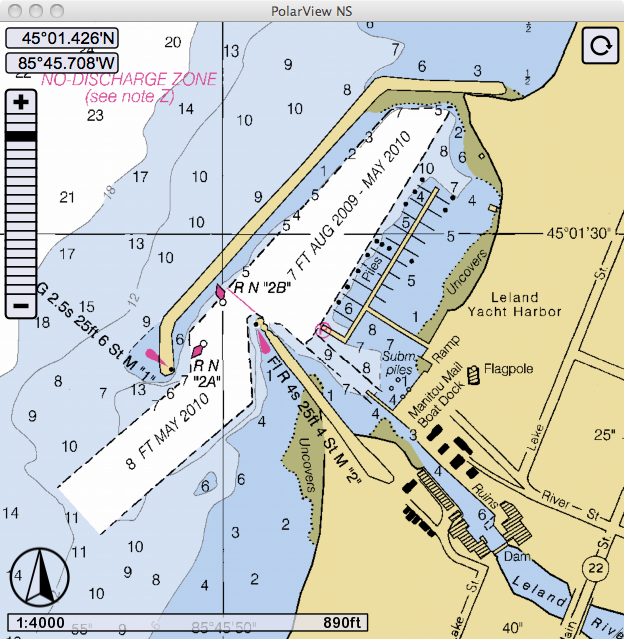
Here is a recent NOAA Chart:
It seems to show the harbor was dredged in 2010. If the entrance has shoaled to four-feet or less at present that is only two years since the dredging which had a project depth of 8-feet. That is a very significant and fast shoaling. Maybe there was a helluva storm. |
| martyn1075 |
posted 05-15-2012 12:49 AM ET (US)
Whoever uses it must pay a fee. Drop box like a government wharf or a patrol booth during the summer months or maybe THE BLUE BIRD can manage the docks during the summer and charge transient fees if they are coming in by boat to have dinner or walk around town. Nobody likes it but most understand that money needs to be collected just like a strata property to build a contingency fee. Its not really that complicated whoever owns it or was in charge of building it is the one or group that is responsible to make the decision on what to do. If it was a free public service provided by the government ? then it just comes down to if they decide to put out the money. Everybody will have to live with that decision since nobody else to this point is managing the docks. However, if it keeps costing more money all the time usually it means the fun is over just like an old dying engine on a boat. We keep fixing them until we have finally had enough and either pack it in altogether or use the money we saved and managed to buy a new one as needed expense for a lifestyle we live for. I think if this expense is ongoing there might need to be a compromise between the people that use it and the group that has funded to keep a public dock. The in between are the merchants that should pitch in and manage the docks to bring in transient moorage fees. |
| ConB |
posted 05-15-2012 08:38 AM ET (US)
Man against nature. The SUV is on the launch ramp and the camera is looking South West.--Con |
| hauptjm |
posted 05-15-2012 10:07 AM ET (US)
quote: jimh,you hit the nail on the head! NEVER assume the ACE has the slightest idea of how, what or where when it come to building something/anything. Their incompetence is only marginlized by their ineptitude. Who in their right mind builds a harbor that is completely cut off from a cross flow water, while being freshly supplied with river sediment and what appears to be a natural SAND beach, right at the mouth of the pen. Could you ask for a more impossible condition? Now the other shoe to drop should be the obvious question: what have they spent over the last 50+ years to keep this thing open. I'm no engineer, but the harbor entrance needs to be moved to the north and the southern end will "ebb and flow" the sand/sediment as it would as if the harbor wasn't there. Shoot, it might even contribute to building and maintaining a healthier beach. |
| newt |
posted 05-15-2012 11:08 AM ET (US)
This just goes to show how hard it is to change the forces of Nature. We are experiencing a similar problem hear on the East Coast at the mouth of the Merrimack River in northern MA. Less than two years ago, they dredged the river mouth to a depth of at least 12 feet minimum. All the sand they removed was pumped back up onto the beaches of Plum Island (to the south of the river) and Salisbury (to the north of the river) in an effort to replenish the beaches that in recent years have eroded rapidly - to the point that houses are endangered. The sand pumped back to the beaches for the most part quickly eroded away, and now the river mouth is clogged up again. Here is an article in one of the local papers. http://www.eagletribune.com/local/x241725745/Sand-choking-river-mouth I suspect that boating will be interesting to say the least at the mouth of the river this year. Some of the best fishing occurs at or around low tide in this location, which just happens to be host to at least one fatality every year, and is where one of the forum members capsized his Montauk last year also. While not as crazy as the left coast inlets, the Merrimack is the most dangerous around this neck of the woods. |
| Agntvbb |
posted 05-15-2012 11:50 AM ET (US)
I concur with the others who have commented on the deficient design of the harbor. Opening the other end would probably prevent the sedimentation. |
| K Albus |
posted 05-15-2012 12:22 PM ET (US)
I am somewhat familiar with the Leland area, and I think all of the speculation about location of the harbor entrance being on the south rather than the north is unfounded. There is no prevailing strong current in the area. While the current may most frequently come from the south or southwest, most of the big storms in the area come from the north or northwest. Also, the river flowing into the harbor is dammed a short ways up, so I doubt that the river is the source of the sand that is clogging the harbor entrance. On the issue of the actual users paying the cost of the dredging, the problem is that the federal government has restricted the class of acceptable users. In order for the harbor to be self-sufficient, some of those restrictions have to be removed. The marina is a very nice facility in a very beautiful location. It's a shame that it is being wasted, and the town is suffering, due to inaction by the government. |
| andygere |
posted 05-15-2012 12:51 PM ET (US)
In all likelihood, a large fraction of the sediment is coming from the river, with the rest contributed from the surrounding lakeshore. The silt laden water takes a hard left to get around the small jetty tied to the shoreline, and it drops it on the inside of the curve where the water is flowing somewhat slower. Some of the river flow bends into the harbor after reflecting off the outer jetty, and that sediment is dropped along the inside of the wall. Some of the shoal at the harbor mouth is probably due to wave action and storms, but not knowing the prevailing weather, it's hard for me to guess how much. Still, Leland is not that different than Santa Cruz harbor in this respect: The harbor fill up with creek sediment, and the harbor mouth shoal is compounded by wave action and storms. In the winter when we have most of our storms, the dredge at Santa Cruz works nearly continuously to maintain the channel at the harbor mouth. It picks up the sand intercepted by the jetties, and pumps it to the beach where it was originally headed. The bottom line is that these man made harbors almost always require maintenance dredging. That's a known fact when they are built, and it only becomes a problem when the business model to fund it is not upheld or is flawed to begin with. Leland looks like a really nice spot, and I imagine it would be a very popular home port and cruising destination if the channel were reliable. I hope they figure out a way to keep it operational. |
| contender |
posted 05-15-2012 05:16 PM ET (US)
The 1st clue to this mistake/harbor is "Your tax dollars at work" The correct way would have been to have the opening in the center on the outside, and then another barrier/break water that would be longer on the outside of the opening, This would have given an entrance from both directions, the water would have flowed natural, and always would be deep water at the entrance.... |
| martyn1075 |
posted 05-15-2012 06:07 PM ET (US)
contender funny I was thinking the exact same thing when I first saw the photo. I don't know the area and which way the winds usually blow from so maybe there is a method to their madness but yes a cut away wide enough for two boats to pass would be sufficient I would think. Sure the spot at the head of the marina would get blasted a bit but also a big boat may just protect that wind from moving any further. Must be managed though this is not going to work as is. If its too good to be true is usually is. If its man made it will eventually bow down to nature which means more money to keep it afloat.
|
| Jefecinco |
posted 05-15-2012 06:55 PM ET (US)
An exit at the opposite end from the entrance COULD possibly allow the sediment to flow through the harbor rather than depositing at the entrance. It's obvious that there is heavy sedimentary flow into the harbor but because the sedimentary flow is interrupted by the harbor the sediment settles at the entrance. That harbor is a good design for a sand trap. USACE, if they were the designers or contracted for the design, did a poor job. The Corps has many excellent hydraulic engineers. Unfortunately they also have some less than excellent ones who are not well supervised. Butch |
| jimh |
posted 05-15-2012 07:56 PM ET (US)
Con--Thanks for the pointer to the video that shows the type of Southwest blow that Leland is exposed to all fall and winter. A few days of a storm like that could easily move 100,000-cubic-feet of sand from the beach to the harbor mouth. I know there is a popular notion that the Army Corps of Engineers is notoriously inept at its principal function of maintaining navigable waterways, but I find it hard to believe that their design for Leland harbor could be so bad that even a casual boater could see a better way. |
| Jerry Townsend |
posted 05-16-2012 12:49 AM ET (US)
When I saw the first view of the Leland harbor - I asked myself - why would they design it the way they did. I can't think of a single reason - I would think there would not be much difference in cost either way. Perhaps they can redo it right and eliminate the drifting sand and periodic dredging. ----- Jerry/Idaho |
| gusgus |
posted 05-16-2012 04:19 AM ET (US)
My first view of the harbor was questioning [its] value. It can't be worth much since there isn't even one boat in the harbor. A perfect waste of tax dollars, save a harbor a few use to eat at the empty restaurant. Huruumph! |
| L H G |
posted 05-16-2012 02:50 PM ET (US)
I think you guys are being a bit hard on Leland. As far as I know, that harbor in [its] present form has been there for at least 30 years, and there is a water flow inlet on the north side. It is the only harbor on this long stretch of high sand dune shorline between Frankfort to the south to Charlevoix to the North, a distance of 60 miles or so. It is definitely needed for recreational cruising. The very existance of this high dune shoreline indicates how wild the wind and waves can be in this area. The Sleeping Bear Dunes National Lakeshore is just to the south. Many harbors on the Great Lakes are suffering from very low water levels, anc combined with the National Debt and the state of the economy in Michigan, the result is inadeqate funding to provide for the routine dredging maintenance a harbor like this needs. Low water is the main culprit here, and the locals are going to have to pick up the expense evidently. |
| andygere |
posted 05-16-2012 03:35 PM ET (US)
Looking at Leland on Google Earth, it appears that any intended channel between the land and the north jetty is completely filled in with sand, and it doesn't look like water passes through from that side, although it may have when the harbor was constructed. Although all the slips are empty in the photo jimh posted, it may be because the photo was taken prior to the boating season. The trees don't seem to have much foliage. |
| jimh |
posted 05-16-2012 06:14 PM ET (US)
Re the water level, here is information from the United States Army Corps of Engineers:
quote: The level of Lake Michigan and Lake Huron is only one-inch above chart datum. In contrast, in c.1986 the level was five-feet above chart datum. |
| gusgus |
posted 05-16-2012 10:03 PM ET (US)
I sure don't know Lake Michagan at all, but with this discussion I am learning. Looking into the Leland Harbor placement and design, there are evidently huge design flaws. Flaws that may never be repairable. But 50 miles south there is Betsie Bay and it seems to have many services as well as sand free harbor conditions. North and around the point, maybe 25 miles are 2 harbors (associated with Hall bay)that naturally remain sand free. Why isn't the federal safe harbor there, OH,,,,Never mind, It makes too much sense. |
| jimh |
posted 05-16-2012 11:08 PM ET (US)
I think some of the participants here missed their calling. From all the advice given to the ACE, a lot of you should have taken up careers as hydrologists and erosion experts, instead of your current professions. |
| jimh |
posted 05-17-2012 08:19 AM ET (US)
The image (above) was probably taken during the Winter or early in Spring. The boating season in Northern Lake Michigan is not in full swing in April or even May. The water temperature was probably 40-degrees when that picture was taken. When the harbor at Leland is open to deeper draft boats the marina will typically be full every night in prime season, which begins in July and runs to late August. This is another problem: the marina cannot depend on year-round income to support the dredging. For harbors on Lake Superior the recreational boating season is even shorter--the last two weeks of July and the first two weeks in August. |
| Jefecinco |
posted 05-17-2012 09:09 AM ET (US)
Jim, I don't believe my comment had any particular merit as I am not a hydraulic engineer. However, I did spend virtually all of my adult working life (35 years) as a USACE soldier. My last USACE assignment was with a civil works district where I was in the Navigation Branch of the Operations Division. The Navigation Branch is responsible for all dredging operations within the District boundaries. I was able to learn a wee bit in the two years I was there but I cannot claim even freshman knowledge of hydraulic engineering. The USACE civilian engineers are a great bunch and incredibly dedicated to the job. Your comment defending USACE is appreciated. Butch |
| Tom W Clark |
posted 05-17-2012 09:25 AM ET (US)
I do not know who designed this harbor but anybody who has spent time on a beach knows that is you place an obstacle in the way of the prevailing littoral drift, sand will build up. So why is the jetty at Leland constructed so it captures the littoral drift? You don't need to be an engineer to understand that is a bad idea. Have the prevailing winds in Michigan reversed their direction since the harbor jetty was constructed? |
| ConB |
posted 05-17-2012 10:13 AM ET (US)
Fall and winter winds at Leland are north west with gales not uncommon. Summer winds are south west. So the harbor entrance is in the best spot if you want a harbor at Leland. An other thing that influenced the upgrading of Leland harbor was that along with the commercial fishing boats that operated there also was a United States Mail Boat that took mail and supplies to the Manitou Islands and a U.S. Coast Guard manned light house. The "crib" was in Manitou Passage between North and South Manitou Island. Con |
| K Albus |
posted 05-17-2012 10:27 AM ET (US)
I think the whole point of Jim's original post is that the federal government took over the harbor and put restrictions on its use, so the federal government should pay to properly maintain the harbor. I agree - the federal government should either properly maintain the harbor, or it should loosen some of the restrictions so that the harbor can become self-sufficient. |
| Tom W Clark |
posted 05-17-2012 10:38 AM ET (US)
You Liberals are so tiresome. You expect the Federal Government to pay for everything!
|
| Landlocked |
posted 05-17-2012 10:39 AM ET (US)
A great deal of my time is spent designing stream channel relocations, stream restorations, and bank stabilization projects. I've worked closely with the Corps Regulatory folks for the last 20+ years and would agree with both Butch and Jim that they are a very qualified group of proffessionals. I'd have to have a lot more data to know whether or not a simple fix is possible. My suggestion simply was meant to suggest that there could be. Few designs are perfect which is why there is a 5 to 7 year monitoring requirment and an adaptive management plan required for all of our projects. Ll |
| ConB |
posted 05-17-2012 12:30 PM ET (US)
Leland is now heavy to a resort community. They could not get enough fudgies into the old marina. http://www.flickr.com/photos/upnorthmemories/96420906/in/photostream/ Con |
| Tom W Clark |
posted 05-17-2012 12:59 PM ET (US)
Very interesting photo. It clearly shows the accumulation of sand on the north side of the jetty indicating a north to south littoral drift. If the winds are really as seasonal in their change of direction as Con indicates, there may be no way to prevent heavy sedimentation of the harbor entrance. |
| jimh |
posted 05-17-2012 01:32 PM ET (US)
To give some appreciation to the force of nature in this area in the non-prime boating season, I will recount the events of a few years ago and the offshore South Fox Island. There was a Spring storm that blew from the Northeast. (Of course the Northeast is not a concern for Leland, but it is if you are an island offshore.) A fellow had built a rather fancy home on the Southeast shore of South Fox Island. During the storm the beach erosion and movement of sand was so great that about 50-feet of beach disappeared in two or three days. The foundation of the house was in peril from the waves. The house had to be moved (at enormous expense) inland several hundred feet to avoid being washed away. This all happened in one storm in a two or three day period. Kevin presents more clearly my initial point, which I suggested with my several mentions of the ironies affecting Leland. From an economic point of view, a deep entrance to Leland is a machine that allows visitors to spend money there. When I visit Leland I spend money. I pay for a slip, I buy some fuel, I buy one or two dinners for two at nice restaurants. I may buy something in the gift shop. I figure I probably drop $200 minimum for each day I visit. There are 50 slips. That is $10,000-per-day as a minimum from the marina. The marina is probably full the entire months of July and August, or 60-days. That is $600,000 in spending in Leland that might not happen if not for the marina. Add in the long term leasing of dock space to the park service and natural resources boats. Add in the shoulder-season revenue. It probably adds up to $800,000 in spending in Leland. If Leland has to invest $80,000 per year in dredging, I think they can consider it a good investment. The $80,000 dredging will permit $800,000 in extra spending to occur in the town. I don't know that this model will work for all the harbors of refuge on the Great Lakes. Some of them, like Grand Marais, are not much of a tourist magnet. They will never draw $800,000 in added spending to the community. But if you are caught in a sudden Summer storm on Lake Superior, you would very much appreciate being able to enter the harbor at Grand Marais. By the way, the dredging mentioned in the linked article (above) about the Merrimack River in Northern Massachusetts was a project of many millions of dollars. Leland does not need a multi-million-dollar project. It just needs the ACE to drop by for three or four days in the Spring and clear out the shoal at the harbor entrance. |
| gusgus |
posted 05-17-2012 03:21 PM ET (US)
jimh-I guess I missed seeing and reading the rule that says any comments should only be from experts. |
| newt |
posted 05-17-2012 04:01 PM ET (US)
quote: True. The Merrimack dredging costs also included an upcharge to pump and spread the sand back up on the beaches instead of simply dropping it out to sea. |
| jimh |
posted 05-17-2012 05:01 PM ET (US)
gusgus comments:
quote: Comments are welcome. In the matter of maintenance of waterways, the Army Corps of Engineers has been doing it for two hundred years, or more. Some participants apparently have decided that the ACE are idiots and they could do better. Their assessment of the hydrology of Leland consists of looking at one small image taken at one particular day of the year. Now they know more than the ACE does about Leland, even though the ACE has been maintaining it since 1965 in its current form. To reply to you, gusgus, in the same manner you have commented, I would then have to say: gusgus--I guess I missed seeing the credentials and experience of the armchair hydrologists who could tell so much from one small aerial image. Some comments are quite acute and show some judgement. I like Tom's observation of the pre-1965 breakwall. Tom notes that the accumulation of sand is clearly on the North side of the breakwall, indicating that the source of most sand movement is from the North. I would characterize that as a reasonable comment and offered with explanation. |
| gusgus |
posted 05-17-2012 08:20 PM ET (US)
I am not an armchair hydrologist, since i haven't the time with my brain surgery clinic and my porn star routine taking my time. My point is the internet is never the place to fix anything. No one is an expert. No one is the end all of information, through anonymity. Leland aside and hydrology aside, to suggest comments need accompanied fact is not likely when it could never be a forum's intention to fix the world. If it is someones intention, then we have a seriously misguided individual, IMHO. That is a different internet use, that is called wikipedia. Jimh, you are a fantastic source, no argument there. I have thoroughly enjoyed your information threads on radio use and technology advancement. |
| jimh |
posted 05-17-2012 10:42 PM ET (US)
I do not think the issue we are discussing is the competence of the ACE to design a harbor. The issue is who ought to pay for the dredging that is needed to maintain the harbor in the manner is has been maintained since 1965. There is a fund with $6-billion that has been collected to maintain harbors, but a change in policy has caused Leland to stop getting its harbor dredged by the federal government. The federal government keeps coming up with money for welfare cheese (and here I use that phrase as a figure of speech not as a literal phrase) but it no longer has the money to keep harbors dredged. Leland is not operating with a free hand; they're constrained because their harbor is a federal harbor of refuge. All of a sudden Leland--a town of population perhaps 400 in a township of population 2,033--is supposed to dredge the harbor so the federal government's boats can run out and back to the federal park and administer the federal fishery. I don't think the federal government asked the 600,000 people in Boston to pick up the tab for the $14.6-billion spent on THE BIG DIG. |
| martyn1075 |
posted 05-17-2012 11:30 PM ET (US)
Oh so there is money coming in from the marina slips. I was under the assumption that this marina is not being managed and therefore is public and funded by the government. I heard no mention of this in the opening post. This is a no brainer then the port of Leland will, and should pay for this repair. Absolutely, if it brings in six figures over three months or so then as a maintenance fee the 80k should be allocated as a contingency fund for this problem. They certainly owe it to their cliental to fix this and keep it working as functional marina. I would be shocked if they did not pay this and relied on federal help. Foolish, but I am sure they will do it because 600K is not easy money to come by in this world. It takes spending a little money to make money. Martyn |
| jimh |
posted 05-18-2012 08:12 AM ET (US)
The marina does not get all the money I mentioned in my hypothetical example. In my case the marine only got $35 of the $200 I spent. The fuel dock got more of my money, the restaurants got more of my money, and the gift shop got a few dollars, too. The slip fees don't pay for the dredging. The total economic activity in the town might be able to cover the dredging, but not the slip fees. Here is an analogy: if there is an interstate highway running past your town, and the exit ramp become impassible, would you expect the local merchants to take up a collection to repair it? I don't think that would be the norm. The norm is the problem on the exit ramp would be repaired and the federal highway maintenance fund would pay for it by using the money they collected from gasoline taxes. This is precisely analogous to a federal harbor of refuge that needs some repair. There is a fund, collected from taxes on marine activities, that exists to maintain the harbor. It is not being used. Instead, the local merchants are being asked to take up a collection to repair the harbor entrance. It's like asking a little town off an interstate to collection from all the local merchants to fix the pavement on the exit ramp. |
| martyn1075 |
posted 05-18-2012 11:03 AM ET (US)
I see what you mean now. To put a twist on that analogy I look at it like a strata lot. If one of the units has a sagging roof but the others are fine we all pitch in to help that owner with their problem even though it doesn't really affect us in the slightest. Further more if a managed strata lot is run properly their should always be money leftover for a rainy day. In the case of Leland this particular repair is the rainy day but with some recent evidence is looking more like a ongoing repair due to the design but probably more to do with just natures force. Anyway we slice it this marina that sounds like a real nice boating spot that is profitable to the merchants in my opinion needs to be supported solely by them because as you said it really does bring in business from many different forms that are related to transient boating. It so easy to bring in money and not look the other way. If we have to put out money that is not always expected its generally a bit of a shock. In their current state I can see why some of these business owners may not want to put money aside. However, if we look at the bigger picture they should see that if managed properly I don't think it will be that noticeable. Lets put it this way, without the marina they really! will notice it, and in a negative manner. Martyn |
| Newtauk1 |
posted 05-18-2012 11:27 AM ET (US)
Actually Jim the residents of Boston and the drivers that pay tolls on the roads associated with the Big Dig are paying a portion of the tab and the overrun costs. Suggesting that the Big Dig and the dinkly marina problem in Leland have anything in common is commical. If a baseball team wants a new stadium it often has to pay to build the state or federal infrastructure associated with the access and parking. Our current president is creating a welfare mentality and many like yourself are drinking the coolaid. |
| sportroyalwulf |
posted 05-18-2012 02:55 PM ET (US)
Possible dredging progress? http://www.lelandreport.com/Default.aspx?bid=4177&rdate=5/15/2012 |
| gusgus |
posted 05-18-2012 03:32 PM ET (US)
Fact: this country can't afford to dredge Leland. Fact: Leland is a luxury, not a requirement, no matter the law. Without this harbor, people will just have to be much more careful. If it is important enough, it will exist, if not, it shall be filled by sand. Lastly: this period in American history will either destroy us or enable us once again. Cut spending or die a financial suicide. Supporting the likes of Leland is almost as absurd as supporting the roller rink in central Detroit for underprivileged kids, who break in and steal the equipment regularly. Taxes have a purpose and if the constitution doesn't specifically direct it, it needs to be removed, including welfare. I have no issue with Leland's existence. My issue is 100% about tax dollars and expecting people who will never use the harbor, pay for it. That is stealing. |
| martyn1075 |
posted 05-18-2012 03:58 PM ET (US)
As well its likely they don't need the money anyways. It sounds like they are bringing in enough to make this a non issue. Having someone else flip the bill so it enables the merchants to bring in more money during the nice boating months is wrong. Sorry they were given a gift way back in the day now its time for them to keep it going. I don't want to paint a evil picture on these business they are probably good people who work hard for their money but its just the way business is and they should be taking it on themselves as a group to keep it alive and not looking for tax dollars for regular maintenance at least what seems like is starting to become inevitable with the sand issue. Personally I don't think they really have a choice if they want to keep the business they are accustomed to over the many years. Martyn |
| jimh |
posted 05-18-2012 08:09 PM ET (US)
Newtawk says: "Suggesting that the Big Dig and the dinkly marina problem in Leland have anything in common is commical (sic)." No, I disagree. It is a great analogy. It shows how the federal government lavishes taxpayer money on some projects and refuses to spend money already authorized on others. |
| jimh |
posted 05-18-2012 08:14 PM ET (US)
The taxes collected already were in place to pay for dredging of harbors. To not spend the money collected for harbor maintenance on the maintenance of harbors is not a defensible position. The $6-billion in the harbor maintenance fund was not collected from income tax; it came from fees and taxes on marine activities. Use the money to maintain the marine environment that creates the economic activity that raised the $6-billion in the fund. My personal view: the administration thinks it can hold out and spend the $6-billion somewhere else because it won't lose too many votes. The administration seems to be correct. I am surprised that so many people participating here--all boaters I presume--seem willing to let the federal government collect money for harbor maintenance and then not spend it on harbor maintenance. |
| jimh |
posted 05-18-2012 08:25 PM ET (US)
Let me give another example as an analogy. On Interstate 75 in mid-Michigan there is an exit at the sleepy little town of West Branch. There is a big mall there. The retailers in that mall receive a steady stream of customers from the exit ramps of the federal highway. They sell more merchandise in one day than Leland can sell in five years. If the pavement on the exit ramps is bad, the federal highway fund repairs it. No one expects the town of West Branch to repair the highway exit ramp, and there is no argument that can be made that will convince me that the Leland gets more economic benefit from their harbor than West Branch gets from that interstate highway exit. |
| newt |
posted 05-18-2012 09:24 PM ET (US)
The people of Leland need to start making a stink with their representatives, or start a media campaign an get the attention drawn to their harbor. This is precisely what the residents of Plum Island did and eventually it worked. If the federal government pays to dredge one harbor - commercial or otherwise - they should pay to dredge others, including Leland. Then again, perhaps there is more to this story. This entire thread is based on second or third hand information. Is there more to go on besides "comments from locals"? |
| martyn1075 |
posted 05-18-2012 11:11 PM ET (US)
I am not a local so in all fairness can't comment with complete confidence but based on the information provided can someone here explain why Leland cannot take care of this issue on their own without asking for help through taxes via government? Martyn |
| gusgus |
posted 05-19-2012 03:34 AM ET (US)
Do road taxes from fuel go where they promised they would? Do cigarette taxes go where we were told they would be spent? Did the toll on our bridges end when the bridge was paid off, as promised? Does our Social Security taxes remain where we were promised they would remain for us to use at later dates? The obvious answer is of course no. Just because taxes are stolen from us does not demand that we get in a line and marching to this countries funeral. Like Zombies without clear vision. There is a much more important direction than understanding who stole from whom. The federal government is so corrupt it doesn't really matter to them what happens as long as we continue to argue about little things like this. While they give a billion to another islamic country without us even batting an eye, because Leland is far to sandy! We are playing ourselves for fools when we believe any part of the promises these thieves have told us or that they will follow any laws they are ordered to follow. I'm done with this thread. Leland is just a pimple on this governments bottom, they will keep all the people depending on it's existence, anxiously waiting for a little more and a little more, and all the time stealing billions, and tossing pennies to us to keep us busy arguing. |
| jimh |
posted 05-19-2012 07:34 AM ET (US)
Newt says: "This entire thread is based on second or third hand information." The picture of the harbor and the excerpt of the chart are first hand information. The exact quote of the text of the letter to members of congress from other members of congress is first hand information. All of the dollar cost figures are as reported or cited or quoted in numerous newspaper articles. The DETROIT FREE PRESS article cited is on-line, but you have to pay an archive fee to read it. All comments from me about Lelend are based on actually having visited there many times. I am not sure how the discussion could be conducted better, unless we all traveled to Leland and met face to face on the pier. Is it necessary to personally take soundings at the harbor entrance to be able to discuss its depth? |
| jimh |
posted 05-19-2012 10:03 AM ET (US)
The picture of Leland mentioned above (see link in ConB's post) shows the harbor entrance prior to c.1965. The chart and aerial photograph show the current harbor. The primary purpose of the federal government in making Leland a harbor of refuge was to provide a resource to boaters in bad weather conditions. Let me ask for opinions on this question: If you were approaching Leland from seaward in storm conditions with large waves coming onshore, which harbor would be safer or easier to enter? The pre-1965 harbor with its straight-in entrance? Or the post-1965 harbor with its dog-leg entrance? My opinion is the pre-1965 harbor would be easier to enter from seaward in a storm. The approach is a straight line. You could approach the opening from a wide range of angles and pass through it at the best angle with the waves. The current harbor could be difficult to enter from seaward in certain conditions. If there were large waves from the Southwest, one would have to approach from the Southwest, then make a 90-degree turn across the waves and duck behind the breakwall. A corollary question: which harbor gives the inner harbor the best immunity to waves. In this case I favor the post-1965 design. I suspect that the earlier harbor did not knock down all the wave action coming into its entrance.
|
| Newtauk1 |
posted 05-19-2012 01:45 PM ET (US)
[After 65 articles in this discussion, tried to changed the topic to discuss whether or not this discusion is appropriate. Deleted these comments, as one might expect. We do not care to discuss the discussions. You can be certain that if the moderator engages in a topic that the moderator feels it is appropriate.--jimh] |
| jimh |
posted 06-24-2012 07:21 PM ET (US)
We spent a very enjoyable day and night at Leland a few weeks ago, and while enjoying the splendid accommodations of the boater's lounge there--which being about the only transient boat in the harbor we had to ourselves--I came across a reprint of a newspaper article published many years ago that gave the history of the iron works at Leland which was established c.1880 and ran for about 15-years before going out of business. One of the reasons cited for the failure of the iron works was the lack of a good harbor. Ships could not count on being able to come to the dock of the iron works to unload iron ore because the harbor was not protected, and it was mentioned that an unloading that might have taken a few days in a protected harbor could take more than a week or two at Leland because of the frequent high winds and high waves coming ashore there. I mention this because here we are , about 130 years later, and we are still bemoaning the lack of or at least the cost of a good harbor at Leland. By the way, as it happened, we arrived at Leland on June 12, a Tuesday, and found that the dredging of the harbor entrance had been complete just the day before. We found the dredge made fast to the bottom by her spuds just inside the harbor and the entrance having a depth of about 12-feet. I want to thank the people of Leland who voluntarily contributed their own money to maintain the harbor in a navigable state. On that day we were the only boat arriving until much later in the day, when a sailboat came in that had travelled the width of Lake Michigan from Sturgeon Bay, Wisconsin. We two were the only recreational boats using the harbor. We could have snuck in to Leland even without the dredge, but the sailboat had a six-foot draft, there were four-foot waves running at the inlet, and it would have been very chancy for that boat to enter the undredged harbor. At the marina docks there were very few boats, only a half-dozen local boats whose owners had sufficient resources to pay the daily dockage rate to keep their boats there, but there was quite a collection of boats owned by federal agencies there. As best as I can recall, there were-- --two RIB type law-enforcement high-speed boats owned by some federal regulatory agency related to fisheries --a 25-foot aluminum chambered boat from a federal agency involved in some sort of geologic survey activity --a 40-foot utility boat for the National Park Service --a 65-foot passenger ferry for the National Park Service that takes people out to the two offshore island national park grounds (and, by the way, it was so rough that day that the ferry did not run, which gives you an idea of the sea state we were out running around in with our Boston Whaler 22-footer) --a 20-foot tribal fishing boat owned by the Grand Traverse Band of Indians --a 50-foot tribal fishing boat owned by the Grand Traverse Band of Indians I think it was darn nice of the local citizens to pay for the harbor dredging so that all of those federal government boats could continue to use the harbor. I am sure there were a few state-owned boats there, too, but I don't recall the details. And I bet the local law enforcement boats would have been around the harbor, too, but for the ramp being closed. As for the ramp, it was closed and in the process of being rebuilt. I will tell more about that in a separate article. |
| jimh |
posted 07-14-2012 12:24 PM ET (US)
The harbor at Leland has just raised the mooring fees for transient boats to $2-per-foot-per-night. Because the harbor is operated under the MIchigan Waterways Commission, Leland had to seek approval for the rate change. Leland is now the most expensive publicly operated harbor in Michigan. The harbormaster mentioned that the recent dredging cost a total of $175,000, and as explained in the discussion above, was paid for by Leland itself, in spite of the accumulation of millions and millions of dollars in tax revenue collected by the federal government for harbor maintenance that remains unspent. The increase in mooring fees is anticipated to recoup some of the expense borne by Leland in conducting their own harbor dredging project without any federal or state support. Considering the very deluxe accommodations available to transient boaters, the harbormaster anticipates that the higher fee will not be a deterrent to passing boats stopping in Leland. He also noted that many of the boats making a passage up Lake Michigan originate from Chicago, where boaters are already accustomed to paying similar fees for mooring. |
| jimh |
posted 07-14-2012 12:29 PM ET (US)
Final inspections of the new renovations in the public rest rooms and parking lot improvements were anticipated to be approved the week of July 9th, so all the construction at Leland should finally be finished by this time. For more about the new ramp and parking facilities, see my comments in |
| martyn1075 |
posted 07-14-2012 01:37 PM ET (US)
Good on management to take control. As I mentioned before they will need to look at the bigger picture. Its not ideal to be dredging this out every five years or so BUT its a business after all and this is a unique expense that must be provided to their clients to make it work. Visitors will have to understand this. Some might not fully grasp it and therefore never return but at the same time they wouldn't visit anyway if the marina was full of sand and couldn't safely get their boats through. There is no other choice other than to close it down which kills most of their small town livelihood. Im glad to see they are doing something about it. I hope they have long term plan to put money side for the future dredging occurrences.
|
| L H G |
posted 07-14-2012 07:21 PM ET (US)
The Boston Whaler Great Lakes Cruising Club should hold a 5 night, 4 day long weekend rendezvous at the Leland facility sometime this summer. If we got 15 to 20 boats, that would give them a nice chunk of revenue to help them pay for dredging their excellent facility. Being just North of the Sleeping Bear Dunes National Lakshore and with access to all of the Lake Michigan island chain, there are lots of great day trip cruising destinations out of Leland. As a founding member and President of the Club, I can think of 6 to 8 boats I could produce for the event, people some of you have not seen in a while. Perhaps sometime in August. I think the days of Dealer sponsored events are gone, since the Classic Whaler crowd does not produce any sales of either new Whalers or loose Mercs. |
| Dave Sutton |
posted 07-14-2012 08:00 PM ET (US)
"Considering the very deluxe accommodations available to transient boaters, the harbormaster anticipates that the higher fee will not be a deterrent to passing boats stopping in Leland"
One would hope that the good citizens who paid for the dredging apply for a 10X increase in mooring fees for Federally owned boats, as a thank you for not chipping in ther tax funds for the improvements. We will probably spend a few nights there in September, be nice to see the harbor now.
. |
| home Aside |
posted 07-15-2012 01:12 AM ET (US)
LHG--count me in, I've never been to Leland on my Whaler, it's certainly on my "To Do List". although I've got a lot of premium time off in August I don't think I can make the north Channel trip. Pat |
| jimh |
posted 08-19-2012 01:17 PM ET (US)
The situation with lack of funding for dredging in Leland Harbor was used in a long article in the BoatU.S. magazine as an example of how small recreational boat harbors are unable to get federal help to maintain their waterways. See the AUGUST/SEPTEMBER 2012 issue and page 30, Can America Keeps Its Waterways Working? There was also more news locally about the dredging. The dredging was done by Michigan Hydraulic Dredging of Cheboygan, Michigan. They undertook the job on the basis of a $18,000 mobilization fee and a charge of $7 per cubic-yard of sand removed. There was an anticipation that 10,000-cubic-yards of sand would be removed, and the cost would be $88,000. The work was begun with a partial payment of $15,000 and a promissory note for the balance. According to the United States Army Corps of Engineers (USACE) survey of the harbor, the dredging removed 14,000-cubic yards of material, with the result that the cost of the work increased to $116,000, a variance from the original estimate of $28,000. According to an article in the local newspaper, the dredging company is still awaiting payment. Adding further to Leland's difficulties, a significant portion of promised voluntary contributions to pay for the dredging has not materialized, as some donors have apparently backed away from their pledged commitments. Of the pledged $60,000, only $22,000 was actually raised, and of that amount $15,000 was used for the down-payment to begin the work. Thus there remains only $7,000 in the coffers and a $101,000 outstanding bill for the dredging. Leland Harbor is $94,000 short on its dredging bill. There are committed donations in the works from the National Park Service and the U. S. Geologic Study. Both agencies use the harbor for their boats and as an access point for the offshore island park lands. They're going to kick-in $12,000, which seems only fair, considering their dependence on the harbor being open for operation of their boats. That leaves $82,000 to be raised. The USACE also helped control the project cost by not charging their usual $40,000 fees for the permitting and survey work. The Leland Township Board recently approved making a $20,000 payment to the dredging company "as soon as possible," and hopes to perhaps negotiate a reduction in the cost of services provided. If we figure a slip rental at $2-per-foot and 25-foot boat as average, that is $50-per-night for a slip on average. Dividing $82,000 by $50-per-night-per-slip means that Leland needs to have 1,640 boats visit and rent a slip for the night to generate the funds needed to pay for the dredging. I'd say they can accommodate about 65 boats in the marina with their present dock space, so at that rate it will take 25 nights at full capacity to generate $82,000 in revenue. There are just about 25-days left in the boating season for Northern Lake Michigan, so we can hope for Leland to be very busy the rest of the Summer and early Fall. |
| jimh |
posted 09-03-2012 12:55 PM ET (US)
According to an article in the local newspaper, the Grand Traverse Band of Ottawa and Chippewa Indians made a $25,000 donation to Leland to assist in paying for the cost of the 2012 Spring dredging project that opened the harbor this year. The GT Band generally has one or two of their fishing boats moored at the dock in Leland during the fishing season. |
| jimh |
posted 10-14-2012 01:19 PM ET (US)
According to an article in the award-winning local newspaper, the LEELANAU ENTERPRISE, Leland Township has now paid in full its bill from the dredging contractor, Michigan Hydraulic Dredge of Cheybogan, for the 14,000-cubic-yards of sand that were removed from Leland Harbor this Spring in order to open the harbor for navigation. With the continuation of the unprecedented 14-year-span of low water, it may become necessary to perform more dredging next year to keep the water in the harbor entrance at an acceptable depth, a local boater reported to me recently. Water levels in Lake Michigan-Lake Huron are decreasing this Fall, and may reach historically low levels, as a long-time Lake Michigan boater recently speculated. |
| jimh |
posted 03-17-2013 12:46 PM ET (US)
A bit of recent news about our favorite harbor of refuge on northern Lake Michigan: The Michigan State House of Representatives is said to be about to approve or may have already approved a proposal from the governor authorizing the expenditure of about $20,900,000 to perform emergency dredging of certain harbors in Michigan. The Michigan Department of Natural Resources will add this funding to their own budget allocations for dredging to create an Emergency Dredging Plan. For more details, see http://www.michigan.gov/dnr/0,4570,7-153-39002_23334-296565--,00.html Leland is on the list of harbors to receive assistance in dredging. See http://www.michigan.gov/documents/deq/ Emergency_Dredging_Projects_412972_7.pdf The above document calls for removal of 12,000-cubic-yards of material from the harbor. The document shows the 12,000-cubic-yards of material are in the column marked "USACE Responsibility." I am not clear if that means the USACE is going to do the actual work. The local newspaper, THE LEELANAU ENTERPRISE, is reporting the DNR has announced $420,000 will be allocated to this project. I believe the $420,000 figure comes from this pending legislation: http://www.legislature.mi.gov/documents/2013-2014/billengrossed/Senate/ pdf/2013-SEBS-0233.pdf See page 15, where Leland Township Harbor is a line item with $420,000 allocated for estimated cost of emergency dredging. Recall that dredging in June of 2012 removed 14,000-cubic-yards of material at a cost of $116,000. (See article above.) That is more material removed for about one-third the cost of the estimate of $420,000. When Leland hired a private company to dredge their harbor, they paid much less than the State is prepared to pay the U.S. Army Corps of Engineers, if I understand the facts and figures correctly. On further investigation, the State seems to be using a figure of $35/cubic-yard of material, which is perhaps on the high side of what the actual costs will be. Last year's dredging was done in unusual circumstances where the USACE waived its usual permitting fees. The hope is the USACE will do the actual dregding to the project depth, including the outer approaches to the harbor. The details of these projects are still in flux at the moment. If all goes according to plan, Leland will be dredged this year and the local community won't have to pay out of pocket for it. |
| thammer |
posted 03-21-2013 09:40 AM ET (US)
Thanks for the update! |
| hauptjm |
posted 03-25-2013 12:17 PM ET (US)
I hate to keep picking on the USACE, but they are easy pickin's: http://theadvocate.com/news/5514116-123/barge-gate-issues-loom |
| jimh |
posted 03-25-2013 03:46 PM ET (US)
When the legislation enabling the $20-million for emergency dredging was the subject of a newspaper article in a local paper, I happened to read some comments appended by readers. The comments were mainly in strong opposition to the spending, based on the governor's party affiliation and the notion that the beneficiaries would all be wealthy yachtsmen. This view is not surprising to me. I have said for a long time now that in the current political climate the State of Michigan would never have authorized the creation and funding of all the beautiful public harbors, marinas, launching ramps, and other boating facilities that make Michigan such a fantastic boating location because that sort of public spending and public works would all be seen as some special subsidy for the rich. It is unfortunate that recreational boating has become a pastime that is now perceived as being something that only the very wealthy can participate in. |
| jimh |
posted 03-25-2013 04:01 PM ET (US)
Here are some polarizing comments:
quote:
quote:
quote:
quote: |
| Dave Sutton |
posted 03-25-2013 04:43 PM ET (US)
These comments would likely surprise the thousands of small businesses and tens of thousands of people employed to service and support the HUGE tourism industry provided by the recreational facilities and infrastructure of the harbors. I know from study that our dive operation, just myself, one other person, and a 28 foot boat, brings over $200K worth of business revenue to Michigan yearly. Multiply that times ?? x and you have a multi billion dollar economic engine.
. |
| jimh |
posted 03-25-2013 06:51 PM ET (US)
I suppose it is not a particularly present-day phenomenon that there is a debate about public spending. I was astonished to find that in the 1950's the building of the Mackinaw Bridge was not actually a project funded by the State of Michigan or its legislature. The State only seems to have authorized a Bridge Commission. The Bridge Commission sold its own bonds to finance the project without any backing of the credit of the State of Michigan! Essentially, some Upper Peninsula Republican's drove the project, got the funding, and built the bridge. Popular Democrat governor Soapy Williams attended the ribbon cutting ceremony and posed for pictures, but the State of Michigan and his administration didn't really lend much support. Today, it is hard to imagine not having the Mackinaw Bridge to link the two peninsulas. It is also a great benefit that the bridge was built in the 1950's. It only cost $92-million and only took three years to build. I doubt the bridge could be built today, under any circumstances, as there would be too many opponents, lined up for miles and with hundreds of lawsuits, based on environmental concerns, Indian burial mounds, and who knows what other objections. If you don't believe that, just look at the stupidity in Detroit that is trying to stop the State from building a new bridge to Canada. Thank goodness that opposition was defeated in the last general election referendum on the subject. But we still have not broken ground for a new bridge. |
| hauptjm |
posted 03-26-2013 10:53 AM ET (US)
quote: Amen! To bring it to a boating level, many complain of indulgence and conspicuous consumption when waxing woefully of the wealthy and their oversized yachts, but exactly who is the beneficiary of this indulgence? Is it the fiberglass layup crew, or maybe the joinery worker/craftsman, maybe it's the welder or the line worker at the radar factory, or it could be the salesman, or.....We always need to be real careful of what we condemn, for the reach of the free enterprise system is quite involved. We had to deal with many realities of renewing a city that was destroyed by man-made systems that were built and insured and ensured that would sustain Mother Nature. Admittedly, you can't prepare for every event, but nonetheless, decisions had to be made afterwards. Does a city repair its highest tax base assets (businesses and rich folks) first and get the wheels of economy going (which propels everyone), or do you do the politically correct thing of cater to the needs of the poor and "disenfranchised." Reality: you do both as best you can! You get lambasted by the ivory tower press, but do your best to ignore and move forward. No good deed goes unpunished! The biggest problem I think we have in these public works projects in today’s climate is the loss of truthfulness: honest discussion on merit and reality and not whose feelings and "disenfranchisement" will be affected. If the project is honestly a positive thing for the general masses of the municipality, then so be it! Keeping them clean (politician’s hands) and on budget, wouldn’t hurt either. |
| Plotman |
posted 03-28-2013 11:24 AM ET (US)
At the risk of getting too political, you will never get those with the entitlement mentality to understand basic economics. It's all about how they deserve more, more, more. With absolutely no clue where the "more" they want is going to come from. I worked as a research assistant in college for a professor whose research showed that over time, the amount the government brought in in taxes remained remarkably constant regardless of what the marginal income tax rate was. However, there was a very strong inverse correlation between the marginal tax rate and GDP growth. Yes, lower marginal tax rates mean more growth of the economy, and a larger base on which to levy taxes, and therefore a growing pool of money actually collected in taxes... |
| jimh |
posted 03-30-2013 01:37 PM ET (US)
The best analogy, perhaps, for the shoaling in the harbor and the public interest in removing the shoaling so that the harbor is reopened to boat traffic is to make a parallel with a large mud slide that could block all the roads into Leland. I don't think there would be outrage if the State of Michigan paid for the removal of the mud slide on the public highway to permit traffic to reach Leland by automobile. The notion that people visit Leland by boat appears to be difficult for some to understand. There was a time when travel by boat to Leland was the much preferred method to get there. It was only after a few trillion dollars of public money were invested in a public, free, no-toll, paved, high-speed highway system that a car became the more convenient means of travel for reaching Leland. The only reason the State of Michigan has taken action is because the USACE is not taking action. The USACE has maintained harbors like Leland for decades, but apparently there has been a policy change, and now USACE is not going to spend its own money on harbor maintenance, even for harbors of refuge like Leland. By the way, the emergency spending authorization sets out criteria for funding, and one of them is the harbor should be a harbor of refuge. In the case of Leland, the open water of Lake Michigan to the West and Southwest is some of the most dangerous of all the Great Lakes, having been the location of many ship wrecks and loss of life. A small boat out in bad conditions in that area needs a harbor of refuge, and Leland provides it--but only if the harbor entrance is not shoaled so that no boats can enter. |
| ConB |
posted 05-14-2013 05:41 PM ET (US)
Seems like Deja vu all over again. Leland just can't get any respect. http://www.upnorthlive.com/news/story.aspx?id=897663#.UZKr45WQ5UQ Suttons Bay Harbor is being dredged as we speak and will be open soon. Paying for the dredging them selves, I think. Con |
| EJO |
posted 05-15-2013 04:25 PM ET (US)
It's like this all over on the East side of Lake Michigan or most of West Michigan's harbors. With exception of a few--Grand Haven, Muskegon, St.Joe-Benton Harbor, and Ludington--all refuge harbors on the West coast have problems and need dredging. The aforementioned four had priority due to commercial vessel travel all the others are mostly left to fend for themselves, even with Michigan government having stepped in and some dredging going on. I sold my sailboat; for the last two years I could not get to some of the refuge harbors which are so conveniently placed and accessible being 15 to 30 miles apart. All are nice resort towns with good food and entertainment. Many times commercial boaters and pleasure boaters have ducked into these harbor to wait out a storm. I couldn't and can't get into Leland with my 5-1/2-foot draft, and ran into problem in many other harbors. Back to Jim's original posting: yes, we all pay taxes for national infrastructure which is going down the drain--pun intended--and therefore all federal harbors of refuge should be subsidized. |
| jimh |
posted 05-15-2013 05:18 PM ET (US)
One of the reports said the current harbor opening was only three feet wide and eight feet deep, but I think what was meant is there is eight feet of water only in a width of about three feet in the center of the channel. The channel itself must be wider than three feet. I think I can get in there with my Boston Whaler with only three feet of water, but, if a big swell is rolling in, I would not try to get over the shoal in those conditions. |
| |
Powered by: Ultimate Bulletin Board, Freeware Version 2000
Purchase our Licensed Version- which adds many more features!
© Infopop Corporation (formerly Madrona Park, Inc.), 1998 - 2000.