 ContinuousWave
 Whaler
 Moderated Discussion Areas
ContinuousWave: Whaler Performance
Propeller Power Curve
Moderated Discussion Areas
ContinuousWave: Whaler Performance
Propeller Power Curve


search | FAQ |
profile | register | author help
|
|
ContinuousWave Whaler Moderated Discussion Areas
ContinuousWave: Whaler Performance
Propeller Power Curve
|
| Author | Topic: Propeller Power Curve |
| jimh |
 posted 01-13-2008 11:46 AM ET (US)
posted 01-13-2008 11:46 AM ET (US)  
Please use this discussion exclusively for questions, comments, or criticism of my article Propeller Power Curve I will be glad to answer any questions, acknowledge any comments, or defend my method against reasonable criticism with follow-up comments. |
| tmann45 |
posted 01-13-2008 01:30 PM ET (US)
It has been a few years since I read Gerr's book. I remember it was focused mostly on displacement hulls, which I was most interested in at that time. Do his calculations apply as well to planning type hulls as well as displacement type? Tom |
| jimh |
posted 01-13-2008 01:54 PM ET (US)
I cannot speak for Mr. Gerr's work. You'd have to ask him if it applies. My calculations are derived independently of Gerr's (as he does not show any derivation of his formula) , and I have based my analysis on the work of Crouch. The Crouch speed prediction formula is for moderate planing hulls. We have independently confirmed its accuracy many times with test results, so I feel it is entirely applicable to boats such as my Boston Whaler REVENGE. Using that as a basis I have derived a propeller power curve formula which seems to be in general agreement with that proposed by Gerr. I rely on Gerr's assessment that n=2.7 is a good average value, that's all. [Also, I should add that I do not agree with the characterization that Gerr's propeller handbook is limited to boats with displacement hulls. That is not an accurate characterization in my opinion, and I would recommend Gerr's book to people with non-displacement hull boats.] |
| jimh |
posted 01-13-2008 03:17 PM ET (US)
The concept that there should be some extra power available from the engine at certain speeds is important. You cannot accelerate the engine unless it has some extra power. Therefore, the amount of extra power available at a particular engine speed is a good indication of how fast the boat will accelerate to a higher speed. As you can see in the graphs, the hypothetical two-cycle engine I diagram based on an E-TEC power curve will be able to accelerate faster than the hypothetical four-cycle engine power curve based on a Honda BF150. |
| jimh |
posted 01-13-2008 03:44 PM ET (US)
I also explored the differences in using various values of n , from 2.2 to 3.0, as suggested. I added an addendum which shows a plot of this using the SST 15-inch propeller as a reference. |
| Peter |
posted 01-13-2008 06:16 PM ET (US)
Nice article. This should develop into an interesting discussion. There are some parallels to this article by David Pascoe regarding diesels. www.yachtsurvey.com/GasNdiesel.htm It would be nice if the outboard manufacturers published power torque and fuel consumption curves like the marine diesel manufacturers do. See, for example, 84.241.129.114/uploads/products/pdf/BY/6BY220Z.pdf .
|
| Tohsgib |
posted 01-14-2008 11:30 AM ET (US)
I agree that torque would be a better medium than HP. Also your engine although it hits 5900rpm it does not make 225hp there, more likely around 5500rpm. |
| jimh |
posted 01-14-2008 11:38 AM ET (US)
It is possible to speculate about the power curve on my engine, but that speculation is not the focus of the article. For the purpose of the article, which is to derive a propeller curve from some reasonable data, the assumption was made that the engine produced 225-HP in the range for which the manufacturer specified it would. If the manufacturer published a power curve for the engine, it would, of course, be useful for the purpose of developing a power curve for the propeller, but, since this data was not available, I just took the manufacturer at his word and used 225-HP. This assumption is explicitly mentioned in the article. The effect of assuming, for example, that the engine only produced, say, 210-HP, would be just to move the curve slightly, and not to change its overall shape very much. |
| newt |
posted 01-14-2008 04:53 PM ET (US)
Jim, forgive me if this comes across wrong, but what is the point? What is purpose does the Propeller Power Curve? Is the curve a tool to use in selecting or comparing an engine? I'm not trying to be a wise ass, I just don't get it. |
| cooper1958nc |
posted 01-14-2008 05:25 PM ET (US)
Jim is to be appreciated for attempting some of these derivations. Derivations like these are helped when "units" are obeyed. In other words, if a constant is used to translate RPM to HP (or whatever), it must have appropriate units, like HP/RPM. The constants shown are all dimensionless, which is confusing. More substantively, the propeller power curve graphed, which is just a of graph y= x ^2.7, is not related to the hull at all. It might be fairly correct if the propeller were being run in a test tank, but not if the boat is underweigh. A planing hull's resistance curve is not a monotonic function of speed, but has an inflection point where a transition occurs from displacement to planing speed. The torque required to turn the propeller follows this curve as well, so it looks nothing like the curve you show. In proof of this, it often takes near full throttle to get over the planing transition. There is little reserve torque available, because the "torque required" and the "torque available" are almost equal. The error in the mathematics that led to the curve is I believe, when you multiply RPM * f(RPM)^2 and get RPM ^2.7. f(RPM) is the tipoff that it is a FUNCTION of RPM, which in this case is a function that looks like a steep climb followed by a shallow step, then gradual climb after that. You can't ignore the FUNCTION. |
| cooper1958nc |
posted 01-14-2008 05:34 PM ET (US)
Methinks it would be much better to forget about the propeller for now. To predict reserve torque (power) at any RPM, 1. go to the published full-throttle torque vs RPM curves, plot them. that gives power available. 2. To find power actually required, go to fuel consumption data for the hull and engine. Use a s/f/c estimate to estimate power required at different speeds. Plot that. If you use an s/f/c for a given point (full throttle) that will automatically take the prop issues into consideration, at least as a first approximation. 3. The difference is the "reserve power." You will see it looks different from your curves. |
| towboater |
posted 01-14-2008 05:49 PM ET (US)
Last night I spent a good hour looking over Mercury engine/prop performance results for 60 HP EFI Big Foot. The tests included a large variety of hulls and prop dia/pitch. Nice job Merc. I am leaning your way. [urlhttp://northamerica.mercurymarine.com/look_deeper/index.php?Filter=11[/url] I read all this because, coincidentally, I am poised to repower and interested to know how Merc would use DATA to put X wheel on Y engine for Z hull. Thanks again for your time and hard work Professor (Jimh)...and patience, I will get there. I am a little confused with portions of your article. One para refers to obtaining power via PITCH whereas my local Pro prop expert refers to power via DIA and speed via PITCH. I also wonder, as long as Merc and the others are testing engines/props on various hulls, why dont they hook a tow rope up to a bollard pull meter? Actually, it wouldnt matter which hull they used. mk |
| cooper1958nc |
posted 01-14-2008 06:27 PM ET (US)
Static thrust (bollard pull) is not a good indicator of how high speed propellers will function at speed. They are operating at a wierd angle of attack for one. For another reason, the lower pitch and higher diameter will always outpull. |
| jimh |
posted 01-14-2008 08:21 PM ET (US)
newt--What's the point? To try to have a better understanding of how propellers and engines interact. Coop'--Yes, the curve is a graph of y=cx^2.7, so are all propeller power curves drawn with an exponent of n=2.7; this is more or less a given in the definition of the propeller power curve. As the method says, it is "arbitrary" that we choose the propeller power curve to meet the engine power curve at maximum engine RPM. Being able to see a propeller power curve gives you a chance to compare the power required by the propeller with the power available from the engine. |
| newt |
posted 01-14-2008 09:04 PM ET (US)
OK, I get it now. It is interesting to see the relationship between power required and power available. The first thing that pops into mind is the advantage of a transmission. According to your graph, at 4000 RPM your propeller requires around 60 hp, however the engine can produce 60 hp at 2000 RPM. Think of the fuel savings if you could switch into second gear and cruise at half the RPM! Jim, wouldn't your engine power curve more resemble that of the E-TEC? For example, my Johnson 150 engines produce maximum HP at 5000 RPM and your engine likely peaks before maximum RPM also. |
| cooper1958nc |
posted 01-14-2008 09:05 PM ET (US)
But jimh, a propeller has no "power curve" independent of the hull any more than a tire has a "power curve" independent of the car. If run in a test tank, true, it has a defined power curve. But when it is moving, its RPM to power ratio (defined by the torque required) depends on how easy the boat is to move at that speed. The "power curve" you show is not applicable to a propeller on a planing boat. That curve looks like a test tank or displacement hull. The engine produces power, which is torque times RPM. The propeller converts torque to thrust. The Delivered power is force (thrust) times speed. If the hull has high resistance at 16 mph it takes more torque to move it. It might take a little less torque to move it at 20 mph, depending on the hull. The power required would be slightly more or slightly less, but certainly not (16/20)^2.7. |
| towboater |
posted 01-14-2008 09:52 PM ET (US)
Jim, SPEED? isnt the topic Propeller POWER curve? I am conjecting, BP test will reveal how much pulling power or static thrust the combo of any engine/prop will produce independant of the hull factors. Certainly this assumes the combo will reach OEM safe operating RPMs. If safe operating RPMs are not reached or exceeded I realize the setup that has the highest BP rating may not be the best setup for a Gzillion hull performance factors. With recent comments about fuel consumpion at cruise the highest % of concern. I think it would be interesting to calculate best performance at WOT vrs a POWER performance setup and see which setup provides best fuel economy at cruise. Thx Peter for the link to Pasco. He mentions one of the most common mistakes one can make is to underpower a boat. No prob there. |
| jimh |
posted 01-14-2008 10:11 PM ET (US)
Coop'--the propeller power curve is derived from the function of the hull speed increasing with horsepower according to Crouch's formula. If Crouch's formula is accurate in describing that relationship (and most agree it is) then the influence of the hull is incorporated into the HULL FACTOR, which is a constant that is given to each hull type. Since the hull influence is given by a constant, it is also appropriate that it is given as a constant in the propeller curve. If you want to explore the power-versus-speed right as the hull transitions from displacement mode to planing mode, I am sure it will be more complicated. But even Crouch does not try to describe this transition area. The propeller power curve can be compared for a few different propellers. When I get a chance I will add an additional graph showing a few different propeller power curves drawn. Again, these will be estimates based on my observation of what maximum engine speed these propellers allow. |
| jimh |
posted 01-14-2008 10:46 PM ET (US)
towboater--I am glad that you found it interesting to read other information about propellers available elsewhere. There is an enormous number of discussions about propellers, how to select them, where to buy them, and so on, but I have not found too much about propeller power curves. That lack of information was one of the reasons I undertook to write about propeller power curves. As for the topic of bollard pull, using bollard pull to assess propeller performance, and other elements of propeller design for best bollard pull, I am sure they are of interest to people who plan to do a lot of towing with their boats, however, most recreational small boat owners are more interested in getting good moderate speed performance on plane from their boats. I do not think that bollard pull will be an important factor in selecting a propeller. If you do not mind, I suggest that you start a new and separate discussion about the use of bollard pull testing as a way to select or evaluate propellers for moderate speed planing hulls. It should be an interesting topic, and I am looking forward to seeing the theory behind your method. |
| jimh |
posted 01-14-2008 11:35 PM ET (US)
I added two more graphs to the article to show the propeller power curves of two additional propellers plotted against the engine power curve. In the second graph I expanded the horsepower scale so you can see just how much more power these larger propellers will need to turn them to 6,000-RPM (engine crankshaft speed)--much more than my old 225-HP motor can handle. |
| towboater |
posted 01-15-2008 12:24 AM ET (US)
so be it. |
| itl |
posted 01-15-2008 03:23 AM ET (US)
Why not just use Crouch's formula to calculate power what propeller takes in certain boat and certain speed/rpm? Then you can subtract that power from your engine power curve and you get the extra power what you can use for accelerating your boat. |
| jimh |
posted 01-15-2008 08:57 AM ET (US)
itl--Using Crouch's speed prediction formula to develop a propeller power curve is precisely what I have just demonstrated. If you have an alternative method for developing a propeller power curve, please feel free to show it and how you derived it. |
| jimh |
posted 01-15-2008 09:05 AM ET (US)
coop'--Regarding the propeller power curve being derived "in a test tank" I can only say that the interaction between a hull and water is the same in a test tank as it is in open water, other than the influence of some bottom effects which might occur due to the test tank being slightly shallower than deep ocean water, or from the influences of waves creating dynamic loads. However, I do not see any analysis of boat propulsion and horsepower required which includes factors for dynamic loads like head seas. By not including the influences of sea conditions in my propeller power curve I do not see that I have taken a different course than any others. These formula are too simple to include analysis of wave influences on the interaction of the hull and the water. The use of test tanks to derive data about the performance of a hull is a very common approach and has been proven to have outstanding faithfulness to the results obtained in the real world. So I am not prone to discard or devalue the information about propeller power curves based on your assessment that it represents a situation as might occur in a test tank. |
| Peter |
posted 01-15-2008 10:16 AM ET (US)
Newt -- Jim's engine is rated at 5500 RPM with a top RPM of 6000 RPM. Your 150 is rated at 5000 RPM with a top RPM of 5500 RPM. Coop' -- The marine diesel industry uses propeller power curves (I think with n=2.7) to illustrate their products power production capability relative to such propeller power curve. These propeller power curves ARE used for planing vessels as evidenced by the provision of propeller power curves on the power and torque charts for stern drive configured marine diesels such as the one in the above link. To the best of my knowledge, stern drive configurations are rarely ever used for displacement applications. The marine diesel manufacturers do not try to simulate the on-plane transition point because it varies from hull to hull and its basically irrelevant if the motor does not have enough reserve power to climb over the bow wave. |
| itl |
posted 01-15-2008 04:39 PM ET (US)
Say, we have a boat which weight 2500lbs (with 150hp Honda engine and gears), hull factor is 180. Honda power curve shows that engine is actually producing around 160hp and that is the max. power output. We also know our boat performance and it is known how fast it goes when engine is running 3000-6000rpm. With Crouch's formula, we can calculate that propeller is taking power as following: 160hp 6000rpm 45.5mph (top end) Then we compare these power ratings to Honda powercurve provided by engine manufacturer: 160hp 6000rpm We notice that propeller took 10hp less than engine is producing in 3000-5000rpm range and we can accelerate our boat with that 10hp reserve until we reach the top end where engine and propeller powercurves cross :) Previous data is taken from hat and my results probably does not meet with real life situation. Honda powercurve is same as is in jimh's propeller power curve article. |
| jimh |
posted 01-16-2008 08:07 AM ET (US)
itl's approach is interesting. You drive your boat at a particular speed, deduce the horsepower from Crouch's formula (using a predetermined HULL FACTOR), and note the RPM. Then you compare the horsepower the engine power curve predicts at that RPM. However, there is no way to write it down as an equation. The individual boat determines the function. When I get a chance I will use some of my own data and graph the results using the approach suggested. |
| hwsiii |
posted 02-07-2010 03:38 AM ET (US)
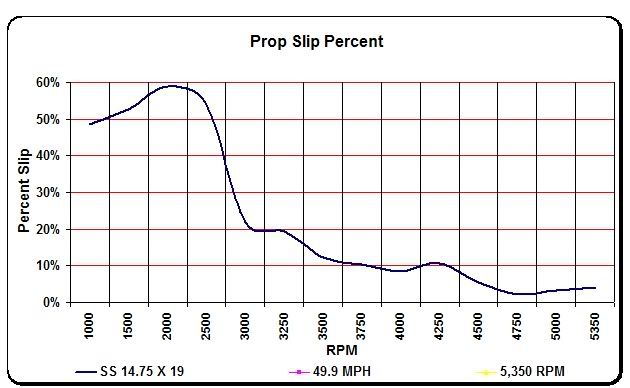
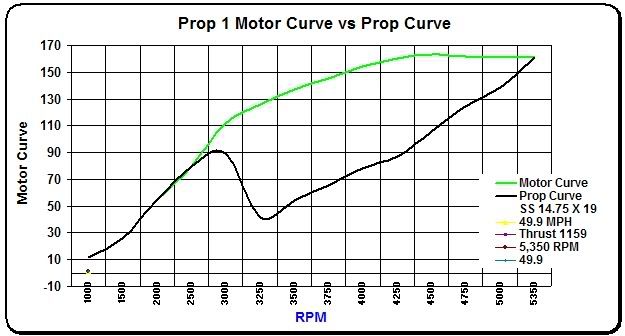
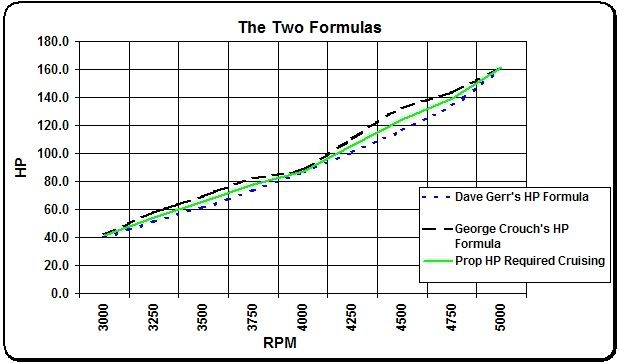
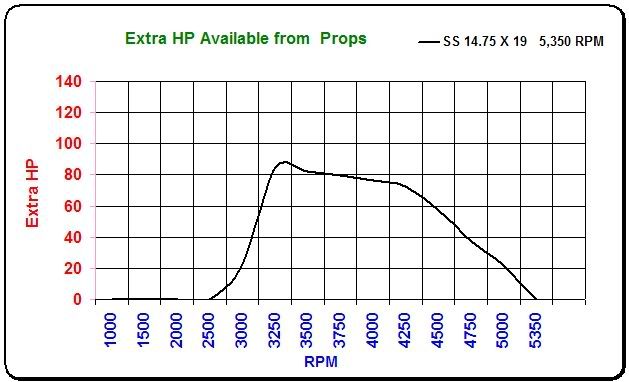
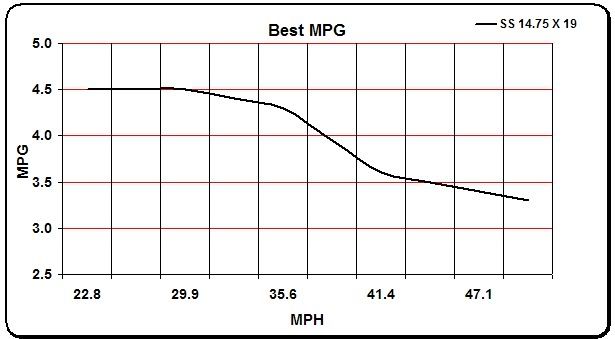
Jim, I have been trying to do an in depth analysis of motors and props to try and determine what information I can glean from the resulting data and charts to help me understand better the interactions between the two. As I have found, that by finding the data points and then charting them my understanding of what is actually happening at any point in time has increased very much. I also have been trying to use the old formulas in new ways to help attain new data that previously was not available to me. I know you also have been doing the same thing for a long time as well, as I have been coming here and comparing my data with yours. Of course we both use a lot of the same formulas to find the information we are concerned about, and I did find I had miscalculated Crouch by comparing our results, so thank you very much. Like you, I have had people say I am wasting my time, as well as these formulas are absolutely useless and self fulfilling, especially by engineers. LOL But I have found that even though I have made errors at times because of prior convictions in my mind, that in the long run it has helped me very much understand concepts I had no idea were there right in front of my eyes, the following is what I have found by charting the data. And I have had to apologize to people for giving them the wrong information as well. When I first started doing this I was using theoretical data only and the results gave me indications of where I might want to look deeper, but as I reverted to using real life data my knowledge and understanding increased dramatically when I looked at the charts. Luckily, I recently had a gentleman on another forum lead me to an older Evinrude brochure with performance curves on the Etec 150 HP engine and I was also able to get performance bulletins from Evinrude with that same motor used on different boats. I have found this to be very useful in quantifying my theories as well as give me a chance to use REAL data to justify my thoughts and to try some ideas that I felt were true but could not PROVE in the real world. I have looked at your Propeller power curves for your boat with different props and I have run many of the same type curves with data I was able to attain from a good friend who is a prop tester for many of the major Prop manufacturers. I am in the middle of doing comparative analysis of these props that are on the same boat with the same motor to see what I can possibly extract from the charts, as he has many of the same props in different pitches that he ran. So I am studying the data to determine exactly what information is important and what isn’t. But I am also lucky to have found many other props used on the same boats with full RPM and speed curves as well as MPG uses. I have been able to extract cruising HP and Torque required for any particular speed of a boat using Crouch and Gerr’s formulas. That is something I was testing by using both sets of formulas in the same spreadsheet they are so close that I am now convinced that the cruising numbers are within 5% of the HP stated in the spreadsheets, although I do realize that they are both very related to each other. By having those numbers it implies that we have power curves for the motor of the second order. I am trying to see if I can get the actual data from the manufacturer at this time, through another friend to compare the two. One of my Spreadsheets and the accompanying Charts The following numbers come from Evinrudes 2007 E-Tec Brochure and their performance reports and I cite both browser locations directly below here. There is more to the spreadsheet than I have shown but it is too wide to put on the screen and the other data is not very important. http://www.evinrude.com/NR/rdonlyres/ F4AB6628-0C3E-4134-8B50-3C7B0E4F9215/0/PE403.pdf 1. Taken directly from the Etec brochure 2. Tachometer RPM 3. Propeller RPM 4. Taken directly from the Etec brochure 5. Prop thrust using the standard Prop Thrust Formula 6. Motor Torque available at this RPM and HP 7. Boat Weight, this is directly from Evinrude’s performance report 8. Theoretical Speed from the standard formula 9. Knots Speed from the standard speed for conversion from MPH 10. Real MPH, these numbers come directly from the performance report 11. Tach RPM, just there so it is close to the other end of the spreadsheet 12. Pitch, this is the prop pitch that was used for this boat 13. Gear Ratio, this is the gear Ratio for the Etec 150 used on this boat I obtained the crouch number from the weight, HP and maximum speed of the boat, it is 214 A. This is the HP derived from using Dave Gerr’s constants and George Crouch, I add them together and divide by 2, Crouch’s is probably more exact but I decided to use both for verification.There is no excess HP available up to about 3,000 RPM as almost all of the maximum HP and Torque is needed just to get to planing speed. In the future I will only be using Gerr for the HP up to planing speed and then converting to Crouch after the boat reaches planing speed. B. Excess HP available is calculated from Motor output HP available at WOT at the specific RPM stated and subtracting the Prop HP Required cruising. The MORE excess HP available the more acceleration is available at that speed C. Motor Torque used cruising is figured from the Prop HP required cruising and the standard Torque formula E. This is for my uses only F & G. This is David Gerr’s constants for deriving HP used by a specific prop on a specific boat H. This is Dave Gerr’s results from his constants of HP needed I. This is George Crouch’s formula for finding the HP attained from a specific speed on a boat, after calculating his constant from the weight, HP and speed of the boat as given by Evinrude I used the theory that the boat comes on plane somewhere about 3,000 RPM When I look at the prop slip graph it makes me think that they have some bad numbers or that somebody moved in the boat because the curve should be much smoother than it is instead of the anomalies that occur in a couple of places I see the same thing in this chart as well and it is also notable that this particular prop has extreme prop slip at takeoff and yet has almost no prop slip at WOT, which tells me that the stated pitch for the prop is lower than what the effective pitch is This is where I made a comparison between Gerr’s and crouch’s numbers to find the correlation line between them You can see by the chart that the WOT thrust curve is ramped up fairly quickly to attain planing speed and then starts going down slowly as speed is increased after planing is obtained if you keep the throttle wide open But if we look at what happens if we just hold the throttle at cruising, instead of keeping the throttle pushed all the way open look at the difference in the thrust required at the same RPM to hold those RPM and speed This is the extra HP available that is not being consumed by the prop, that can be used for acceleration, as you can see after reaching planing speed there is plenty of power available for acceleration up to about 4,600 RPM This shows the best MPG speed and the accompanying MPG Jim I would appreciate it if you would look at this and see if you can find any errors. --H |
| jimh |
posted 02-08-2010 09:07 AM ET (US)
H--I made your graphics in-line elements so they could flow better with the text. I will have to study your results a bit before I comment. |
| hwsiii |
posted 02-09-2010 10:34 AM ET (US)
Jim. I am sorry about the numbers I sent you. My son played a joke on me and changed a few items, he took the motor weight out of my calculations of 470 pounds, which makes the Crouch number 230 and he also changed two of the speeds at 3,250 and 4,250 RPM, that is where the speed anomalies come from. He had no idea I was sending it to some one to look at and just thought he would have some fun. When I finally found the problems by rechecking the Evinrude performance sheet he laughed so hard on the phone he almost dropped the phone, and I don't believe he will do that again. The new Crouch number is 230 and now the speed anomalies are gone. The only thing that changes major though is the speed anomalies. Here are a couple of new charts.
H |
| cooper1958nc |
posted 02-10-2010 05:48 PM ET (US)
I'm trying to make sense of this. Your graph "prop theoretical vs real speed" shows theoretical speed as a green line. That line changes slope, but it cannot do that. Prop "theoretical speed" whatever that is, is just pitch times rpm times the necessary constant. You derive propeller thrust, and also horsepower. Which is derived from which? HP delivered is related to thrust delivered by a simple formula. Which did you derive first, and from what? In your "new" curves, I see a full throttle torque curve and a full throttle hp curve. The hp curve looks suspiciously flat. Torque times RPM times a constant equals hp. Torque is declining nonlinearly towards the end of the RPM range, RPM is increasing linearly. How can hp be nearly constant? Manybe its just the graph resolution. |
| hwsiii |
posted 02-11-2010 11:57 AM ET (US)
Cooper, quote: 8. Theoretical Speed from the standard formula this is the formula I use for Theoretical speed: ((Motor RPM / Gear Ratio) * Prop Pitch) /1056 I also checked it with this formula:
quote: I input the actual HP from the Evinrude Etec chart into the spreadsheet, then I used Crouch and Gerr to derive "Prop HP required cruising" ONLY. Then I just used the standard formula for thrust times the actual HP from the evinrude chart for "Prop Thrust at WOT".
quote: 6. Motor Torque available at this RPM and HP Cooper, I use the formula (5252 X HP) / RPM I have a larger spreadsheet with more categories and more information that I also use, I am just using this one to be certain that I am not making errors in my basic theories and calculations. I also chart all of these different calculations, as I find that when I look at the different charts it makes it much easier for me to notice correlations and other factors that I can't see when just looking at raw numbers. I will post a couple more charts to show some more things that I look at and try to use in my analysis to compare information. H |
| hwsiii |
posted 02-11-2010 02:31 PM ET (US)
Here are two more of my charts from another spread sheet. As you can see, I have trouble with my c key. This particular chart compares the speed of the boat at any particular RPM with the "True", or Effective prop pitch of that prop at that RPM. What I mean, is that if you negate prop slip and make it zero (0) this is the actual pitch of a prop that would be required to reach this speed at this RPM. This is helpful in analyzing a prop that is on the boat currently against other props that may be better for that particular hull form and boat. I show it in this chart to compare it against the speed attained at this pitch and RPM. The main reason I have it is to compare one prop against another prop on the same boat and different boats to see the differences in performance of the props with either the same model of prop or another model that has different blade geometry as well as the same prop with different boats with different hull forms, it gives you some interesting perspectives on different props with different hull forms as well as on the exact same boats. http://i369.photobucket.com/albums/oo138/hwsiii3/Tackle%20for%20Sale/ JimSpeedandTruePropPith.jpg This chart shows the seat of the pants feel you get when you are at WOT through the whole RPM scale. You can see that at 3,500 RPM it starts decreasing, the same as the Thrust and Torque curves start falling off, because it has a direct relationship to them. It is just another chart to use for my comparative analysis, so I don't miss anything that might be important to my studies and I haven't thought of it. http://i369.photobucket.com/albums/oo138/hwsiii3/Tackle%20for%20Sale/ JImSpeedandAeleration.jpg
|
| cooper1958nc |
posted 02-12-2010 12:57 PM ET (US)
Thanks for that information. I am still trying to figure this out. "Then I just used the standard formula for thrust times the actual HP from the evinrude chart for "Prop Thrust at WOT"." I'm sorry I can't understand that sentence. What is "thrust times actual HP?" Power is speed times force. Thus, HP is thrust times speed (times a units conversion constant). Multiplying thrust times HP does not give anything I have heard of. Evinrude gives a chart of Prop Thrust at WOT? What prop? Static thrust or thrust on a hull? At what RPM? "This particular chart compares the speed of the boat at any particular RPM with the "True", or Effective prop pitch of that prop at that RPM. What I mean, is that if you negate prop slip and make it zero (0) this is the actual pitch of a prop that would be required to reach this speed at this RPM. This is helpful in analyzing a prop that is on the boat currently against other props that may be better for that particular hull form and boat. " The use of "slip" to compare props is unsound. Slip is a wastebasket term that compares a highly theoretical concept of pitch times rpm with actual boat speed. Slip results from two entirely different physical phenomenon, propeller effects and hull drag. Propeller effects. An ideal propeller translates torque into thrust by accelerating a column of water sternward. The ideal propeller produces a water column ("slipstream" in aeronautical parlance) that is a uniform prop-diameter-wide flow at the speed of pitch times rpm. Any deviation from this uniform prop-diameter-wide flow at the speed of pitch times rpm is a result of propeller issues, some fixable some not. For example, water is not accelerated by the propeller hub; some energy is lost in rotational flow; bent or deformed blades do not accelerate water properly; cavitation, ventilation, or gearcase turbulence reduce the slipstream. Hull drag. However, the main contribution to slip is not a problem, but a physical necessity. In order to produce thrust, water must be accelerated sternward. The momentum change of the water is equal to the thrust. If the slipstream is not moving faster than the boat, there is no momentum change and no thrust. Thrust balances drag in unaccelerated forward motion. High drag means high thrust which means high slip, for a given diameter. Momentum is mass times speed. You can get the same momentum change from accelerating a lot of water a relatively small amount of speed change, or a smaller amount of water a larger speed change. Because kinetic energy is mass times speed squared, there is more energy in the small amount of water accelerated to higher speed. You can get a larger amount of mass with a larger diameter prop. In that case slip will decrease, all other things being equal. (The energy saving using large mass small delta v is evident in the design of helicopters, which use huge diameter rotors--they could not fly with airplane sized propellers, tugboat propellers, etc.) However, there are practical limits to larger diameter propellers, especially in high speed applications. The point of all that is, "slip" is a composite term without uniform physical reality behind it. The way to compare props is to forget about slip and compare performance. Which propeller pushes the boat faster, or on less fuel, or has better acceleration, or has better throttle response, or better resistance to ventilation, or any combination of the above that suits the operator. |
| hwsiii |
posted 02-12-2010 04:26 PM ET (US)
cooper, I will answer your questions to the best of my ability cooper quote: Thrust is derived from a constant * HP * prop slip / speed and Evinrude doesn't have a chart for Thrust as it is very different for every boat, prop and motor, as you know. What I meant was that I got the HP from the evinrude chart to use in the formula. cooper and hwsiii quote: cooper quote: hwsiii quote: My chart shows the propeller WITHOUT ANY prop slip, just pure pitch based on speed and RPM, assuming there is NO prop slip at all and this is the pitch required to make that speed at that RPM. So I am not comparing Slip between the props. I tried to make that clear, but evidently I failed, sorry. Here is one of my charts comparing 3 props on the same boat and motor and the resulting PURE PITCH, what I call Effective Prop Pitch, maybe this will help you understand better what I am saying. After we get everything understood about what I am trying to say and chart I would like to go through an analysis of what I think is happening with each of these props on the boat, and I would also like to hear you and Jim's analysis of what y'all think is happening. Boat: Custom Outboard Dory Boat H |
| hwsiii |
posted 02-12-2010 04:37 PM ET (US)
I tried making the chart smaller but it is too small and you can't read it so I am making it bigger.
|
| cooper1958nc |
posted 02-13-2010 11:45 AM ET (US)
OK I am looking at your chart "Speed & True Prop Pitch". First, the "effective prop pitch" graphs are meaningless to me. The interesting information is on the speed vs RPM graphs. At 4700 RPM the comparison is sort of what you would expect. The props are tightly clustered with the largest pitch showing marginally higher speed. Although fuel flows and/or manifold pressures are not given, I assume this is WOT for the 18 becaus it is the end of the graph. Surprisingly the 16 is at WOT at 5050/31.5 mph, whereas the 17 is turned all the way to 5750/ 36.9. True the 17 having a 1/4" smaller diameter has 3% less swept area ((13.25/13)^2), but this cannot account for how the engine is able to turn this propeller 700-1000 RPM faster, and push the boat faster, than either the 18 or the 16. The only conclusion I can draw from this is that the 17, for some reason, is much more efficient in converting torque to thrust than either of the other propellers. Whether that is due to blade design or some other factor we don't have accounted for, I don't know. The slip speculations do not add or substract from this. By the way, the formula: "Thrust is derived from a constant * HP * prop slip / speed" Is unknown to me. Thrust (force) is power divided by speed. In English units, 1 hp equals 500 lbs * 1 ft/sec, or 1 lb of thrust equals 1/500 hp at 1 ft/sec. Prop slip does not enter into that equation. The trouble is, one does not usually know the "power" delivered to the water at any given speed or throttle setting. Perhaps one could estimate power delivered either through power charts or through fuel flow. Allowance for drivetrain and propeller losses would need to be estimated. Thrust could, in theory, be measured by a strain gauge on the transom, I suppose, but I have not seen that done. Static thrust, with the boat pulling against a fixed object, can be measured with a big fish scale, but its dangerous because cleats and lines can break. Furthermore, static thrust does not tell you much because its very dependent on propeller pitch. You can get insanely high static thrust with a very very small pitch ("houseboat") prop. That's why 40 hp tractors can pull 500 hp Ferarris backward. Returning to the graph, I would consider the props as black boxes that turn torque into thrust. You can use the advertised "pitch" as a reference to select the next test prop, but the only meaningful numbers thereafter are speed and rpm. (Plus any other important features, such as resistance to ventilation or cavitation, acceleration, etc.) Calculating "slip" is pretty meaningless |
| Jerry Townsend |
posted 02-13-2010 06:52 PM ET (US)
I offer a few comments of the many thoughts and notes regarding the above threads. Firstly - all equations must be dimensionless, by definition. In other words, you cannot have apples on one side of the equation and on the other side of the equal sign, lemons. Exponents on dimensioned parameters apply also to the dimensions of that parameter - for example, velocity squared gives ft^2 / sec^2. One cannot see velocity to some fractional power! Exponents on dimensionless terms (ratios, variable constant, et al.) are generally established by plotting the test results on semi-log or log-log paper and the exponent is the slope of the plotted data. Spreadsheets are good for making rapid calculations - and the computer will do what-ever the user has programmed - including making/enhancing errors and/or garbage. There are wide-spread words regarding the relationship between power and thrust. Frankly, the relationship is power = thrust X velocity !!! Other derivations or definitions are, at best, wrong. And remember - the thrust or force is really the driving force minus the resistance forces - so that when these two forces are equal - there will be accelertion - and the velocity will me a maximum at that point. The resistance forces are the resistance/drag from the water and also from the air. Note the mass is not involved! The mass of the boat primarily enters the picture during acceleration, climbing up on place, et al. But the power - what power? Some use the rated horsepower of the engine - whereas, and quite frankly, it is the power driving the prop - or in other words - engine power X effeciency (of the internal combustion engine and the gearing). And the velocity - but what velocity? A lot of you are using the velocity of the boat, whereas, the velocity is the velocity of the fluid is what is required - and perhaps an average between the inlet velocity and the outlet velocity would be a good first shot. But, what is the outlet velocity of the fluid. And remember - the thrust of the prop is really the change in momentum (mass times velocity) between what goes into the prop and what comes out. And then, what mass to use? Probably the "theroretical" volume of the prop - might work. And the effeciency of a prop will "cover-up" these flucuations and will probably vary with prop rpm. There has been somewhat wide-spread use of the word slip - which is meaningless - or worse - here. Instead, the prop will have an effeciency - which will vary with prop rpm. I have always been surprised that prop manufacturers have not incorporated "bladelets" on the tip of each blade. My thoughts here come from the aircraft industry where "winglets", vertical sections at the tip of an airplane wing to minimize the amount of air spilling off the tip of the wing. I don't see "bladelets" incorporated in the props that I have seen. Running tests on such a prop would be interesting. And I will let it go at that ---- Jerry/Idaho |
| hwsiii |
posted 02-13-2010 07:22 PM ET (US)
cooper, this is my analysis of what is happening and why it is happening with these props and also why my formulas are right and why they have to be used with propellers and the normal formulas you use will not work.
quote: First of all pitch and blade geometry have nothing in common with each other. Having a 17" pitch with one prop and having a 17" pitch in another prop does NOT mean that they will react on any particular boat anywhere near the same speed, even if they have the same diameter. Blade Geometry can and usually does always matter more than pitch in a prop. I know you already know this, it just becomes more apparent when you look at charts instead of the raw data. The two Yamaha Performance Series props have almost the exact same thrust numbers until the 18" pitch runs out of power at 4,700 RPM because of the pitch difference, and the 16" pitch doesn't run out of power until it reaches 5,050 RPM. This proves that blade geometry matters more than pitch when you compare props that are of different blade geometry, because the Painted Steel 17" pitch doesn't run out of power until it reaches 5,750 RPM and 5 MPH more in speed which is almost 16% more speed and almost 22 % more RPM than the fastest of the other two.
quote: A prop is not a steel able pulling a 500 lb weight, think of it as a nylon rope pulling that weight and it stretches, that is like prop slip, it is slipping as you pull the weight up. But the equation is correct, and I used Savitsky's equations to check it with to be sure I am right, and there is less than a 3% difference in any one of them.
quote: I use George Crouch's formula to find the horsepower required at any particular speed for each prop, and each prop requires a different Crouch number. Naval architects have been using this formula for over 60 years so I believe it to be true.
quote: cooper I guess the only thing I can say to that is that you don't know as much about props as I do, because you haven't spent the time I have spent studying them, knowledge increases with experience and research time. The way you are using PITCH as a reference point only truly works if you pick a new prop from the same manufacturer and the same model prop you have on the boat now. If you do not take into consideration the overall geometry of the prop you have on the boat now and the prop geometry you are intending to change to, then you have as much chance to pick a prop that is worse than what you have now as you are to pick a prop that is better than the one you have now, and I am sure you know that is true.
quote: I don't know why you continue to make this statement, as I have made it quite clear that that there is NO slip used for Effective prop pitch, it is REAL speed, with real RPM multiplied by real prop pitch with NO prop slip, I hope this is clear enough.
|
| hwsiii |
posted 02-13-2010 09:43 PM ET (US)
Jerry, there is a small company already making props with bladelets on the end for a reduction of tip losses for work boats about 35 feet long. I haven't been able to get any numbers so I can do a comparative analysis of exactly how much it helps with the props yet. I have the website on my computer somewhere, and as soon as I find it I will send you the website address. I appreciate your involvement in this discussion, and hopefully I will be able to learn more, the more people that become involved in it. I have other charts I am posting and I would be very happy if you will show me where my numbers are significantly wrong, so I can
quote: In my opinion prop slip is analogus to prop efficiency, and prop efficiency almost always increases as RPM increases, to a certain point at least, as they are designed that way. http://i369.photobucket.com/albums/oo138/hwsiii3/Tackle%20for%20Sale/ JimSpeedandThrust1.jpg http://i369.photobucket.com/albums/oo138/hwsiii3/Tackle%20for%20Sale/ JimSpeedandEffetivePith2.jpg http://i369.photobucket.com/albums/oo138/hwsiii3/Tackle%20for%20Sale/ JimEffetivePithandThrust3.jpg I hope Jim gets through going over my spreadsheet shortly and joins in the conversation.
|
| cooper1958nc |
posted 02-14-2010 05:19 AM ET (US)
Jerry and I agree totally. Slip is meaningless here. So is pitch, except as I said as a rough guide to pick the next prop to test.Prop efficiency is well described in the speed vs rpm curve. The "effective pitch" stuff does not add information. The 17 appears to have much greater efficiency, whether from blade design or otherwise, or some other test factors are at work. Estimating horsepower with crouch is ok as far as it goes, but it is just a rough estimate. Nor does it give you any new information. Especially when you must make up a new crouch constant for every prop. At that point you are just making things come out the way you want.None of it affects prop selection. The factors I explained above: speed vs rpm, acceleration, ventilation, cavitation, etc. are the keys. |
| hwsiii |
posted 02-14-2010 12:22 PM ET (US)
cooper, here are my thoughts.
quote: So I guess that means that a recreational boater that has 25% prop slip with his prop should not concern himself with the wasted energy that his prop is creating, and the accompanying loss of speed and fuel economy.
quote: Do you not know that speed versus RPM is directly proportional to prop slip, and ventilation and cavitation are also directly proportional as well, so in my opinion prop slip has everything to do with what the factors are that are important to you. So, out of the four concerns you mentioned three of them or 75% are directly proportional to prop slip, so I believe I have made my case about prop slip, and I can make an excellent case that acceleration is especially affected by prop slip at WOT settings.
quote: You make that statement as if you know what the real HP numbers are at any particular speed of a boat cruising and you are making a comparison, and I do not believe that to be a true statement, just your thoughts, because you have no way of knowing without Crouch. I believe this number to be within 3% or less of the actual HP being used at cruising speeds, you tell me what better way you have to find the HP cruising at any particular speed, and I will be glad to see if it works, and I already use Savitsky and he and Crouch are less than three percent apart on everything I have checked.
quote: Quite to the contrary, I would NOT know how much thrust is being produced at cruising speeds without it. Even without a prop curve from the manufacturer I know very close to what the HP is when cruising so I can run a lot of my numbers without a motor curve. WOT thrust numbers are the ones that are not as important, because most people are not running their boat at WOT at all speeds and RPM, they mainly CRUISE, at some generalized speed. Thrust curves using HP available and not HP actually used when not at WOT are not the norm, but rather the exception, as people don't ride around all day pushing the throttle to the max and then bringing it back down to idle and starting over the same way again.
quote: Make up implies pulling a number out of thin air, George Crouch has a specific formula that has only one specific answer when you use it. Why don't you try the formula some time, and then you can expound on its faults if you find any, don't just throw it to the wolves because you are not familiar with it, that is kind of like the old saying that you can't teach an old dog new tricks, and I know that statement is not always true. That is like saying when I change to a different pitch prop, on the same boat and motor and I calculate the new theoretical speed of that prop I am MAKING up a number, that makes just as much sense as you saying that I am making things come out the way I want. So I guess you consider that is made up too. Just because you are not familiar with it and you don't use it doesn't make it wrong, I am sure there are a lot of formulas you don't know but that doesn't make them wrong, just like there are a lot that I don't know about.
quote: I am sure it doesn't, the way you probably pick a better prop for a boat, I am just not convinced that guessing is a better way to pick a new prop. I am retired and I still believe that using scientific means to find answers to questions is still a reasonable way to come to the right conclusions. H |
| Richard Quinlivan |
posted 02-15-2010 09:46 AM ET (US)
Propeller "slip" is the way that propeller blade angle of attack shows up. Blade angle of attack is necessary to create blade lift which ends up as propeller thrust which is what it is all about.I recommend that you review the material on the Mercury web site at http://sites.mercurymarine.com/portal/page?_pageid=126,48572,126_49291:126_49299&_dad=portal&_schema=PORTAL The same article also discusses propeller pitch and whaat it means. Key to some of the discrepencies and confusion about the behavior of different style props relative to their advertised pitch are the effects of camber (progressive pitch) and cupping on the performance of the prop in service. Dick Quinlivan |
| hwsiii |
posted 02-15-2010 07:23 PM ET (US)
Dick, these are my thoughts. Dick quote: The formula for Prop Slip is simple, it is: (Motor RPM * Prop Pith) / (Gear Ratio * 1,056) As the blade lift increases in the upper RPM range and it is approaching the maximum blade angle of attack you see a large drop in blade lift and an inverse increase in (Drag) prop slip, and that is a true statement whether we are talking about a propeller or an airplane wing, and it is called blade stall. When I am discussing prop slip the only slip I am talking about is prop slip in about the upper 30% of the RPM range, because that is all that matters, most prop slip below planing is not material to this discussion, other than people who have a problem getting on plane. I don't need to review the material, at cruising speeds and above, for most recreational boats, not heavy cruisers, prop slip should be between about 20% at the lower RPM to about 8% at the maximum RPM, depending on the particular RPM and speed of the boat at any point in time. The faster the prop is turned theoretically the lower the slip is and the higher the prop Efficiency is.
quote: In my opinion this statement is misleading as far as Diameter is concerned, blade surface area and/or the blade geometry of the prop matter more than the diameter of the prop. As Mercury themselves decides what the diameter of the prop will be compared to the pitch of the prop, which is designed for a specific speed range, and the diameter follows the engines that the prop is designed for. Merury quote: The same thing that I said in my statement above about diameter and that blade surface area as well as blade geometry matters more. Dik quote: In my opinion, in SS props almost all of them has progressive pitch and cup. The factors that truly matter are blade surface area, zero rake, flat rake, progressive rake and cup, if it is on the blade tip it increases bow lift and pitch and if it is on the trailing edge it produces the opposite effect as it lifts the stern and adds pitch to the prop. H |
| Richard Quinlivan |
posted 02-15-2010 07:43 PM ET (US)
Actually when the prop rpm is high the slip is generally at its lowest. This is true with all my boats. I believe that means that the blade aoa is nearly constant. If you are interested in propeller performance I recommend that you acquire a copy of: Propeller Handbook It is available on Amazon for $13.57. Dick |
| hwsiii |
posted 02-15-2010 09:18 PM ET (US)
Dik, what exatly did I say in this statement.
quote: H |
| hwsiii |
posted 02-16-2010 02:04 PM ET (US)
Dick, I want to thank you, I have just ordered The Propeller Handbook, I have been trying to do all of my analysis by studying as much as I can, but I think it will be much easier getting the information from one of the best.
|
| hwsiii |
posted 02-20-2010 05:56 AM ET (US)
Cooper, let’s go over your thoughts on trying to build a power curve for a propeller on a specific vessel: cooper1958nc posted 01-14-2008 05:25 PM ET (US) quote: Ok let’s use crouch’s formula for his constant used for comparing HP, speed and weight to compare different props to each other. It is also used to compare different boat hulls to each other, or different weights for the same boat to each other, as well as to find the speed expected with a different sized motor on the same hull. Hull Factor = Actual Speed /((HP/Weight)^(0.5)) This formula has an exact constant number when you enter all of the information into the formula, and ONLY one number, when the correct information is entered. If the speed, weight or HP change then that constant changes with it as well. That is why we have to use a different constant for every prop, because when you change props it can and usually does change HP, and/or speed and thus why it is a different constant for almost all props on any one boat. cooper1958nc posted 01-14-2008 05:25 PM ET (US quote: The speed numbers that are plotted are directly from the boat performance data, and thus these are correct. By using crouch we are able to plot the amount of HP that is required at any particular speed, once the boat reaches planning speed, on this boat to plot how much is required at any particular speed. And by doing this we are able to plot the HP used cruising for the motor at any particular speed, although we may not know exactly how much HP is available from the motor without a motor curve from the manufacturer. cooper1958nc posted 01-14-2008 05:25 PM ET (US quote: The only time that crouch's constant’s are not usable is when the boat is trying to get on plane, as nobody can do that without a computer tied into the GPS, fuel consumption and the tach on the motor, because no one is quick enough to write down these numbers as they happen without a computer logging the information when the throttle is pushed way past the displacement speed to reach planing speed, and on older motors you need a lot more information just to gauge HP against fuel use at that time, so we use a guess for transition to planing. cooper1958nc posted 01-14-2008 05:25 PM ET (US quote: Jim did not try to show transition to planing at all because of the aforementioned reasons. I show it only because I am guessing, it is NOT real numbers at all. BUT I would very much like it if you would get us some REAL numbers to use, since that appears to matter so much. cooper1958nc posted 01-14-2008 05:34 PM ET (US quote: cooper1958nc posted 01-14-2008 09:05 PM ET (US) quote: Show me where the propeller power curve is WRONG, and why does the curve look like a test tank or displacement hull curve. Of course the curve is NOT independent of the hull, but every propeller has its own power curve for every different boat it is attached to. This chart shows this propeller curve versus HP NOT Torque, the torque curve would be totally different, because it is proportional to the prop power curve, whereas the HP curve isn’t proportional to the prop power curve, just like it is NOT proportional to the Torque curve as well. If you want to compare a Torque curve versus the prop curve please run one for us, and lets compare the prop curve versus the Torque curve together. http://i369.photobucket.com/albums/oo138/hwsiii3/JimooperPropurve.jpg I also added the numbers at all RPM and the speed at each RPM as well. This chart is for the Evinrude Etec 150 HP motor on the Evinrude website here: [URL]http://www.evinrude.com/NR/rdonlyres/ F4AB6628-0C3E-4134-8B50-3C7B0E4F9215/0/PE403.pdf[/URL] H |
| hgs |
posted 02-21-2010 08:48 AM ET (US)
hello sirs, this is my first post, After I have read all yours arguments and contraarguments I have a few questions: - do you know what organism certified the power declared from varios outboard manufacturer? -the certification tests and condition are avaible for public? In automotive industry the power cud be ISO, SAE, DIN, GOST..... All these method have own procedure and condition for tests. If we can found technical papers for a specific brand/model we have the real power, torque, and mtbf. Probably in this papers we can find minimum fuel consumption in dependence of partial torque and revolution. Iconsider that this will be the first step in this field. Concerning Crouch calculator enybody off you try to tow a boat with a long rope and to plot a graph speed/force.
sincerelly |
| hwsiii |
posted 02-21-2010 05:02 PM ET (US)
Hgs, your english is very understandable, and I am positive it is much better than my interpretation of whatever language you speak. When they do tank tests they use similar techniques and instruments just like you are talking about to perform those tests. My problem is I don't have the equipment to do those tests with and I am trying to do the tests on many different boat and prop combinations to assimilate all of my data, and I don't believe it is plausible at this time. I am mainly trying to get data on different prop combinations on different hull forms and how those props interact with the hull as far as blade surface area and blade geometry, as well as thrust and the prop efficiency numbers of different blade geometry props on different hull forms. In my database right now I have just over 160 boats and motors with two different props for each boat, but most of them are only at WOT and I really need the numbers and speeds for the full RPM range to conduct my analysis correctly. And I definitely am open to all ideas and theories of how to accomplish this. Thank you very much Hgs, H |
| hgs |
posted 02-22-2010 05:35 AM ET (US)
I supose that your final research is to find the most efficient combination engine/proppeller for speed mph or cruising mpg. After I read your topic I believe that mpg is actual worldwide problem. There are 3 main factors: 1. boat 2. engine 3. proppeller 1. boats have 2 best mpg speed The engine efficiency increase in the case of lean mixture end also at maximum effective compresion raport (attained at speed of maximum torque) 3.Proppellers for a real model of outboard are in a limited number in the best cases less than 20. After what Iread and observe usual best pitch have best efficiency. Diameter is limited by engine antiventilation plate. Also if you want more efficiency uou can try a big foot engine My conclusion: If the best mpg is the way you must buy a outboard wich can have enough power to turn the bigest pich proppeller avaible at the speed where you are just on clear plane stadium. You must be very carefull to stay under the maximum torque permited. You can feel this (engine will vibrate and possibly will knoking) In connection with your work, will be very difficult, you can observe this in the microskiff site where they tested on the same boat 4 25 hp outboards (practical 3 mercury=tohatsu) There are a lot of differences in graph even 2 engine are identical except proppeller.
|
| hwsiii |
posted 02-22-2010 10:10 PM ET (US)
Hgs, I went to the microskiff site looking for the tests you were talking about, but I could not find this data, would you please send me the url and page for these test results.
|
| hgs |
posted 02-23-2010 02:59 AM ET (US)
hello, here is the link: http://www.microskiff.com/reviews/products/Four-Stroke-Shootout/conclusion.html the test boat have also trim tabs and a jake plate, another 2 variables hard to corelate with other influence factors from your work. good luck, hgs |
| hwsiii |
posted 02-23-2010 07:30 PM ET (US)
I want to thank you very much for the website Hgs. Your intentions for your boat are different than mine are. I am just trying to find a mathematical basis to compare props against each other by blade geometry and hull form, so it is not a crapshoot for most people to try and find a much better prop for their boat, that fits their unique uses of their boat, and I have been working very hard on this for over a year and a half. My assumption is that it will take me at least that much longer to finally arrive at my formulas, but half the fun is the ride to the end. I know most people think I am absolutely wasting my time and it is an impossible task, and it may be, but I do not believe that to be true. I guess we will see as I continue towards my goal.
|
| hgs |
posted 03-01-2010 05:26 PM ET (US)
Here is the most complete link I can find, with many complete graph including also the relative throtle /torque in relation with engine speed, boat speed and fuel consumption. Data are extracted from Honda engine software not from other independent device. I believe also all new efi engine have this function. All you need is oem software a laptop in connection to receiver gps and a program/man to record the values. After this you can analise/optimize your work in any direction you wish. I hope that this will help you. |
| jimh |
posted 03-04-2010 08:15 PM ET (US)
Several comments have been directed at me in the above discussion. I will try to reply when and if I find the time to read and absorb all of the material presented for comment. |
| E4ODnut |
posted 06-02-2011 01:36 AM ET (US)
I found this thread while searching "Propeller Power Curves". It is the best discussion on the subject I have ever found, so I'd like to re-activate it if possible. I have both of Dave Gerr’s books, "The Nature of Boats", and "Propeller Handbook". I have studied them both in detail, and though I may not agree with everything he says, most of what he says is logical to me. What prompted my search for "Propeller Power Curves " is to get more information on how to select a propeller when economy of operation is the prime concern. Conventional wisdom is to size a propeller, for any kind of boat, with any kind of engine and gear, so that the engine will attain it's full manufacturer's rated maximum horsepower RPM. The logic is that you will now be able to take full advantage of all the power the engine has been designed to produce with no chance of overloading it. This logic works well in most situations for most people, but there are always special situations, like the one I am in. As Jim has pointed out in his work, and is also illustrated in Dave's books, a propeller power curve, and an engine power curve have opposite shapes, and cross at only one point. The propeller curve is somewhat theoretical, but the fact that most modern marine diesel engine manufacturers publish them along with their engine data adds some credibility to the concept. These curves tend to be of a rather smooth shape, starting out shallow and increasing in steepness with speed. Engine power curves can be quite interesting, as in the case of some high performance outboards, but most tend to start out steeper and decrease with speed. Some are almost linear. It all depends on the particular engine but in almost all cases, there will be reserve power at the lower RPM range of propeller curve. My position is that you can "over prop" a boat and gain some fuel efficiency at lower speeds and not overload your engine at these lower speeds, IF you are prepared to give up some top speed and acceleration, and IF you know how to determine your engine load and know where the limit of your safe continuous load is. This position is usually not met with much enthusiasm. To be specific. My boat is a '32 Bayliner. Semi-displacement hull, 351Ford Windsor gas engines 235 HP @ 4200 RPM. The boat is over powered for my particular boating style. I originally propped her for 4200 RPM, light boat. At WOT she would do an honest 27 kts according to the GPS, light boat, clean bottom, about 150 litres per hour total fuel burn at that speed. First of all, like me, she is no longer light, I suspect that her top speed now would be about 23 kts, but no matter, less RPM but same fuel burn. I can't afford to travel at that speed, nor am I prepared to stress my engines like that for any length of time. As far as I'm concerned anything less than 6" of manifold vacuum is emergency power only. The other thing is that there is simply too much drift in the waters around here, and it comes up on you really fast at almost any speed above displacement, which is about 7.5 kts. A comfortable cruising speed for us is between 8 and 13 knots. If I need emergency power, 15 to 17 would be tops. I have the Ford torque and horsepower curves for these engines. The torque curve is quite flat, so the power curve is almost linear, but I suspect I could use a propeller with a diameter and pitch combination that would limit me to about 3900 RPM and still keep my cruising speed above 6" of vacuum. I'm not even going to try to calculate what combination this would be as there are some very good propeller shops in our area that have software that can get it very close. Fortunately I have kept accurate records on sea trials with my existing propellers and have plotted RPM, manifold pressure, boat speed and fuel consumption. Why am I posting this? I’d just like to hear other’s point of view on the subject. |
| jimh |
posted 06-02-2011 08:43 PM ET (US)
First, thanks for the kind words about the article. They are appreciated. Next, regarding propeller selection and fuel economy, we usually go for the pitch that lets the engine run to the very high end of its recommended full-throttle engine speed. We could choose a propeller with more pitch, which will hold down the engine speed, and if we select a propeller with a pitch that puts the maximum engine speed at the low-end of the recommended range, we will probably get more fuel efficiency. In general you can say that to move a boat at a certain speed, say 30-MPH, a certain amount of horsepower is needed. With that perspective, the difference in propeller pitch should not affect fuel economy. A lower-pitch propeller might mean the motor runs at a higher speed compared to using a higher-pitch propeller, but in theory the horsepower needed should be the same in either case. However, there are two other variables which will affect fuel economy: the change in engine efficiency (which we measure by brake specific fuel consumption), and the propeller efficiency. Engine efficiency is not a constant across all engine speeds and loads, and there are some combinations of engine speed, load, and throttle setting which will result in the engine becoming more efficient at converting fuel into power. This efficiency is measured as the brake specific fuel consumption (BSFC). We have had many discussions about BSFC and how it varies. In general one can say that there is a trend for most engines to show the best BSFC in the mid to upper portion of their mid-range of engine speeds and with mid-range throttle settings. Every engine is different, and it cannot be said with certainty where a particular engine will have the best BSFC. You can say that very high engine speeds and very large throttle openings probably tend to make BSFC worse. (In numerical terms a higher value of BSFC means less efficiency.) Propellers are not uniformly efficient, either. There is a tendency for propeller efficiency to increase with increasing pitch-to-diameter ratio. For typical outboard engine propellers, this generally means that a propeller for a V6 engine with a diameter of 15-inches to 15.75-inches and a pitch of 19-inches to 21-inches will produce more efficiency than a similar diameter propeller with pitches down in the 15-inch to 17-inch range. If we are lucky, we can get better fuel economy by moving propeller pitch higher and letting the engine run at a mid-range throttle setting where its BSFC peaks up a bit. The influence of the propeller power curve is really not a factor that I can see in fuel efficiency. However, we can see that as we increase propeller pitch we will change the propeller power curve (making it steeper). The higher pitch propeller will place a greater load on the engine, and the engine will have less reserve power to accelerate the boat. This means the boat will be more sluggish and may feel less responsive to throttle input. This is the price that must be paid for the higher pitch propeller and its expected improvement in fuel economy. |
| E4ODnut |
posted 06-03-2011 09:36 PM ET (US)
Jim, You are welcome. You’ve obviously put a lot of work into this It looks like we may be thinking along the same lines, but it is all too easy to convince one's self that one's view is the only correct one. I'm only trying to be my own devils advocate here. Most of my experience has been with automotive applications. There are those who would argue that automotive and marine applications are completely different and that there is no common ground. I disagree with that view to the point that I feel that there are very few distinct differences when it comes to engine loading. It matters not whether an engine is in an automobile, boat or aircraft. Load is load. It can be measured at any point in the RPM range of the engine and used to help select the best prop for whatever you would like to do, be it best all around compromise, or best in one particular RPM range. I prefer to use manifold vacuum, or manifold absolute pressure as an indication of load on my engines. I consider an engine to be lightly loaded if vacuum is above about 14” (about 54 KPA pressure). Moderate load would be about 15” to 6”, (about 51 to 81 KPA). Heavy load would be vacuum less than about 5” (pressure greater than about 88 KPA). It’s been my experience in automotive that for a given vehicle speed it is more economical to run the engine at a lower speed, but heavier load, than a higher engine speed with a lighter load. This holds true even to the point where the engine is heavily loaded, but it’s not a good idea to hold these power settings for long periods of time. On sea trials I did with my boat, with props sized for maximum horsepower RPM, I found that that at about 8 knots I was pulling about 15” of vacuum. At about 13.5 knots I was pulling about 10”. I was up to 17 knots before my vacuum was down to about 6”. This tells me I have considerable reserve power in the 8 to 13 knot range where I like to cruise. Different propeller curves would be useful to help estimate how they would interact with the engine power curves to maximize economy in the range I like to cruise. |
| eb3g10 |
posted 07-27-2011 08:09 AM ET (US)
Hi, I've found your article after reading this article on diesel electric propulsion: http://www.ossapowerlite.com/tech_library/fuel_efficiency/fuel_efficiency.pdf I was looking for more detail because some stuff said in this article were a little bit confusing, and maybe wrong. In a few words, here is the problem: looking at the figure page 3, here is what they said, if I understand well: On this graph, the top curve (M) is the maximum power the engine can produce. The bottom curve (P) is a typical propeller power (i.e. the power required by the propeller versus its speeds corresponding to the c*rpm^n in your article). The dotted lines show the power that can be produced by the engine at a given fuel consumption. That's what is explained in the paper.
Then, while the propeller needs 23 kW at 2000 rpm, they consider the engine delivers its maximum power for this speed (43 kW), and thus to consume 11 L/h, but where the go the 20 extra kW? I guess, following your article, the engine will just consume less but then how can I assess this consumption? So am I misunderstanding something or the author of the paper have done mistakes? (please forgive any spelling mistakes or basics misunderstandings, I'm not a native english speaker) |
| jimh |
posted 07-27-2011 09:35 AM ET (US)
I will have to read the entire other article to get a sense of what is being discussed. At first glance, it appears the other author is suggesting that the fuel consumption of an engine is always the same when it runs at a certain speed, no matter what the load is at that speed. I don't know if that is true. For example, if I run an engine under heavy load at 5,000-RPM will it burn the same amount of fuel to produce 5,000-RPM as if I ran it with no load at all? My sense is the answer is "No." The fuel consumption of an engine is likely to be proportional to its speed and its load, or at least that is how it intuitively seems to me. If there is no load on an engine, it ought to burn less fuel turning at a particular engine speed than if there were a load on it that required the engine to produce maximum power available at that engine speed. In all engines there is a variation in the rate of fuel consumption with engine speed and load. This is usually measured by the brake specific fuel consumption (BSFC) figure for the engine. Most engine manufacturers do not publish any data about the BSFC curve for their engines, but from experience we tend to know that BSFC will be best at moderate engine speeds and moderate loads. The other author suggests that by using several engine-generator sets to create the electrical power for the propulsion motor that these engine-generator sets could be kept operating in a portion of their BSFC that was most efficient most of the time. This seems like reasonable approach. There is seldom loss of efficiency in aggregating electrical power sources in parallel. |
| eb3g10 |
posted 07-27-2011 12:10 PM ET (US)
That is also my thinking, and I guess the paper is wrong (or unclear) about fuel consumption. Moreover, the "up to 50%" with diesel electric written there seems quite optimistic for me. Your idea that the area between the propeller curve and the engine power curve corresponds to a "load margin" appears very more realistic to me. If you have the time (and interest) to read this paper, I'll be glad to have your opinion on it. |
| jimh |
posted 07-28-2011 09:18 AM ET (US)
The fuel consumption rate or BSFC of an engine does indeed vary with the engine speed and load. It also seems that BSFC tends to be best around the engine's peak torque point, and for the BSFC to become worse as you move away from that operating point. Curiously, in looking at some curves that show BSFC versus engine speed and power output, some of the worst BSFC numbers occur when running a high engine speed with very light loads. This is probably because there is not much actual power being produced (because of the light load) and the frictional loses of the engine are proportionally greater at higher engine speeds. So perhaps the case where an engine is running at relatively high RPM but with a light load not requiring much power to be delivered results in inefficient use of fuel (as indicated by the high BSFC). However, I don't see immediately from the other article how this is avoided with electric propulsion motors being operated from an engine-generator source. If the load on the electrical motors decreases, you would think the load on the generator decreases, and then the load on the engine running the generator decreases. I don't see where the fuel savings comes in. I guess I will have to read the other article more carefully a few more times. |
| number9 |
posted 07-29-2011 06:45 AM ET (US)
The diesel-electric link is clearly not a "paper" it's a sales pitch for Glacier Bay Incorporated. They're just trying to blow typical marketing hype towards some who may believe it. As previously said the fully loaded generator consumes more fuel than lightly loaded at the same rpm. |
| Jerry Townsend |
posted 07-29-2011 03:13 PM ET (US)
The speed (rpm) of an engine is dependent on the fuel input and the load - via the energy balance which no-one sees, but the engine knows all about it. That is, if there is more energy produced by the engine than is disipated/consumed via friction and the prop, in our case, the rpm will increase. The effeciency of an engine increases with speed/rpm, peaks out, and then decreases with speed/rpm - to wide-open-throttle (WOT). Therefore, the most efficient operating point is backed-off from the WOT - which gives the best specific fuel consumption. ---- Jerry/Idaho |
| hgs |
posted 12-02-2011 04:46 AM ET (US)
maybee will help: 1. http://www.torqeedo.com/en/hn/background-knowledge/propeller-technology-and-hydrodynamics.html |
| jimh |
posted 12-05-2011 01:28 PM ET (US)
Exactly what part of the propeller power curve article is supposed to be helped by the three resources you mention? You will have to be more specific exactly what sort of help you are providing. Help for what? |
| hgs |
posted 01-21-2012 06:45 PM ET (US)
First, I wish to you a good new year and thanks for your question and patience I presume that the final reason of this post--propeller power curve--is to create a tool to obtain the most for your boat and engine. This maximum randament [efficiency] is useful at maximum speed, power, or economy. Better at [hypothetical] at all range. Your supposition starting with Geer' formula speed = f(power) [is] accurate when the boat is planning. In displacement mode other formula are more suitable. Unfortunately all planing boats must pass this situation where more power is needed than in the next planing stage. Here, in the case of limited power versus weight, trim is very important, [as is] the pitch of the propeller to exploit the maximum power of the engine. This maximum needed possible thrust could also be a limit. For this reason, I send the link with the efficiency in displacement mode. Just for fun: In the past I can plane a monohull 2,000-lbs YOLA boat with a old Johnson 18-35-HP [unclear] with a Russian variable pitch propeller. The blades are elephant ear and made from a material probably [polyethylene] with low rigidity. (Pitch is variable--trust me.) [Performance was] 22-MPH and 3-GPH. With all 9-pitch to 13-pitch original propeller [the same engine cannot get the boat on plane]. Finally, I put a Mercury 50-HP [on the boat and tested against] a friend with inboard Peugeot turbo 110-HP and Volvo-Penta drive. With empty boats, [my boat ran] 30-MPH and my firend's 27-MPH. Just the weight of the engine made this difference--not trim. Sincerely |
| hgs |
posted 02-07-2012 04:26 PM ET (US)
With respect, I expose this example just to try to propose a criteria to compare the propeller power curve. What are you think to consider another point off reference: hull power curve (composed mainly from aerodynamic and hydrodynamic resistance) = propeller engine power curve minus reserve (inertia) power. This is a translation of Newton's law: aerodynamic power resistance is Pair = kVxVxV where K is a constant depending of the form of boat, air density and maximum frontal surface; V is the boat speed. This drag coefficient is similar to a car's aerodynamical resistance. Sincerely--hgs |
| E4ODnut |
posted 02-14-2012 12:08 AM ET (US)
[Wrote a critical reply in eye dialect that complained about spelling errors.] |
| elaelap |
posted 02-14-2012 12:18 AM ET (US)
Mr. Donut--CW member hgs is an engineer living in Bucharest, and I suspect his English is just a bit better than your Daco-Romanian. But thanks for the oh-so-helpful comment. Tony |
| jimh |
posted 02-14-2012 03:35 AM ET (US)
[I applied a bit of editing to HGS's article to improve its readability] HGS--I have to apologize for not giving a cogent reply. I have not had time to analyze your comments regarding the propeller power curve, and now one might extrapolate to a general solution based on the influence of aerodynamic resistance on automobile speed. |
| E4ODnut |
posted 02-14-2012 06:28 PM ET (US)
I apologize. Bad form on my part |
| jimh |
posted 02-14-2012 10:45 PM ET (US)
I think what HGS is trying to say is that the power is [related to] boat speed (V) according to POWER = k x V3 What I demonstrated was a derivation or correlation of the generally accepted propeller power curve as POWER = C x RPM2.7 [I should also mention that the work of Crouch has taught us that boat speed is related to power by an exponent of 2, not 3. There is a lot of experimental observation of moderate speed planing hull boats that confirms Crouch's analysis--jimh.] |
| E4ODnut |
posted 02-15-2012 12:52 AM ET (US)
On the subject of BSFC [I have returned this article as it was not on our topic, propeller power curves--jimh] |
| jimh |
posted 02-15-2012 09:07 AM ET (US)
The subject of brake specific fuel consumption is not the topic of this discussion and is something of a distraction. If readers feel that brake specific fuel consumption warrants further discussion or that they have new insight into brake specific fuel consumption which has not been presented in prior articles discussing brake specific fuel consumption, I would encourage the starting of a new discussion on brake specific fuel consumption as a separate topic. Or, revive one of the previous discussions on brake specific fuel consumption, like |
| E4ODnut |
posted 02-15-2012 09:32 AM ET (US)
Here are some other good links [about brake specific fuel consumption]. [Please append your comments to a discussion whose focus is brake specific fuel consumption. This discussion is not focused on brake specific fuel consumption, and the repeated introduction of brake specific fuel consumption is a distraction with the main topic of discussion. Thank you.--jimh] |
| E4ODnut |
posted 02-15-2012 09:17 PM ET (US)
I have a problem with the lordsworth2007 [in another thread]. [Please follow up to the other thread with your comments about what has been said in the other thread. This thread is not discussing another thread. We are discussing the derivation of the propeller power curve. Thank you--jimh.] |
| jimh |
posted 02-15-2012 11:27 PM ET (US)
There is field data that tends to show that the speed of a moderate speed planing hull will be proportional to the power-to-weight ratio according to Speed = C x (Power/Weight)^0.5 where C is some constant related to the hull type. This is known as Crouch's formula, and is frequently used in speed prediction estimates and often confirmed by observations. HGS seems to say that we ought to find that Speed = C x (power/Weight)^0.33 Does anyone have any field observations that could confirm HGS's theory and contradict the established work of Crouch? |
| jimh |
posted 02-17-2012 07:44 AM ET (US)
Further in reply to HGS's suggestion that boat speed is related to power by the exponent 3: In deriving the propeller curve I used the assumption that boat speed was related to power by the exponent 2, and then related engine speed to boat speed. The result was that the propeller power curve was found to be some exponent of engine speed of at least 2 and perhaps as high as three. If I were to follow HGS's assumption that boat speed is related to engine power by an exponent of 3, then the propeller power curve would lie in the range of an exponent from 3 to 4. It appears that there is some agreement among naval architects that the exponent of the propeller curve is between 2.7 and 3.0, and this tends to contradict HGS's assumption. |
| hgs |
posted 05-27-2012 03:59 PM ET (US)
I try to sugest that the air/fluid drag is a important part of boat resistance. Because to move a corp you need power proportional with speed at cube is logical to have a 3 grade exponent ecuation. Not 2.7 or other coeficients. Fluid motion law are true also for boats like other else. I presume that Mr. Geer propose his formula for practical reason, with speed limitation. Again sory for my english |
| Jerry Townsend |
posted 05-28-2012 12:34 AM ET (US)
hgs - there is no need to apologize - I and many others understand. And you are right on - but I go a step further - again - the power of the engine and as dissapated via the prop - is totally dependent on the weight and acceleration of the boat and the air and water resistance. And of course, at maximum speed, the acceleration is zero - so at maximum speed, it is only air and water resistance. And the resistance - both air and water - are dependent on the density of the fluid, the area in contact and the velocity^2. And of course, this shows the power to be dependent on the velocity^3. Those that question this - look up at the next airplane flying overhead - designed, in part, via the same equations. The actual resistance force is equal to: (coefficient of friction) * (density) * area * velocity^2 / (2 * (acceleration of gravity)) - or: (constant) * (lb/ft^3 * ft^2 * (ft/sec)^2 / (2 * (ft/sec^2)) and multiplying this resistance force by the velocity in ft/sec gives the power in ft-lb/sec which can be converted to what-ever units wanted. And looking at the above equation - indicates that power varies as the velocity^3. And - as noted, the units are consistent - a requisite of every equation I have ever seen - except the propeller power formula given in this thread. I suspect, as I have commented before - the propeller power curve was the result of attempting to correlate experimental data - but that is but a guess. But doing this, based on the rated HP of the engine is questionable because of the efficiency and condition of the engine and the efficiency of the prop. Frankly, a better shot would be to use the fuel consumption and knowing the heat of combustion of the fuel, assuming an efficiency of the engine of around 0.33 +/- and getting a prop efficiency from the manufacturer - would be a hell of a lot better. And with that - thanks - to all my fellow vets and our armed forces. -- Jerry/Idaho |
| |
Powered by: Ultimate Bulletin Board, Freeware Version 2000
Purchase our Licensed Version- which adds many more features!
© Infopop Corporation (formerly Madrona Park, Inc.), 1998 - 2000.